
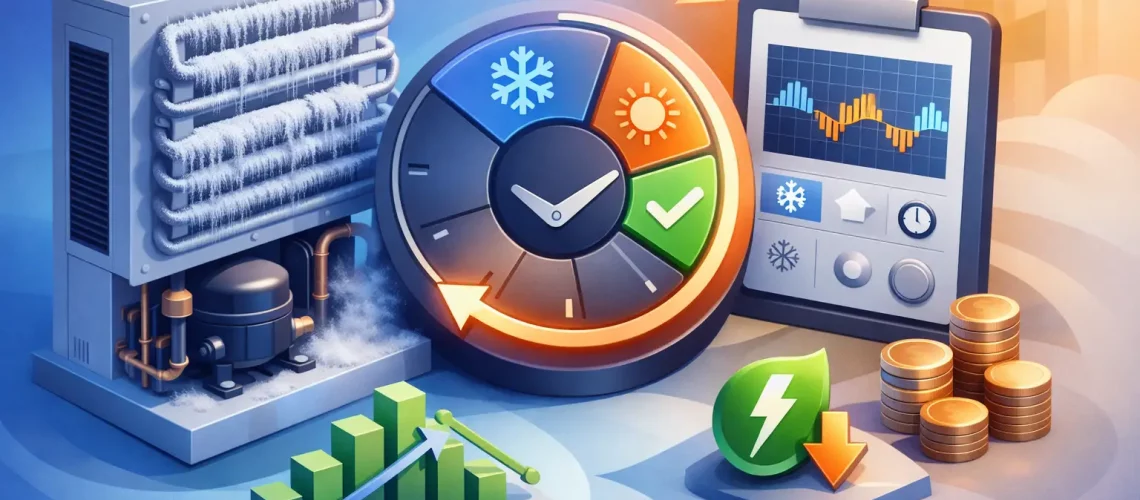

A walk-in freezer that defrosts at 2 p.m. during a busy loading period can create more than a brief temperature swing. It can add compressor load, raise humidity, compromise product handling, and leave operators reacting to alarms that were avoidable. To optimize defrost cycle scheduling, facilities need to replace fixed assumptions with operating data: actual frost accumulation, refrigeration load, door activity, ambient conditions, and system performance.
For grocery, food service, cold storage, medical, and biotech operations, defrost is necessary. The opportunity is not to eliminate it. The opportunity is to run the right type and duration of defrost only when the equipment needs it, while protecting case temperatures, inventory, and system capacity.
Why Fixed Defrost Schedules Leave Savings Behind
Many refrigeration systems still follow a timer-based schedule set during installation or inherited through years of service. A freezer may initiate four electric defrosts every day whether it has experienced heavy door traffic and humidity exposure or a quiet overnight period with minimal frost formation. That schedule is predictable, but it is rarely precise.
Every unnecessary defrost event consumes energy in more than one place. Electric heaters or hot gas add heat to the evaporator. The refrigeration system must then remove that heat, often while cases, rooms, or production areas are carrying their normal load. Fans may run when they should be delayed, moving moist air through the space before the coil has drained and cooled. The result can be elevated energy use, temperature recovery issues, and excess wear on compressors and components.
The opposite problem is just as costly. Defrosting too infrequently allows frost to insulate the evaporator coil and restrict airflow. Capacity falls, suction conditions can deteriorate, run time rises, and temperatures become less stable. In a mission-critical environment, a poorly timed or incomplete defrost can become the first visible sign of a broader reliability problem.
The right schedule depends on the application. A low-traffic frozen-food warehouse, a busy restaurant walk-in, a floral cooler, and a laboratory freezer do not accumulate frost at the same rate or tolerate the same temperature recovery profile. That is why a schedule copied from another site, or left unchanged after a remodel or equipment upgrade, deserves scrutiny.
How to Optimize Defrost Cycle Scheduling
Effective optimization begins with a baseline. Before changing defrost frequency or duration, document how the system is currently operating. Review the programmed start times, termination controls, fail-safe limits, heater or hot-gas run time, fan delay, and drain-pan operation. Then compare those settings with actual temperature trends, coil conditions, compressor performance, and site activity.
A one-time visual inspection is useful, but it cannot show whether frost is forming gradually between service visits or whether certain defrosts consistently occur when the system is under its highest load. Trend data reveals the pattern. Look for prolonged recovery after defrost, repeated high-temperature alarms, unusually long compressor run time, coil temperature behavior that does not reach termination as expected, or a defrost that regularly ends on its time limit rather than its termination sensor.
Start with Coil Demand, Not the Clock
Demand defrost controls use operating conditions to determine when a coil needs defrosting. Depending on the equipment and control strategy, the system may evaluate factors such as coil temperature, pressure, accumulated compressor run time, air temperature differential, or frost-related performance changes. The principle is straightforward: initiate defrost when frost is affecting performance, not simply because a fixed interval has elapsed.
Demand-based strategies can reduce unnecessary defrost events, particularly in applications with variable traffic, seasonal humidity changes, or fluctuating load. However, they are not a universal plug-and-play answer. Sensor placement, control logic, equipment condition, and the operating requirements of the facility all affect results. A poorly calibrated demand control can delay defrost too long or respond to misleading conditions.
For this reason, demand defrost should be engineered around the specific evaporator, refrigerant type, product temperature requirement, and control architecture. It should also retain appropriate safeguards. A maximum interval or fail-safe schedule may still be necessary where product protection and coil reliability cannot depend on a single input.
Set Termination and Fan Delay for Actual Conditions
Defrost initiation is only half of the schedule. Termination determines when heat is removed, and fan delay determines when airflow returns. Both settings can influence energy use and product conditions.
If termination is set too high or relies only on a generous time limit, heaters may continue operating after the coil is clear. If it is set too low, residual frost can remain and accumulate over successive cycles. The correct termination point should be verified against coil conditions and equipment manufacturer guidance, then validated with field data rather than assumed to be correct because the controller accepts the setting.
Fan delay deserves the same attention. Restarting evaporator fans before the coil has drained and returned to a suitable temperature can push warm, moist air into the refrigerated space. That can create a temporary product-temperature rise and contribute to ice formation. An overly long fan delay, however, can reduce air circulation and extend recovery. The goal is a controlled return to refrigeration, not the fastest possible restart.
Schedule Around Operational Peaks When Demand Defrost Is Not Feasible
Some systems require scheduled defrost because of equipment limitations, process requirements, or control constraints. In those cases, timing still matters. Schedule defrosts during lower-load periods whenever possible, avoiding receiving windows, peak customer traffic, production changes, and periods when doors are frequently open.
Staggering defrost events across multiple evaporators can also prevent a concentrated load on the refrigeration system. Defrosting every coil in a large cooler or freezer at the same time may create a sharp demand spike and reduce available capacity during recovery. Staged scheduling can moderate that impact, provided airflow patterns and room temperature requirements are considered.
Facilities should also account for site-specific behavior. A school kitchen may operate very differently during weekends and breaks. A retail store may see different door activity before opening, during deliveries, and at closing. A cold-storage operation may need alternate schedules for seasonal volume changes. Static programming rarely reflects these realities for long.
Verify the Mechanical Conditions Behind the Schedule
No control strategy can correct an evaporator that is mechanically unable to defrost properly. Before expecting savings from revised scheduling, inspect the components that determine whether each cycle is effective.
Confirm that heaters, hot-gas valves, solenoids, contactors, termination sensors, drain-pan heaters, and door heaters operate as intended. Check coil cleanliness, drain-line condition, insulation integrity, door gaskets, strip curtains, and infiltration sources. A blocked drain or failed pan heater can cause ice that looks like a scheduling problem. A damaged door gasket can introduce enough moisture to make a previously appropriate schedule inadequate.
This distinction matters because simply adding more defrosts may conceal the symptom while increasing energy consumption. It does not resolve the source of excessive frost. Likewise, reducing defrost frequency without correcting a weak heater circuit or failed sensor can increase the risk of coil blockage and product-temperature excursions.
Use Monitoring to Keep Optimization From Drifting
Defrost settings should not be treated as a set-and-forget project. Store layouts change, product loads shift, doors age, staff practices evolve, and weather changes the moisture burden on refrigerated spaces. A schedule that performed well six months ago may no longer be the best fit.
Continuous monitoring gives facility teams the evidence needed to maintain control. Trend refrigeration and space temperatures before, during, and after defrost. Track alarm frequency, defrost duration, time to recovery, compressor run time, and repeated sensor or termination anomalies. When available, compare energy use against operational volume and ambient conditions so improvements are measured fairly.
A dashboard-based platform such as ArtikControl™ can help teams see these conditions across one site or many, identify recurring exceptions, and receive mobile alerts before a minor control issue becomes a product-loss event. The value is not merely visibility. It is the ability to make adjustments based on verified performance and confirm whether those adjustments produced the expected result.
Measure Results Beyond the Utility Bill
Energy reduction is a central reason to optimize defrost cycle scheduling, but it should not be the only success metric. The strongest programs improve several outcomes at once: fewer unnecessary heater cycles, shorter recovery periods, more stable product temperatures, lower compressor stress, and fewer emergency calls related to frost or ice.
Establish performance targets before making changes. For example, a facility may aim to reduce daily defrost events on selected evaporators, decrease post-defrost temperature recovery time, or eliminate repeat high-temperature alarms. Measure against a representative baseline, not a single week that happened to have unusual weather or operating volume.
Changes should be deliberate and documented. Adjust one control variable or one group of similar evaporators at a time when practical, then review the resulting data. This approach protects inventory while making it easier to determine which adjustment created the improvement.
The best defrost schedule is rarely the shortest one. It is the schedule that keeps coils clear, temperatures stable, and refrigeration equipment operating efficiently under the real conditions of your facility. When controls, mechanical condition, and monitored performance are aligned, defrost becomes a managed operating function rather than a recurring source of energy waste and risk.