
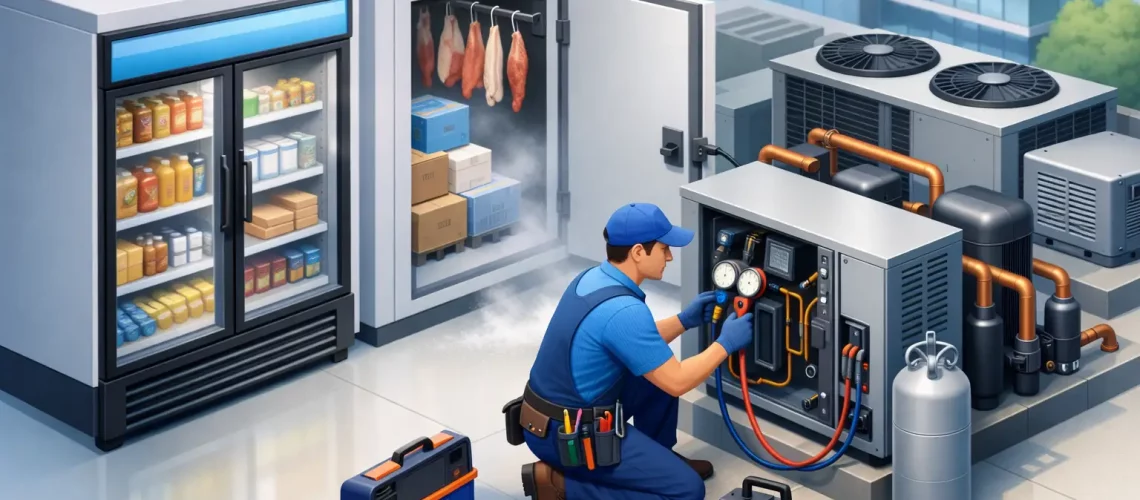

A failed compressor at 2:00 a.m. is not simply a maintenance event. For a grocery store, cold storage warehouse, laboratory, or food service operation, it can become a product-loss event, a safety concern, a missed delivery, and an expensive disruption before the morning shift arrives. Selecting commercial refrigeration contractors should therefore be treated as a reliability decision, not a bid comparison based solely on the lowest hourly rate.
The right partner understands the refrigeration equipment, but also the operational consequences of temperature instability, excess energy use, repeat failures, and limited system visibility. That distinction matters most in facilities where refrigeration is central to revenue, compliance, inventory protection, or patient and product safety.
Start With the Cost of Failure, Not the Cost of Service
A contractor may be able to replace a fan motor, recharge a system, or respond to an alarm. Those capabilities are necessary, but they do not automatically indicate that the provider can improve long-term system performance. The better question is whether the contractor can identify why the component failed, what operating condition contributed to the issue, and how the facility can avoid a repeat event.
Before evaluating providers, define what refrigeration reliability means for your operation. A restaurant may prioritize rapid emergency response and food protection. A multi-site retailer may need consistent service standards, energy reporting, and centralized visibility across locations. A pharmaceutical or biotech facility may require tighter documentation, alarm escalation, and control strategies that protect critical temperature ranges.
This operational context changes the scope of work. A repair-only relationship may be adequate for a low-risk application with simple equipment. For energy-intensive or mission-critical environments, a contractor should be prepared to evaluate controls, defrost performance, case temperatures, compressor cycling, refrigeration load, and the condition of aging equipment.
Evaluate Commercial Refrigeration Contractors by Capability
Technical credentials matter, but certifications alone do not prove that a contractor can manage complex refrigeration assets. Look for evidence that the provider works across the equipment and control layers of the system, from evaporators and condensing units to sensors, alarms, electrical components, and facility-level monitoring.
Look Beyond Brand Authorization
Manufacturer authorization can be useful, particularly when a facility operates specialized equipment or needs warranty support. It should not be the only qualification. Commercial refrigeration systems often contain equipment from multiple manufacturers, have been modified over time, and operate under site-specific loads that standard service manuals do not fully address.
Ask how the contractor approaches systems that have chronic temperature swings, frequent nuisance alarms, compressor failures, high head pressure, or unexplained energy consumption. A qualified provider should discuss diagnostic methods, operating data, root-cause analysis, and corrective options rather than immediately defaulting to equipment replacement.
Confirm Experience in Your Environment
Refrigeration in a floral cooler does not operate under the same business conditions as refrigeration in a distribution center, supermarket, school kitchen, or medical facility. The underlying principles are similar, but the consequences of failure, utilization patterns, sanitation requirements, inventory values, and response expectations differ.
Request examples that align with your facility type and equipment complexity. The goal is not to find a contractor with an identical project in every detail. It is to confirm that they understand the performance pressures specific to your environment and can translate technical work into operational outcomes.
Ask Who Will Actually Perform the Work
A strong proposal can lose value if the field team lacks the experience to execute it. Clarify whether work will be performed by in-house technicians, subcontractors, or a combination. Ask about technician training, supervision, emergency coverage, and the process for escalating difficult diagnostics.
For multi-site operations, consistency matters as much as proximity. A contractor should be able to document work clearly, maintain service history, and deliver a repeatable process across locations without forcing each site to start from scratch.
Treat Monitoring and Controls as Part of the Scope
A refrigeration system can appear normal during a scheduled visit and still be drifting toward failure between service calls. That is why monitoring should be a central consideration when selecting commercial refrigeration contractors, especially for facilities with valuable inventory or limited on-site maintenance coverage.
Remote monitoring provides more than alarm notifications. When properly designed, it creates a record of temperatures, runtime patterns, defrost behavior, pressure conditions, and other indicators that can reveal emerging problems. It allows the contractor and facility team to respond to abnormal conditions before they become an after-hours emergency.
Not every operation needs the same level of instrumentation. A small single-site business may benefit most from targeted temperature alerts and mobile notifications. A large cold storage or retail portfolio may need centralized dashboards, escalation protocols, trend data, and control capabilities across many assets. The right solution depends on the cost of downtime and the level of visibility your team needs to manage risk.
Ask providers whether they offer continuous monitoring, how alerts are prioritized, who receives them, and what action follows an alert. A text message without a defined response process can create false confidence. A useful monitoring program pairs data with accountability, documented thresholds, and a clear path to service intervention.
Refrigeration Technologies, LLC approaches this through engineered assessments, system improvements, and ArtikControl™ monitoring and control solutions designed to identify issues early and give facility teams actionable visibility.
Compare Proposals on Lifecycle Value
The least expensive proposal may be appropriate when the work is straightforward and the scope is fully defined. It is less reliable as a decision method when the proposal addresses persistent failures, inefficient operation, or an aging system with unknown conditions.
A useful proposal explains what is included, what assumptions were made, and what risks remain. It should distinguish between immediate repairs, recommended upgrades, and longer-term improvements. If a contractor recommends replacement, ask for the basis of that recommendation. Is the decision driven by repair history, energy performance, refrigerant availability, capacity needs, equipment condition, or a combination of factors?
Energy performance should also be part of the conversation. Refrigeration is often one of the largest electrical loads in a facility, and small control or mechanical problems can create material utility costs over time. Contractors should be able to discuss opportunities such as optimizing defrost schedules, correcting control issues, improving condenser performance, reducing unnecessary runtime, and replacing equipment when the economics support it.
Do not expect every project to have the same payback period. Some upgrades are justified by direct energy savings, while others are justified by reduced product-loss exposure, fewer emergency calls, improved compliance, or longer equipment life. A capable contractor will be candid about these trade-offs instead of presenting every recommendation as an immediate savings opportunity.
Set Expectations for Service and Accountability
The contract should define more than labor rates and response windows. It should establish communication expectations, documentation standards, preventive maintenance responsibilities, and ownership of follow-up actions.
Ask how the provider reports completed work and unresolved findings. A detailed service record should help your team understand what failed, what was corrected, what conditions were observed, and what should be monitored next. Over time, these records become valuable for capital planning and for identifying equipment that consumes disproportionate maintenance resources.
Response time also deserves careful review. Emergency availability is valuable, but a stated response window is not a guarantee that the technician will have the necessary parts, system knowledge, or remote diagnostic information. The most effective service model combines responsive field support with proactive inspection and monitoring that reduce the number of emergencies in the first place.
For organizations with multiple stakeholders, identify one internal owner for contractor communication and one clear escalation path for critical events. When operations, facilities, finance, and procurement have different expectations, a shared performance plan prevents service decisions from being driven only by the most recent failure.
Use the Site Assessment to Test the Partnership
A site assessment is often the first indication of how a contractor will work after the agreement is signed. Strong assessments involve questions about equipment history, inventory risk, temperature requirements, utility costs, prior repairs, and operational schedules. They also involve observation. The contractor should inspect the system, not merely collect model numbers and issue a generic quote.
Pay attention to whether the recommendations are prioritized. A long list of repairs without context makes budgeting difficult. A practical improvement plan separates urgent reliability risks from efficiency opportunities and future capital needs. It gives decision-makers a path forward rather than a stack of disconnected invoices.
The contractor you select will influence more than the condition of individual refrigeration assets. They will affect your facility’s ability to protect inventory, control energy spend, avoid disruptions, and make informed maintenance decisions. Choose the partner that can help your team see problems earlier, act with confidence, and keep refrigeration performance aligned with the demands of the operation.