
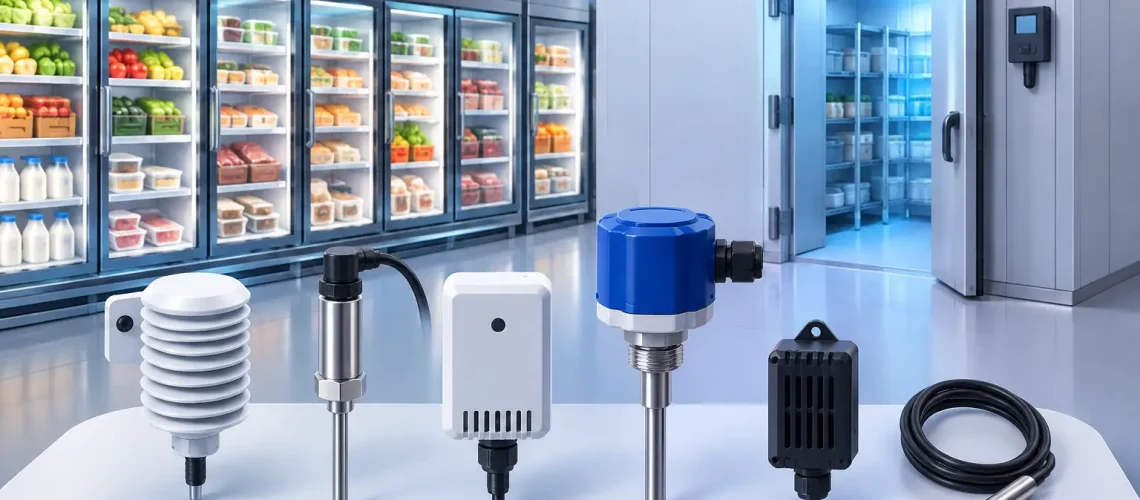

A walk-in cooler can remain within temperature range while a failing fan motor, a frequent door-opening pattern, or an unstable suction condition quietly pushes the system toward failure. That is why a refrigeration sensors comparison should start with the operational question: what failure, cost, or product-loss risk does the facility need to see earlier?
For commercial facilities, sensors are not interchangeable pieces of instrumentation. Each captures a different signal, with different installation requirements, maintenance needs, and value to operators. The right mix gives a facility team meaningful warning before inventory is at risk or energy use rises. The wrong mix can create a dashboard full of data that does not explain what action is needed.
Refrigeration Sensors Comparison: Start With the Risk
Temperature sensors are the foundation of most monitoring programs, but they are only one part of a complete refrigeration picture. A grocery case, walk-in freezer, pharmaceutical storage room, or cold-storage warehouse has different consequences for a temperature excursion and different equipment conditions that can cause one.
A practical sensor strategy begins by identifying the critical risks at each site. These commonly include product temperature exposure, compressor failure, evaporator icing, condenser fouling, door-related load, refrigerant issues, and excessive runtime. From there, facility leaders can select sensors that provide evidence of both the event and its likely cause.
The goal is not to install every available sensor. It is to build visibility that helps maintenance teams prioritize work, reduce diagnostic time, and protect inventory.
Temperature Sensors: Essential, but Not Sufficient
Temperature sensors measure air temperature, product-simulated temperature, coil temperature, or pipe temperature, depending on their placement and design. For most refrigerated spaces, they are the first sensor type to deploy because they verify whether the protected environment is holding its required range.
Air-temperature sensing responds quickly to changes in the room or case environment. That makes it useful for detecting a door left open, an alarm condition, or a loss of cooling. The trade-off is that air temperature can fluctuate rapidly during defrost cycles, loading activity, or normal door traffic. Alarm logic must account for those operating conditions or teams may receive alerts that do not require action.
Product-simulated sensors react more slowly and more closely reflect the temperature of stored goods. They are often valuable where product protection and compliance are the primary concern. However, their slower response may delay detection of an equipment issue compared with an air sensor.
Coil and line temperature sensors serve a different purpose. They help identify defrost performance, icing, superheat conditions, and heat-transfer problems. They generally provide greater diagnostic value, but they require correct placement and interpretation. A poorly positioned sensor can create misleading conclusions about the system.
For many facilities, the strongest approach is to pair monitored space temperature with selected coil or line temperature points in high-risk equipment. This supports both immediate inventory protection and faster root-cause analysis.
Key temperature-sensor considerations
Sensor accuracy matters, but accuracy alone does not determine whether a monitoring point will be useful. Facility teams should also consider response time, calibration stability, operating range, probe construction, placement, and the alarm thresholds used by the monitoring platform.
A sensor rated for a freezer environment may still underperform if it is installed near a discharge-air stream, against an exterior wall, or in a location that does not represent the stored product. Installation discipline is as important as the device specification.
Pressure Sensors: Earlier Insight Into System Health
Pressure sensors monitor suction, discharge, or liquid-line conditions. They are especially valuable on centralized racks, larger cold-storage systems, and applications where compressor performance and refrigerant conditions have meaningful operational consequences.
Suction pressure can reveal conditions that a space-temperature sensor may not show until later. A developing refrigerant shortage, restricted airflow, abnormal load, or evaporator problem may first appear as a changing suction condition. Discharge pressure monitoring can expose condenser fouling, fan issues, elevated ambient conditions, or control problems that increase compressor energy use and mechanical stress.
Pressure sensors provide more diagnostic depth than temperature-only monitoring, but they also require refrigeration expertise. Pressure must be interpreted in the context of refrigerant type, saturation temperature, system design, ambient conditions, control sequence, and load. A single pressure reading is rarely a complete diagnosis.
For a small standalone cooler, the added cost and installation complexity may not justify continuous pressure monitoring. For a rack serving many cases or a mission-critical low-temperature process, the value can be substantial. The decision depends on the financial impact of downtime, the frequency of failures, and the benefit of earlier maintenance intervention.
Current Sensors: Find Equipment That Is Running Wrong
Current sensors measure electrical draw from loads such as compressors, evaporator fans, condenser fans, defrost heaters, and anti-sweat heaters. Their strength is operational confirmation: they show whether a component is running, cycling, or drawing an abnormal amount of power.
A compressor that runs continuously without achieving the expected temperature can indicate a refrigeration issue, loading issue, or control problem. A fan motor that stops drawing current may identify a failed motor or control issue before the evaporator ices and the space warms. Excessive heater runtime can uncover a control sequence that is consuming unnecessary energy.
Current sensing is also useful when a facility needs to validate runtime reduction after a retrofit or control change. It can provide a clear before-and-after view of equipment operation rather than relying solely on monthly utility bills, which are influenced by weather, occupancy, and other loads.
The limitation is that current does not always explain why a motor is operating abnormally. It works best when combined with temperature, pressure, status, or control data. A current sensor can show that a compressor is running. Temperature and pressure data help determine whether it is producing the refrigeration effect the site needs.
Door, Humidity, and Water Sensors: Protect the Conditions Around the System
Door sensors are simple, low-cost devices with significant value in walk-ins, freezers, and high-traffic refrigerated areas. A door held open increases load, raises temperature, introduces moisture, and can drive icing. In a freezer, repeated door events can contribute to conditions that look like an equipment failure when the underlying issue is operational behavior.
Humidity sensors are particularly useful where moisture affects product quality, frost accumulation, packaging, or environmental control. They can help identify infiltration, defrost-related moisture, and conditions that increase evaporator icing. They are not required for every refrigerated space, but they are valuable in applications where humidity has a direct product or maintenance impact.
Water-leak sensors are not refrigeration performance sensors in the strictest sense, but they provide important protection around cases, condensate systems, machine rooms, and critical equipment. A drain blockage or condensate overflow can damage facilities, create safety hazards, and lead to service disruption well before a temperature alarm occurs.
How to Compare Sensor Systems, Not Just Sensors
A meaningful refrigeration sensors comparison must include the monitoring and control system behind the devices. Standalone sensors can collect readings, but commercial operations need data that becomes actionable.
Look at how frequently values are recorded, whether the system retains historical trends, and how it handles communications loss. Consider alarm routing, escalation rules, mobile access, and whether alarms can be adjusted by equipment type and operating schedule. A temperature alert at 2:00 a.m. should reach the right person with enough context to determine whether immediate dispatch is necessary.
Integration is another differentiator. Sensors that feed into an intelligent controller or centralized dashboard can correlate conditions across the refrigeration system. For example, a rising box temperature, open door status, and stopped evaporator fan create a more useful event record than any one alarm alone.
For multi-site operators, standardization matters. Comparable sensor points, alarm policies, and reporting across locations make it easier to identify recurring equipment issues, training needs, and energy opportunities. Refrigeration Technologies, LLC applies this approach through engineered monitoring and intelligent control strategies tailored to each facility’s equipment and risk profile.
Selecting the Right Sensor Mix
Temperature sensing should be considered the minimum requirement for spaces containing perishable, regulated, or high-value inventory. Add current sensing when component runtime, fan operation, or energy performance is a concern. Add pressure sensing where system-level diagnostics and early mechanical warning justify the investment. Use door, humidity, and leak detection where operating practices and environmental conditions can materially affect refrigeration performance.
The highest-value deployments are usually targeted rather than uniform. A low-risk beverage cooler does not require the same sensor package as a pharmaceutical freezer, a busy restaurant walk-in, or a distribution center rack. Criticality, product value, equipment age, service history, and utility cost should drive the design.
A site assessment can reveal where a single additional sensor would prevent repeated service calls, where controls can reduce unnecessary runtime, and where full system monitoring is warranted. The useful question is not, “Which sensor is best?” It is, “What information will let this facility prevent its next costly refrigeration event?”