
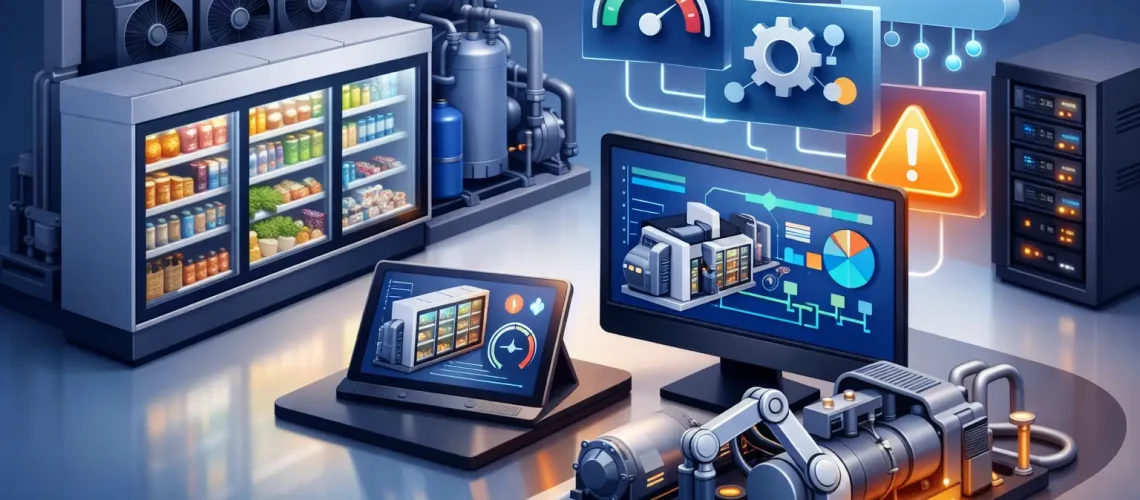

A walk-in cooler does not wait for a convenient time to fail. A weak condenser fan, drifting suction pressure, failed defrost cycle, or rising case temperature can begin as a small performance issue and become a product-loss event before the next scheduled inspection. Refrigeration automation gives facility teams the visibility and control needed to catch those conditions early, protect inventory, and make better operating decisions.
For grocery stores, cold storage facilities, food service operations, medical environments, and other refrigeration-dependent sites, automation is not simply a technology upgrade. It is an operational strategy for reducing avoidable downtime, energy waste, and emergency repair exposure.
What Refrigeration Automation Actually Does
Commercial refrigeration automation connects critical equipment, sensors, controllers, alarms, and reporting into a coordinated system. Instead of relying solely on manual temperature checks or discovering a problem after an alarm has escalated, operators can monitor equipment performance continuously and receive actionable alerts when conditions move outside acceptable limits.
The scope depends on the facility. In a small food service operation, automation may focus on walk-in temperatures, door status, and remote alarms. In a supermarket or cold storage environment, it may include rack controls, suction and discharge pressures, defrost scheduling, condenser performance, case temperatures, energy usage, and multi-site dashboards.
The goal is not to automate every decision without human oversight. Effective systems give maintenance and operations teams clearer information, faster warning, and the ability to correct problems before they affect product, customers, or business continuity.
Why Manual Monitoring Leaves Gaps
Manual logs still have a role in some operating procedures, but they provide snapshots rather than continuous awareness. A technician may record a compliant temperature at 8:00 a.m. while a defrost problem, door issue, or equipment fault develops at noon. By the time the next check occurs, the condition may be much harder and more expensive to correct.
Reactive service has a similar limitation. When a compressor trips or a cooler reaches an alarm condition, the facility is already managing the consequences: dispatch costs, staff disruption, potential inventory loss, and pressure to make a fast repair decision.
Automation changes that sequence. ArtikControl™ identifies trends that often appear before a complete failure, such as repeated temperature excursions, extended compressor run times, abnormal pressure patterns, or equipment that is cycling more frequently than expected. That early warning gives teams time to verify the issue, prioritize service, and intervene under controlled conditions.
The Business Case: Reliability, Energy, and Product Protection
The value of refrigeration automation is measured in operational outcomes, not the number of sensors installed. Facilities typically pursue it for three closely related reasons: preventing failures, reducing energy consumption, and protecting temperature-sensitive inventory.
Earlier Detection Reduces Downtime
Many refrigeration failures are preceded by warning signs. A condenser may gradually lose heat-rejection capacity. A refrigerant leak may affect operating pressures before temperatures rise sharply. A faulty sensor or control setting may cause inconsistent defrost performance. Continuous monitoring makes these developing conditions visible.
Early detection does not eliminate every equipment failure. Components can still fail suddenly, and no monitoring program replaces qualified service. It does, however, reduce the number of issues that remain invisible until they become urgent. For facility managers, that can mean fewer after-hours calls, better maintenance planning, and less disruption to store or site operations.
Smarter Controls Can Lower Energy Use
Refrigeration is often one of the largest energy loads in a commercial facility. Equipment that runs longer than necessary, defrosts on a fixed schedule regardless of need, or operates with poorly maintained setpoints can consume significant energy without improving product protection.
ArtikControl™ can help match equipment operation to actual conditions. Examples include demand-based defrost strategies, optimized fan control, temperature and pressure control adjustments, and alerts when operating patterns suggest inefficiency. The right approach depends on the system design, refrigeration load, ambient conditions, equipment age, and local operating requirements.
Energy savings should be validated rather than assumed. A strong automation project establishes a baseline, identifies targeted improvements, and reviews performance after implementation. This matters because an aggressive energy strategy that compromises temperature stability is not a successful strategy. The best results balance efficiency with dependable refrigeration performance.
Better Visibility Protects Inventory
Perishable inventory, pharmaceuticals, laboratory materials, floral products, and temperature-sensitive beverages can all be affected by refrigeration deviations. In many cases, the cost of a single product-loss event can exceed the cost of monitoring and control improvements.
Remote alerts and dashboard-based reporting give responsible personnel the ability to respond before an excursion becomes critical. They also create a record of operating conditions that can support internal quality procedures, maintenance discussions, and compliance documentation where required.
Where Automation Delivers the Most Value
Not every facility needs the same level of automation. A single-site restaurant with aging walk-ins has different risks than a regional grocery operator with multiple racks and hundreds of refrigerated cases. The most effective solution begins with an assessment of the equipment, failure history, refrigeration loads, operating hours, and financial exposure.
High-value opportunities commonly include sites with recurring emergency service calls, unexplained energy increases, inconsistent case or cooler temperatures, equipment near the end of its expected life, or limited staff available for manual checks. Multi-site operators also benefit from a centralized view of equipment health, particularly when a small maintenance team must prioritize service across a large portfolio.
Mission-critical environments deserve special attention. Medical, biotech, pharmaceutical, and government facilities may have stricter temperature requirements and a lower tolerance for excursions. In these settings, alarm routing, escalation procedures, data retention, and redundancy may be just as important as energy optimization.
A Practical Path to Refrigeration Automation
ArtikControl™ performs best when it is part of an engineered improvement plan, not a disconnected collection of devices. The process should start with a site-level evaluation that identifies where the facility is losing energy, experiencing reliability issues, or operating without enough visibility.
From there, the system design should address the real source of risk. A site with poor condenser control may need a different solution than one with inadequate temperature alarming or repeated defrost problems. Retrofitting existing equipment can often be more practical than replacing an entire system, but replacement may be warranted when core equipment condition limits the value of controls.
Installation is only the beginning. Controllers and sensors must be commissioned correctly, alarms must reach the right people, and thresholds must be meaningful. An alert that arrives too late has little value, while a system that generates constant nuisance alarms can cause alarm fatigue and slow response when a serious condition occurs.
Ongoing monitoring closes the loop. Platforms such as ArtikControl™ can provide continuous equipment visibility, mobile alerts, and performance data that help facility teams move from reacting to failures toward managing refrigeration proactively.
Questions to Ask Before Investing
Decision-makers should look beyond feature lists when evaluating refrigeration automation. Ask what conditions the system can detect, how quickly alerts are delivered, who receives them, and what information is available to support diagnosis. Determine whether the controls can integrate with existing equipment and whether the provider understands the refrigeration application, not only the software.
It is also worth asking how results will be measured. A credible plan should define the operational objectives: fewer temperature excursions, reduced compressor runtime, lower service costs, improved response time, or better visibility across locations. The expected payback will vary by facility, but the evaluation should be tied to measurable business risks and performance targets.
Finally, consider the service model. Refrigeration systems are physical, operating assets. Data is most useful when it is supported by field engineering judgment, practical troubleshooting, and a clear plan for corrective action.
Automation Is Most Valuable Before the Alarm Becomes an Emergency
The strongest refrigeration programs do not wait for a failed compressor or a warm cooler to reveal a problem. They use data, controls, and experienced oversight to identify risk while there is still time to act. For facilities where refrigeration performance protects revenue, inventory, and customer trust, that earlier decision point can be the difference between a routine service visit and a costly operational disruption.