
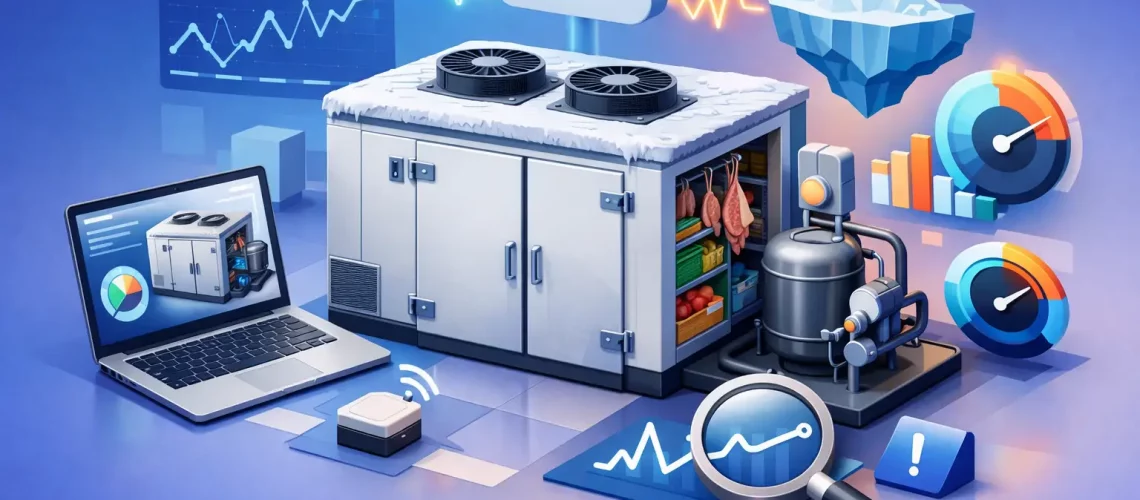

A walk-in box that drifts a few degrees overnight rarely looks like a crisis at 7:00 a.m. The fans may still be running. The case may still feel cold. But for operators responsible for food safety, product integrity, energy cost, and uptime, that small drift is often the first visible sign of a larger performance problem. A predictive refrigeration monitoring system is built for that exact gap – the space between “everything seems fine” and a failure that forces emergency action.
For commercial facilities, that gap matters more than ever. Refrigeration problems do not only show up as obvious breakdowns. They show up as compressors short cycling, defrosts running longer than expected, suction pressure trending out of range, doors being left open too often, aging controls masking equipment decline, and utility costs inching upward month after month. If your operation depends on refrigeration reliability, waiting for alarms alone is usually too late.
What a predictive refrigeration monitoring system actually does
At a basic level, monitoring tells you what is happening now. A predictive refrigeration monitoring system goes further by identifying patterns that suggest what is likely to happen next. It collects performance data from critical refrigeration assets, compares that data against expected operating behavior, and flags conditions that indicate deterioration, inefficiency, or elevated failure risk.
That distinction is important. Standard monitoring may tell you a box temperature is high. Predictive monitoring can help show why that temperature is creeping up before the alarm threshold is reached. It may reveal an evaporator coil icing pattern, irregular compressor runtime, unstable pressure relationships, or a control sequence issue that is pushing the system outside normal performance.
For a facility manager or operations leader, the value is not the data by itself. The value is earlier intervention. Earlier intervention usually means a planned service call instead of an emergency dispatch, a targeted component replacement instead of a major system event, and less risk to inventory, compliance, and operating continuity.
Why reactive refrigeration management costs more than it appears
Most facilities do not choose to be reactive. They become reactive because legacy controls, disconnected equipment, and limited visibility make it hard to see system health in real time. Teams often rely on manual checks, after-hours alarms, and technician judgment in the field. Those are useful tools, but they are not enough when a site has multiple boxes, cases, condensing units, or critical cold storage assets operating around the clock.
The hidden cost of reactive management is not limited to repair invoices. It includes product loss, labor disruption, overtime service, avoidable energy waste, shortened equipment life, and the operational drag that comes from constantly putting out fires. In multi-site organizations, the problem multiplies because decision-makers may have very little visibility into which locations are actually at risk and which are simply noisy from an alarm standpoint.
A predictive approach changes that by helping teams prioritize based on condition and trend, not just alarm volume. That is a better fit for organizations trying to improve reliability without overspending on unnecessary replacements.
Where predictive refrigeration monitoring delivers the most value
The strongest use case is any facility where refrigeration downtime has consequences beyond discomfort. Grocery stores, restaurants, cold storage facilities, medical and biotech environments, floral operations, schools, beverage storage, and government facilities all have one thing in common – refrigeration issues affect operations immediately.
Still, the return on investment can look different depending on the site. In food retail, product protection and energy savings often lead the conversation. In cold storage, avoiding a large-scale temperature excursion may outweigh every other metric. In medical or pharmaceutical settings, the focus may be compliance, documentation, and protection of high-value inventory. The monitoring strategy should reflect those priorities rather than forcing every site into the same template.
The data points that matter most
Not every monitored point has equal value. A well-designed predictive refrigeration monitoring system focuses on signals that help operators understand both performance and risk. That typically includes temperatures, pressures, compressor status, defrost activity, door openings, runtime behavior, and alarm history. In more advanced implementations, control logic, ambient conditions, and equipment-specific thresholds also become part of the analysis.
The point is not to collect as much data as possible. The point is to collect the right data, from the right assets, in a form that supports action. Too little visibility leaves blind spots. Too much unfiltered information creates noise and slows response. The best systems are engineered around decision-making, not dashboards for their own sake.
Monitoring without controls has limits
Many facilities already have some level of remote monitoring, but not all monitoring platforms are built to improve performance. If a system can only notify you after a threshold is crossed, it may help with response, but it does not do much to optimize operation.
That is where intelligent controls become important. When monitoring is paired with engineered control strategies, facilities can do more than observe problems. They can stabilize temperatures, manage defrost more effectively, reduce equipment strain, and improve energy performance. For many commercial sites, the biggest gains come from combining predictive visibility with control upgrades rather than treating them as separate projects.
How implementation should work in the real world
A predictive refrigeration monitoring system should begin with field evaluation, not assumptions. Every refrigeration environment has its own operating profile, equipment age, control history, maintenance reality, and risk tolerance. A convenience store with a few critical cases does not need the same architecture as a cold storage operator or a biotech facility.
That is why the strongest implementations usually start with an on-site assessment of the existing system. Engineers or trained specialists review equipment condition, control strategy, recurring problem areas, utility usage patterns, and the assets most likely to affect uptime or inventory exposure. From there, the monitoring plan can be built around business impact.
In some facilities, the first priority is adding visibility where there is none. In others, the better move is retrofitting controls, correcting existing inefficiencies, and then layering in dashboard monitoring and mobile alerts. It depends on where the operation is starting from.
What buyers should ask before choosing a system
The wrong question is whether a platform can monitor refrigeration. Most can, at least at a basic level. Better questions are whether the solution can be customized to your equipment, whether alerts are meaningful instead of excessive, whether the provider understands refrigeration engineering in the field, and whether the system supports measurable outcomes like reduced service events, lower utility spend, and improved product protection.
Buyers should also ask how the system handles expansion. Single-site visibility is useful, but many organizations eventually need enterprise-level oversight across multiple locations. If data cannot be standardized, prioritized, and acted on consistently, scaling the program becomes difficult.
The trade-offs decision-makers should understand
Predictive monitoring is not magic. It does not eliminate the need for maintenance, and it does not fix poor installation or neglected equipment by itself. It also requires thoughtful setup. Sensor placement, alarm strategy, integration quality, and baseline performance analysis all matter. If those pieces are rushed, the system may generate more frustration than value.
There is also a budget discussion. Some organizations hesitate because they compare monitoring cost to doing nothing. That is rarely the right comparison. The real comparison is between proactive investment and the full cost of one major refrigeration failure, recurring nuisance calls, persistent energy waste, or shortened asset life. Once those costs are considered, predictive monitoring often shifts from optional technology to operational protection.
Why engineered support matters as much as the platform
Technology alone is not the differentiator. The differentiator is whether the provider can interpret what the system is telling you and translate it into field action. Commercial refrigeration is too variable for generic, one-size-fits-all recommendations. Systems behave differently based on load, product, ambient conditions, equipment age, controls, and maintenance history.
That is why engineered support matters. A consultative provider can help identify whether a trend points to a failing component, a setpoint issue, a defrost problem, a control sequencing problem, or a broader retrofit opportunity. That level of interpretation is where predictive monitoring becomes a performance tool rather than just a reporting layer.
For organizations looking to reduce downtime, control energy use, and gain better visibility across critical assets, companies such as Refrigeration Technologies, LLC pair monitoring with retrofit and control expertise so the data leads to measurable operational improvement.
Predictive refrigeration monitoring system as a long-term strategy
The most successful facilities do not treat monitoring as a gadget added after a problem. They treat it as part of a larger refrigeration performance strategy. That strategy includes system evaluation, targeted upgrades, intelligent controls, real-time visibility, and ongoing refinement based on actual operating conditions.
When that framework is in place, teams make better decisions. Maintenance becomes more targeted. Capital planning becomes more informed. Energy savings are easier to verify. And most importantly, refrigeration reliability stops depending on luck and late-night alarm calls.
If your facility depends on stable temperatures and uninterrupted operation, the smartest move is usually not waiting for the next failure to reveal what your system has been trying to say for months.