
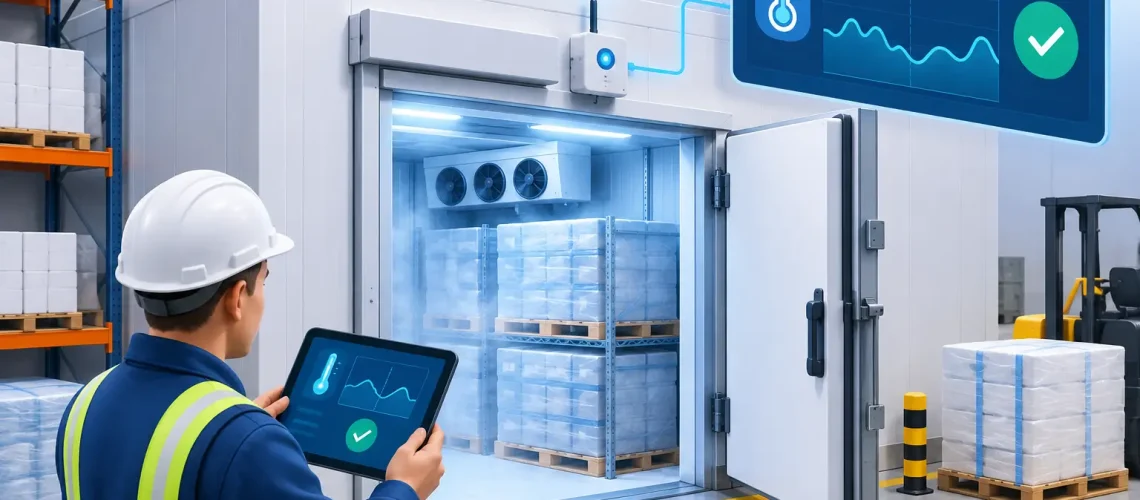

A freezer can remain cold enough to look normal while a failing fan, drifting sensor, icing coil, or unstable power condition pushes product closer to risk. By the time an employee notices a temperature problem during a walk-through, the damage may already be underway. Industrial freezer monitoring gives facility teams continuous visibility into the conditions that affect inventory, equipment life, energy use, and operational continuity.
For cold storage, food processing, grocery distribution, medical storage, biotech, and other temperature-dependent operations, monitoring is not simply about recording a number on a chart. It is an early-warning system that helps teams act before a minor performance issue becomes a product-loss event or an emergency repair.
What industrial freezer monitoring should detect
A useful monitoring program begins with the right data. Freezer air temperature is essential, but it is only one part of the operating picture. Temperature readings should be accurate, located appropriately, and reviewed in the context of the equipment serving the space.
A monitoring system may also track door position, power status, compressor operation, defrost cycles, evaporator performance, condenser conditions, refrigerant-related alarms, and ambient temperatures. The exact points depend on the freezer design, the product stored, the operating schedule, and the consequences of a failure.
For example, a warehouse freezer with frequent forklift traffic may need close attention to door-open duration and recovery time. A pharmaceutical freezer may require documented temperature history, calibrated sensors, alarm escalation, and tighter control limits. A food distribution facility may be more focused on catching overnight equipment failures before morning receiving or shipping activity begins.
The goal is not to collect every available data point. It is to monitor the conditions that reveal a developing problem early enough for a practical response.
Why temperature alarms alone are not enough
A high-temperature alarm is necessary, but it is often a late-stage warning. When the air temperature rises above an acceptable threshold, the refrigeration system may already be under heavy strain. The root cause could be a failed component, a door left open, ice buildup, loss of power, a control issue, or insufficient refrigeration capacity during a high-load period.
Better industrial freezer monitoring uses alarm logic that accounts for operating behavior. A brief temperature change during a planned defrost cycle should not create the same response as a sustained rise with no recovery. Likewise, an alarm that repeats without a work order or verification should not disappear into an inbox as background noise.
Alarm fatigue is a real operational risk. If teams receive too many non-actionable alerts, they can become desensitized to the one alert that demands immediate attention. Thresholds, delays, escalation paths, and notification schedules should be designed around the facility’s actual equipment and staffing model.
An effective system distinguishes between information and urgency. It can notify an on-site technician of a developing issue, escalate to a manager if the condition persists, and provide a remote service partner with the context needed to begin diagnosis quickly.
Monitoring protects more than inventory
Product protection is often the clearest reason to install freezer monitoring, especially when inventory values are high. But the financial impact extends beyond the contents of a freezer.
Unplanned refrigeration failure can disrupt production schedules, receiving, fulfillment, inspections, and staffing. It can force emergency service calls, overtime labor, expedited replacement parts, and unnecessary product transfers. In regulated environments, missing or incomplete temperature records can create an additional compliance burden even if product remains usable.
Continuous visibility also supports energy management. A freezer that maintains temperature but runs longer than expected may be consuming excess energy due to poor control settings, defrost problems, airflow restrictions, worn components, or a mismatch between refrigeration capacity and operating demand. Without trend data, these issues can remain hidden because the space still appears to be functioning.
Over time, monitoring can help identify patterns such as rising compressor run time, recurring temperature recovery delays, unusual power interruptions, or repeated alarm activity during specific shifts. Those patterns give facility leaders a basis for targeted maintenance and capital planning rather than relying solely on reactive repair history.
The difference between data and actionable insight
Facilities do not need another dashboard that requires constant interpretation. They need a monitoring approach that turns operating data into clear decisions.
That starts with a site assessment. A qualified refrigeration partner evaluates the freezer’s design, equipment condition, current controls, critical loads, product requirements, and known failure points. From there, the monitoring plan can be tailored to the operation instead of applying identical sensors and alarm settings to every location.
The most valuable questions are practical:
- Which freezer failures would cause the greatest financial or operational impact?
- How quickly must the team respond before product or equipment is at risk?
- Who receives alerts after hours, and what happens if the first contact does not respond?
- Which equipment trends could indicate wasted energy or approaching failure?
Answers to these questions shape the alarm strategy, sensor placement, reporting requirements, and escalation workflow. A remote alert is only useful if the recipient knows what to do next and has enough information to make the right call.
Designing a response plan for freezer alarms
Monitoring is strongest when it is connected to a documented response process. Facility personnel should know whether an alert calls for a visual inspection, a temperature verification, a product move, a service request, or an immediate escalation.
The process should account for nights, weekends, holidays, and periods of limited staffing. A facility that operates around the clock will have different needs than a school, restaurant group, or public-sector facility with limited after-hours coverage. For multi-site organizations, centralized oversight can help managers see which alarm events require local action and which indicate a broader equipment or control issue.
It is also wise to test the process. Simulated alarm events reveal whether notifications reach the right people, whether contact information is current, and whether the team can access the equipment safely and promptly. A response plan that exists only in a binder is unlikely to protect inventory at 2:00 a.m.
Where predictive monitoring creates the most value
Predictive monitoring looks beyond a single out-of-range condition. It evaluates changes in system behavior that may signal a failure before freezer temperature is affected.
Consider an evaporator fan that begins cycling irregularly. The freezer may remain within its temperature range for a period, but airflow can decline, frost can accumulate, and the refrigeration system can run longer to compensate. Monitoring trends may reveal the change before the issue produces a critical alarm.
The same principle applies to defrost performance. A freezer that takes longer to recover after defrost, or experiences repeated ice-related conditions, may need adjustment or service before capacity is compromised. Similarly, repeated power events can point to electrical issues that deserve attention even if the freezer has not yet experienced a product-threatening excursion.
This approach does require sound engineering judgment. Not every abnormal trend warrants an emergency call, and not every equipment issue can be predicted from remote data alone. Monitoring should support field service and maintenance decisions, not replace hands-on inspection. The value comes from sending technicians to the right issue with better information and less delay.
Selecting a monitoring partner and platform
The right solution combines reliable hardware, practical controls, clear visibility, and responsive expertise. Facility leaders should look beyond a basic sensor package and ask how monitoring will fit into their maintenance, energy, and risk-management goals.
A capable provider can assess existing refrigeration infrastructure, identify priority vulnerabilities, install monitoring points without disrupting operations, and configure alerts for the people responsible for action. It should also be able to connect monitoring findings to equipment upgrades, control improvements, and energy-saving opportunities when the data shows a larger problem.
Refrigeration Technologies, LLC applies this performance-focused approach through engineered monitoring and control solutions, including the ArtikControl™ platform. The objective is to give operators a clearer view of freezer health while helping prevent failures, reduce unnecessary runtime, and protect critical inventory.
The best first step is not to purchase more sensors. It is to identify the freezer assets your operation cannot afford to lose, define what an acceptable response looks like, and build monitoring around that reality. When the next warning arrives, your team should have more than an alarm – it should have time, context, and a path to protect the operation.