
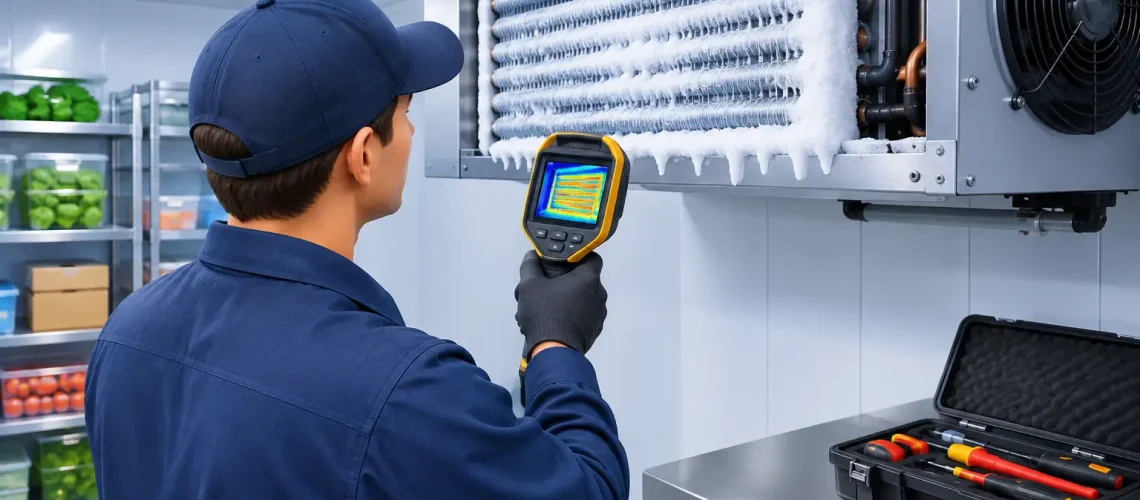

A walk-in cooler that begins icing over rarely fails all at once. It usually gives warning signs first: longer run times, uneven box temperatures, reduced airflow, frost migrating beyond the coil, or a fan that sounds strained. Knowing how to diagnose evaporator icing before the coil becomes a solid block of ice helps protect inventory, avoid emergency labor, and prevent a small performance issue from becoming a compressor, product-loss, or downtime event.
For commercial facilities, the objective is not simply to melt the ice and restart the system. The objective is to identify why moisture is reaching the coil faster than the system can remove it, or why the system is failing to complete its normal defrost cycle. That distinction determines whether the right correction is a door repair, a fan replacement, a control adjustment, or a deeper refrigeration-system evaluation.
First, Separate Normal Frost From Problem Icing
A low-temperature evaporator will accumulate some frost during normal operation. Frost is a predictable result of moisture in the air freezing on a coil operating below freezing. The defrost system is designed to remove that accumulation at scheduled intervals.
Problem icing occurs when frost remains after defrost, returns unusually quickly, or expands enough to restrict airflow through the coil. The signs are operational as well as visual: supply air drops, case or box temperatures become unstable, fans lose capacity, and the compressor may run longer to meet load.
The location of the ice provides an early diagnostic clue. A coil iced evenly from top to bottom may point toward defrost failure, excessive infiltration, or a control issue. Ice concentrated near the refrigerant inlet can suggest a refrigerant-feed or airflow condition. Ice on the fan guards, drain pan, or surrounding panels often indicates that water is not draining or that warm, humid air is entering the refrigerated space.
Do not use appearance alone to make the call. An iced coil can be the result of several overlapping conditions, especially in high-traffic food retail, cold storage, food service, medical, and biotech environments.
How to Diagnose Evaporator Icing Step by Step
Start by documenting conditions before defrosting the coil. Record box temperature, coil appearance, fan operation, door activity, controller alarms, compressor runtime, and the time since the last confirmed defrost. If the coil is immediately thawed without documentation, valuable evidence disappears.
Confirm Airflow Through and Around the Coil
Restricted airflow is one of the most common contributors to evaporator icing. When air cannot move evenly across the coil, sections of the coil run colder, moisture freezes faster, and frost accumulates in areas that receive inadequate heat load.
Inspect the evaporator fans while the system is operating. Verify that each fan is running, rotating in the correct direction, and moving air at a comparable rate. Look for failed fan motors, loose blades, damaged guards, ice interference, and blocked discharge paths. A fan may spin but still provide insufficient airflow because of a weak motor, wrong blade pitch, or accumulated debris.
Also inspect product placement. Pallets, cartons, shelving, or packaging positioned too close to the evaporator can block return air and create localized icing. In a walk-in, maintain the clearances specified for the unit and avoid treating the evaporator area as overflow storage.
Verify That Defrost Is Starting and Finishing
An evaporator that remains iced after its scheduled defrost cycle requires a defrost-system evaluation. Check the controller or time clock for the programmed number of defrosts, initiation times, duration, and termination settings. Compare those settings with the equipment design, room temperature, door traffic, and actual frost load.
Then confirm what happens during a live defrost. Electric systems should energize heaters as intended. Hot-gas systems should establish the expected pressure and temperature change. In either case, verify that the termination device or sensor is ending defrost based on coil conditions rather than ending too early on a fixed time limit.
A failed heater, contactor, relay, sensor, clock, valve, or wiring connection can interrupt the sequence. So can incorrect programming after a controller replacement or site-level energy adjustment. Adding more defrosts may temporarily clear ice, but it can increase energy use and raise product temperature if it does not address the actual cause.
Inspect Drainage Before the Next Freeze-Up
Defrost only works if melted water leaves the evaporator. A blocked drain line, frozen drain trap, failed drain-pan heater, or improperly sloped line allows water to remain in the pan. That water refreezes after refrigeration resumes and can build upward into the coil and fan section.
Look for standing water, ice in the drain pan, overflow marks, or ice trails below the evaporator. Confirm that drain heat is operating where required and that the line is open from the pan to its termination point. In freezer applications, a properly designed and maintained heated drain arrangement is often essential.
Drain issues are easy to overlook because the coil may appear to be the problem. In reality, the coil may be defrosting correctly while the water has nowhere to go.
Identify Sources of Excess Moisture Infiltration
Every door opening introduces moisture, but excessive infiltration can overwhelm a properly functioning defrost schedule. Review door gaskets, hinges, closers, strip curtains, automatic doors, dock seals, and panel penetrations. A door that does not fully close can introduce humid air continuously, even when staff believe the space is secured.
Consider changes in operations as well. Higher delivery volume, seasonal humidity, washdown activity, uncovered product, frequent stocking, or a new process that brings warm product into the room can increase the coil’s latent load. A system that performed well under prior conditions may need a revised control strategy after operating conditions change.
The most useful question is not whether a door opens frequently. It is whether the moisture load has changed enough that the existing equipment and defrost sequence can no longer keep pace.
Evaluate Refrigeration Circuit and Control Performance
If airflow, defrost, drainage, and infiltration appear normal, evaluate the refrigeration circuit. A low refrigerant charge, restricted metering device, improper superheat setting, distributor issue, or liquid-line restriction can create abnormal coil feeding. The frost pattern may be partial or concentrated rather than uniform, but patterns vary by system design and load.
Measure suction pressure, superheat, liquid pressure, subcooling where applicable, coil temperature, and box temperature under stable operating conditions. Compare the readings with the equipment design rather than relying on a generic pressure target. Refrigerant type, evaporator temperature, load, and control sequence all affect acceptable values.
Electronic expansion valves and adaptive controls add another layer to the diagnosis. A sensor drift, valve response issue, communication fault, or incorrect setpoint can produce unstable feeding and temperature behavior. Trend data is particularly valuable here because a single service reading may miss a fault that occurs only during defrost recovery, peak traffic, or overnight operation.
Use Trend Data to Find the Root Cause
The most reliable diagnosis combines field inspection with operating history. Temperature, defrost status, suction conditions, fan status, door activity, and alarm trends can show whether icing follows a repeatable event. For example, ice that develops after every defrost points toward drainage or incomplete defrost. Ice that accelerates during busy receiving periods points toward infiltration. Ice that appears after a fan alarm identifies an airflow path to investigate.
Continuous monitoring also helps distinguish equipment failure from a process change. With intelligent controls and dashboard-based alerts, facility teams can see abnormal runtime, missed defrost recovery, rising temperatures, and recurring alarm patterns before the coil is fully blocked. Refrigeration Technologies, LLC applies this approach through engineered assessments and monitoring strategies designed to identify performance loss before it becomes a product-risk event.
Avoid the Quick Fix That Repeats the Failure
Manually defrosting an iced coil restores airflow, but it does not correct the underlying failure. Avoid using sharp tools that can puncture coil tubing, and do not apply uncontrolled heat that can damage components or create a safety hazard. Follow the equipment manufacturer’s service procedures and ensure qualified personnel perform electrical and refrigeration work.
Once the coil is clear, verify performance through at least one complete operating and defrost cycle. Confirm that fans restart, drainage remains open, temperatures recover normally, and frost does not return prematurely. For critical spaces, establish alarm thresholds for temperature deviation, extended compressor runtime, defrost failure, and repeated coil-related service calls.
An evaporator should not be treated as a recurring ice-removal task. When the root cause is identified and documented, the refrigeration system can return to what the operation needs most: stable temperatures, protected inventory, lower avoidable energy use, and fewer surprises on the maintenance schedule.