
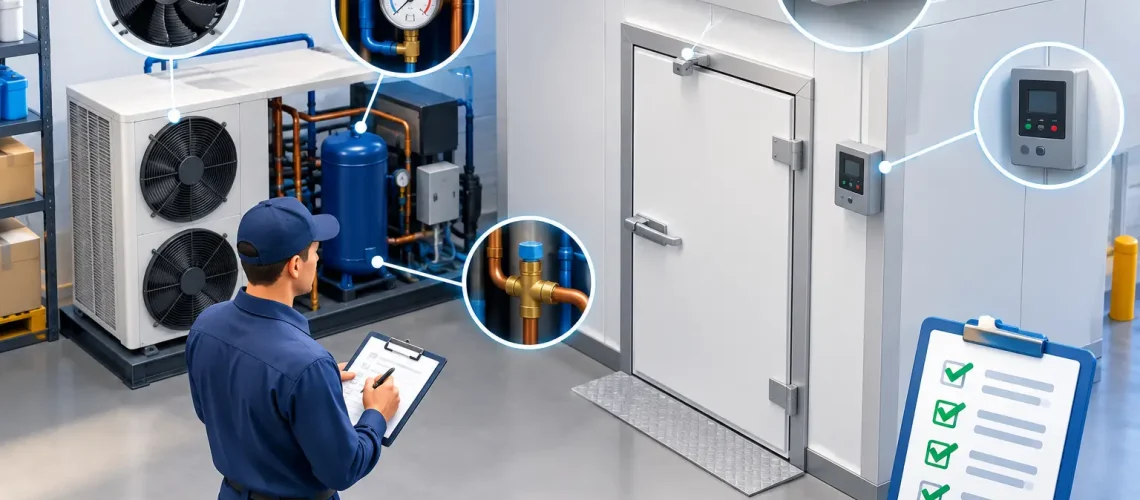

A walk-in cooler holding temperature by a narrow margin may look like a system that is performing. In reality, it may be running longer than necessary, consuming excess energy, cycling components harder, and leaving little room for error when ambient conditions change. A free on-site refrigeration assessment is designed to identify those hidden risks before they become a product-loss event, an emergency repair, or a growing utility expense.
For facility leaders, the value is not simply another opinion on aging equipment. It is a practical starting point for understanding how a refrigeration system operates in the real conditions of the facility, where it is losing efficiency, and which improvements deserve priority.
Why Refrigeration Performance Needs a Field Assessment
Commercial refrigeration systems rarely fail without warning. The warning signs are often subtle: longer compressor run times, uneven case temperatures, frost accumulation, repeated service calls, nuisance alarms, or rising electric bills with no obvious cause. A controller may be operating within its basic setpoints while the system as a whole is under strain.
That distinction matters in grocery, food service, cold storage, medical, biotech, and institutional facilities. Refrigeration is not an isolated utility. It protects inventory, supports compliance, affects staff productivity, and can determine whether a location remains open after an equipment failure.
A field assessment evaluates the relationship between equipment condition, controls, operating practices, load profiles, and environmental conditions. It provides context that a repair invoice or a utility bill cannot provide on its own. The objective is to determine where the system is vulnerable and where targeted changes can improve reliability and operating cost.
What a Free On-Site Refrigeration Assessment Covers
The scope should be tailored to the facility. A restaurant with several walk-ins has different priorities than a multi-site grocery operator, pharmaceutical storage room, or distribution center. Still, a meaningful assessment generally begins with the refrigeration assets that carry the most operational risk or consume the most energy.
Equipment condition and operating behavior
An assessment reviews key system components such as compressors, condensers, evaporators, controls, refrigerant piping, fan motors, defrost operation, and temperature-management equipment. The goal is not to produce a generic equipment list. It is to identify how each component is behaving under actual load.
For example, a condenser with restricted airflow can increase head pressure and force compressors to work harder. A poorly timed defrost schedule can add unnecessary heat load and compromise case performance. A failing fan motor may not trigger an immediate shutdown, but it can cause temperature instability that places inventory at risk.
Field observations also help determine whether existing equipment is being asked to perform beyond its intended capacity. Changes in product volume, door traffic, store layout, occupancy, or ambient heat can turn a once-adequate system into a recurring operational problem.
Temperature control and product protection
Setpoints tell only part of the story. A refrigeration system must maintain stable temperatures through loading periods, door openings, cleaning cycles, defrost events, and outdoor temperature swings. An assessment examines whether the system has enough control precision and visibility to protect product when conditions are less than ideal.
This is especially critical for facilities with high-value or sensitive inventory. A brief temperature excursion in a floral cooler, wine room, laboratory, pharmacy, or cold-storage operation may have consequences well beyond the cost of a service call. Reliable monitoring and actionable alerts can make the difference between correcting a developing issue and discovering it after inventory has been compromised.
Energy use and avoidable runtime
Refrigeration often represents one of the largest controllable energy loads in a facility. Yet inefficiency is not always caused by a single failed component. It can result from a combination of control settings, defrost schedules, heat infiltration, aging motors, poor condenser performance, and equipment that runs unnecessarily during low-load periods.
An on-site review can identify practical opportunities to reduce waste without sacrificing temperature stability. Depending on the application, those opportunities may include control upgrades, fan motor improvements, optimized defrost strategies, better monitoring, equipment retrofits, or operational adjustments.
The right recommendation depends on the system and the facility’s objectives. Replacing equipment may be justified when reliability and efficiency have materially deteriorated. In other cases, controls and targeted upgrades can deliver meaningful improvement while extending the useful life of existing assets.
The Difference Between an Assessment and a Service Call
A service call is usually reactive. Something is not cooling, an alarm has occurred, or a manager needs an immediate repair. That response is necessary, but it tends to focus on restoring operation quickly.
A refrigeration assessment takes a broader view. It asks why the issue happened, whether similar conditions exist elsewhere in the system, and what can be changed to reduce the chance of repeat failures. It also considers the business impact of inaction: emergency labor, lost product, shortened equipment life, operational disruption, and avoidable utility cost.
This approach is particularly useful for facilities that have become accustomed to frequent repairs. Replacing the same parts or responding to the same alarms may keep the system running, but it does not necessarily improve performance. A documented improvement plan helps leaders separate urgent repairs from investments that will reduce recurring problems.
Turning Findings Into an Improvement Plan
The most useful assessment produces clear priorities, not a long list of theoretical upgrades. Recommendations should be organized around risk, expected performance impact, operational disruption, and budget.
Immediate priorities may include conditions that threaten product protection or indicate an impending equipment failure. Near-term projects may focus on high-runtime equipment, control deficiencies, or components that are driving repeated maintenance costs. Longer-range planning can address capital replacement, system modernization, and monitoring coverage across multiple locations.
For each recommendation, decision-makers should understand what problem is being addressed and what outcome to expect. That may include fewer temperature excursions, reduced compressor runtime, better alarm response, lower energy consumption, or improved equipment life. Precise savings will vary by facility, equipment age, operating hours, and local utility rates, so credible planning should avoid one-size-fits-all promises.
Refrigeration Technologies, LLC approaches this work as an engineered performance-improvement process. Where ongoing visibility is needed, intelligent controls and the ArtikControl™ monitoring platform can provide dashboard access and mobile alerts that help teams act on emerging conditions rather than wait for a failure.
When Monitoring Should Be Part of the Recommendation
An assessment is a point-in-time evaluation. Refrigeration conditions change every day. A system that appears stable during a site visit may experience different loads overnight, during a delivery rush, in extreme weather, or after a component begins to degrade.
Continuous monitoring closes that visibility gap. It can track temperature trends, equipment behavior, alarm conditions, and deviations that are easy to miss during routine walkthroughs. For multi-site operators, centralized monitoring can also make it easier to compare performance, prioritize maintenance, and identify locations that require attention.
Monitoring is not a substitute for sound mechanical design or preventive maintenance. It is a decision tool. Its value depends on the quality of the alerts, the ability to distinguish urgent events from nuisance notifications, and a defined response process. Facilities should know who receives alerts, what thresholds require action, and how issues are documented and escalated.
Preparing for the Site Visit
Facility teams can make an assessment more productive by sharing recent service records, known temperature issues, utility data when available, equipment age information, and operational concerns from staff. A maintenance director may be focused on recurring compressor failures, while an energy manager may want to understand why refrigeration demand is rising. Both concerns belong in the discussion.
It is also useful to identify areas where product loss would have the greatest consequence. That helps direct attention to critical coolers, freezers, cases, storage zones, and equipment rooms first. The goal is not to inspect every asset with equal depth. It is to focus engineering attention where operational exposure and improvement potential are greatest.
A free on-site refrigeration assessment should leave a facility with more than a list of observations. It should provide a clearer path from current operating conditions to fewer surprises, better temperature control, and investments that can be defended in operational and financial terms. The best time to assess refrigeration risk is while the system is still running and there is time to choose the right corrective action.