
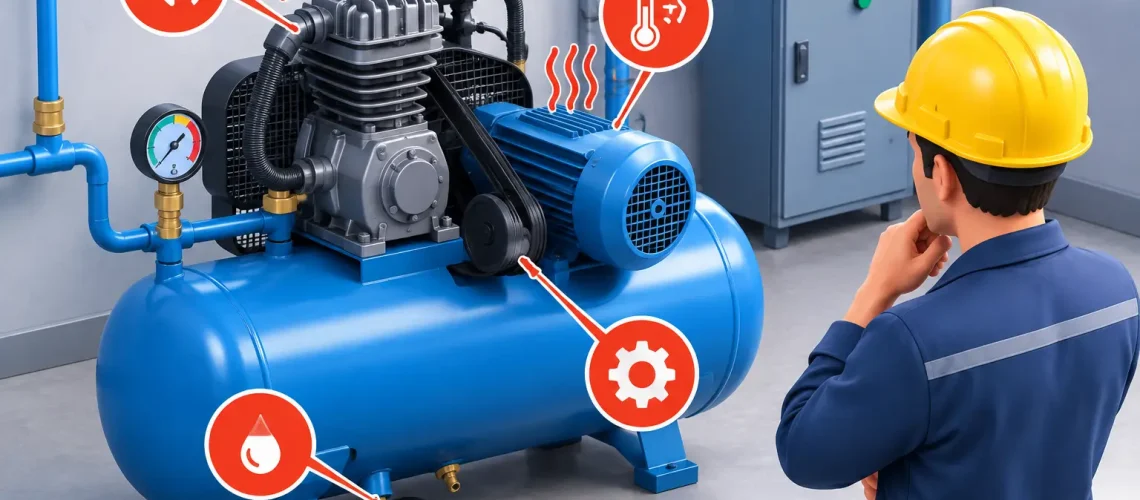

A compressor failure warning is not a nuisance alarm to silence and revisit later. In a grocery store, cold-storage warehouse, restaurant, laboratory, or medical facility, it can be the first measurable sign that product temperatures, operating costs, and business continuity are at risk. The difference between a manageable service call and a compressor replacement often comes down to how quickly a facility team can identify the condition behind the warning and act on it.
Commercial compressors rarely fail without leaving evidence. The problem is that evidence may appear across several places at once: rising run time, unstable suction pressure, nuisance trips, elevated discharge temperature, erratic case temperatures, or a gradual increase in energy consumption. A reactive maintenance model can miss these patterns until the system is already operating outside a safe range.
What a Compressor Failure Warning Is Telling You
A compressor failure warning may come from a rack controller, a variable-frequency drive, a building management system, a connected sensor, or a technician’s observations in the field. The specific alarm matters, but the operational question is broader: is the compressor being asked to operate in conditions that will shorten its life?
Some warnings indicate an immediate protective shutdown, such as a high-pressure trip, motor overload, phase issue, or oil safety fault. Others are early indicators. A compressor that runs longer than its normal duty cycle may still be maintaining temperature, yet it could be compensating for low refrigerant charge, poor condenser performance, leaking valves, a control issue, or excessive load. Waiting for a hard failure turns an efficiency issue into an emergency.
Treat every warning as data with context. A single high-head-pressure alarm during an extreme heat event may require a different response than repeated alarms during normal weather. Similarly, one compressor cycling off on low suction may point to a localized load or control issue, while multiple circuits showing the same behavior may signal a system-level problem.
Compressor Failure Warning Signs That Need Attention
The most useful warning signs are those that reveal a change from the system’s established operating baseline. A compressor room does not need to be visibly failing for performance to be deteriorating.
High discharge temperature or high head pressure
High discharge temperature places stress on oil, valves, windings, and other internal components. It can be caused by dirty or restricted condensers, failed condenser fans, non-condensables, overcharge, high ambient conditions, or improper control sequencing. High head pressure increases compressor lift and energy use, so it should be investigated before protective controls begin cycling equipment off.
The right response depends on the cause. Cleaning a condenser may solve the immediate issue, but if fan staging, pressure controls, or floating-head strategies are not operating correctly, the same condition can return. Facility teams should confirm both mechanical condition and control logic.
Low suction pressure and repeated low-pressure trips
Low suction pressure can result from a low refrigerant charge, restricted liquid feed, iced evaporators, failed evaporator fans, low load, or incorrectly adjusted valves and controls. It may also be associated with compressor short cycling, poor temperature recovery, and increased wear from repeated starts.
A low-pressure alarm does not automatically mean the compressor is the failed component. In fact, replacing a compressor without resolving the underlying refrigerant, airflow, or control issue can lead to a second failure. The system must be evaluated from the load side through the rack, not diagnosed from one alarm alone.
Motor overloads, electrical imbalance, and hard starts
Electrical conditions can cause rapid compressor damage. High amp draw, voltage imbalance, phase loss, loose connections, contactor problems, failing capacitors on applicable equipment, or excessive starting frequency can overheat motor windings and trigger overload protection.
If overload trips are recurring, do not simply reset the control and return the equipment to service. Compare operating amperage to expected load, inspect electrical connections, verify voltage quality, and determine whether abnormal refrigeration pressures are forcing the motor to work too hard. Electrical and mechanical symptoms often appear together.
Oil safety alarms or signs of poor oil return
Oil is essential to compressor reliability. Low oil pressure, repeated oil safety trips, foaming, or evidence of poor oil return should be treated as a priority. These conditions may stem from oil management problems, refrigerant migration, piping design issues, low load operation, failing separators, or internal compressor wear.
A compressor can continue to run briefly while experiencing inadequate lubrication, but the internal damage can be severe. When oil-related alarms occur, protect the equipment first and investigate the system conditions that are preventing stable oil return.
Unusual noise, vibration, or changing run behavior
A change in sound or vibration is often a field-level compressor failure warning before telemetry identifies a definitive fault. Knocking, rattling, grinding, persistent humming, or unusually loud starts can indicate mechanical wear, liquid floodback, mounting issues, or electrical trouble.
These symptoms should be documented alongside operating pressures, temperatures, amps, and alarm history. A technician can make a faster and more accurate diagnosis when the physical observation is paired with trend data instead of a single point-in-time reading.
Why Alarm Response Alone Is Not Enough
Many commercial systems have protective safeties, and those safeties are necessary. They stop equipment from operating beyond certain limits. But a safety control does not explain why the limit was reached, how long the condition existed, or whether other equipment is being affected.
That distinction matters in multi-compressor racks and distributed refrigeration systems. One compressor may be repeatedly tripping while the remaining compressors absorb the load. Temperatures may look acceptable for a time, but run hours and stress shift to the remaining equipment. Energy consumption rises, redundancy disappears, and the facility becomes more exposed to a second event.
A better approach is to trend the factors that lead to failure: suction and discharge pressures, temperatures, run time, starts, current draw where available, defrost performance, case or room temperature behavior, and alarm frequency. With historical context, teams can see whether a condition is isolated, recurring, seasonal, or accelerating.
A Practical Response When an Alarm Occurs
The immediate priority is inventory protection. Confirm temperatures at the affected cases, walk-ins, rooms, or process loads, and verify that backup capacity is available. If temperatures are moving toward critical limits, relocate product or activate contingency procedures while the equipment issue is being addressed.
Next, capture the alarm details before resetting anything: time of occurrence, affected compressor or circuit, operating conditions, recent service activity, weather conditions, and related alarms. A reset may restore operation, but it can also erase the clearest evidence of an intermittent problem.
Then assess whether the fault is safe for on-site response or requires qualified refrigeration service. Electrical faults, repeated safety trips, suspected liquid floodback, oil issues, and high-pressure conditions can cause major damage if equipment is repeatedly forced to run. The most expensive decision is often continued operation without a diagnosis.
For facilities with several sites or limited maintenance coverage, remote monitoring changes the response window. Dashboard visibility and mobile alerts allow operations teams to identify exceptions early, prioritize the highest-risk equipment, and give service personnel useful operating history before they arrive. Refrigeration Technologies, LLC uses ArtikControl™ monitoring and intelligent controls to help facilities turn isolated alarms into actionable performance insight.
Preventing the Next Compressor Event
Compressor reliability is not achieved by monitoring the compressor alone. It depends on the performance of the entire refrigeration system: condenser capacity, evaporator airflow, refrigerant charge, oil management, defrost operation, electrical quality, control sequences, and the actual load placed on the system.
Preventive maintenance remains necessary, particularly condenser cleaning, electrical inspection, leak detection, verification of fan operation, and review of refrigerant and oil conditions. However, calendar-based maintenance has limits. A system can develop a serious fault the day after a scheduled visit, and a component can appear acceptable during a brief inspection while its operating trend is moving in the wrong direction.
Continuous monitoring fills that gap. It helps facility teams establish normal operating ranges, identify deviations, and intervene before a warning becomes a shutdown. The goal is not to generate more alarms. It is to generate better decisions: which events require immediate action, which need planned correction, and which indicate an opportunity to improve controls or reduce energy demand.
A compressor failure warning should create urgency without creating panic. When facilities combine disciplined alarm response, qualified diagnosis, and ongoing system visibility, they can protect inventory, avoid avoidable downtime, and extend the useful life of critical refrigeration equipment. The next alert may be the opportunity to correct a small performance problem before it becomes the event everyone remembers.