
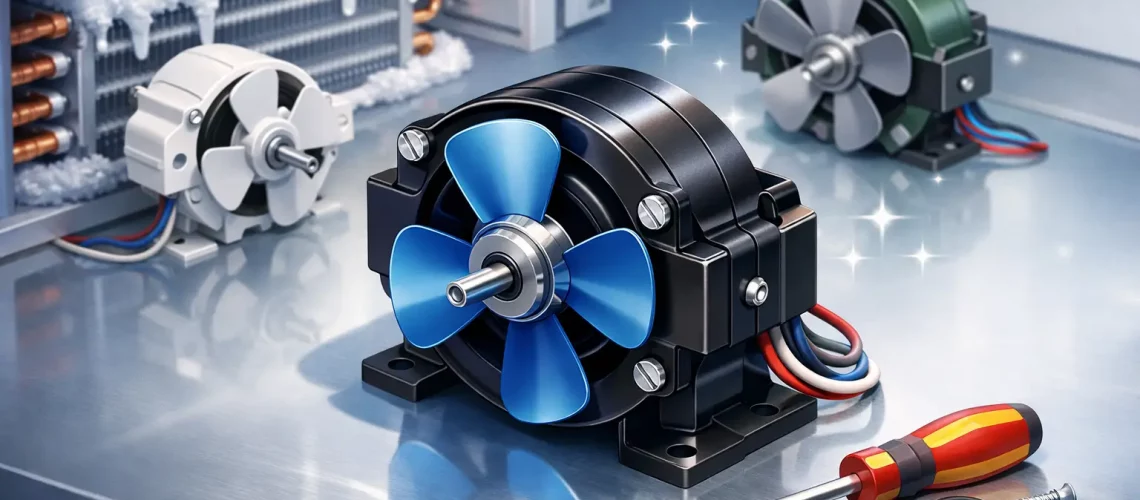

A failed evaporator fan motor can turn a minor maintenance issue into warm product, compressor stress, ice accumulation, and an after-hours emergency. The best evaporator fan motor upgrades address more than motor replacement cost. They improve airflow reliability, reduce electrical consumption, and give facility teams a better chance to identify declining performance before a case, walk-in, or cold room reaches a critical temperature.
For commercial refrigeration operators, the right upgrade depends on the evaporator design, operating temperature, fan blade, controls, defrost sequence, and the consequences of failure at that location. A motor that performs well in a medium-temperature reach-in may be the wrong choice for a low-temperature freezer or a high-humidity walk-in. The most effective decision starts with the operating problem, not a catalog number.
What Makes an Evaporator Fan Motor Upgrade Worthwhile?
Evaporator fans do essential work around the clock. They move air across the coil, maintain product temperatures, support proper defrost performance, and help prevent uneven temperatures throughout a refrigerated space. When airflow drops, the system often runs longer to meet load. That increases energy use and can accelerate wear on compressors, contactors, and other refrigeration components.
A worthwhile motor upgrade should deliver a measurable operational improvement. That may be lower watt draw, longer expected motor life, better resistance to moisture and cold, reduced maintenance calls, or compatibility with monitoring and control strategies. The best result is rarely achieved by replacing every motor with the highest-efficiency option available. It comes from selecting the motor and control approach that fits the application.
For a single critical walk-in, reliability and rapid fault visibility may outweigh modest energy savings. Across a supermarket, distribution center, or multi-site food service portfolio, the accumulated runtime of dozens or hundreds of evaporator motors can make energy efficiency a compelling part of the business case.
Best Evaporator Fan Motor Upgrades by Application
Electronically Commutated Motors for Energy Reduction
Electronically commutated motors, commonly called ECMs or EC motors, are often the strongest upgrade path where fan motors operate continuously or for long daily periods. Compared with many traditional shaded-pole motors, ECMs can significantly reduce wattage while maintaining the airflow needed for the evaporator and refrigerated space.
Their value is especially clear in medium-temperature cases, walk-ins, coolers, and other applications with high annual operating hours. Lower motor heat also reduces the refrigeration load introduced directly into the box or case. That can reduce compressor runtime, although the actual savings depend on system conditions, ambient load, door openings, coil cleanliness, and control settings.
ECM upgrades are not automatically interchangeable. Motor speed, blade loading, mounting configuration, voltage, rotation, and wiring must be verified. Some installations also require attention to control compatibility, especially where variable-speed operation or switched power is involved. An improperly selected ECM may save watts but deliver insufficient airflow, which is not an acceptable trade-off for product protection.
High-Efficiency PSC Motors for Compatible Retrofits
Permanent split capacitor, or PSC, motors can be a practical option when equipment design, budget, or electrical configuration does not support an ECM retrofit. In the right application, a quality PSC motor can offer reliable performance and a meaningful improvement over an aging or inefficient motor.
PSC motors are familiar to most maintenance teams and can be well suited for equipment that needs a straightforward replacement with predictable operating characteristics. The trade-off is that they generally do not offer the same energy performance or control flexibility as ECMs. For low-run-hour equipment or smaller locations with limited capital budgets, that trade-off may be reasonable. For high-runtime assets, an ECM lifecycle-cost analysis often tells a different story.
Low-Temperature and Moisture-Resistant Motor Designs
Freezers, blast chilling environments, humid coolers, and washdown-prone areas put fan motors under conditions that standard replacements may not tolerate. In these applications, the motor’s environmental rating, insulation system, bearing design, shaft sealing, and approved temperature range matter as much as efficiency.
A motor that is not rated for sustained low-temperature operation can suffer from lubricant issues, condensation-related damage, or premature bearing failure. In humid environments, corrosion resistance and moisture protection deserve close attention. Choosing a motor built for the actual environment helps prevent a recurring failure pattern that is too often treated as routine maintenance.
Variable-Speed Fan Control Where the System Supports It
Variable-speed evaporator fan strategies can reduce energy use during lower-load periods and may improve temperature management in selected applications. They are most effective when engineered as part of a broader refrigeration control plan rather than installed as an isolated motor change.
Reducing fan speed can lower power draw, but it also changes coil heat transfer, air distribution, and defrost behavior. If airflow falls too far, product temperatures may become uneven or coil performance may suffer. Variable-speed operation should be evaluated with the refrigeration system’s load profile, case or room layout, and temperature requirements in mind. This is an area where commissioning and ongoing trend data are essential.
Start With Airflow, Not Motor Horsepower
Motor horsepower alone is not a sufficient selection method. The replacement must provide the required airflow and static-pressure performance with the existing fan blade, guard, shroud, and coil arrangement. A motor that spins at the wrong RPM, rotates in the wrong direction, or cannot handle the blade load can create hidden operational problems even if it appears to run normally.
Before specifying an upgrade, document the motor’s voltage, phase, wattage, RPM, shaft dimensions, mounting style, rotation, blade diameter, and operating environment. Confirm whether the equipment uses a fan delay, defrost control, door switch, electronic controller, or other sequencing that affects the motor. For critical assets, baseline suction temperature, discharge temperature, box temperature, superheat, and compressor runtime before the change.
This assessment also creates an opportunity to identify the conditions that shortened the original motor’s life. A dirty coil, obstructed drain, damaged blade, loose guard, repeated icing, voltage imbalance, or short cycling issue can destroy a new motor just as quickly as the old one. Replacing the motor without correcting the cause preserves the failure cycle.
Evaluate Total Cost, Not Just Motor Price
The least expensive replacement can become the most expensive decision when labor, product exposure, energy use, and repeat service calls are considered. For each motor upgrade path, facility leaders should compare installed cost against expected annual energy savings, expected service life, operational criticality, and the cost of a temperature excursion.
High-efficiency motors tend to make the strongest financial case in equipment with long runtime and large quantities of similar fans. A chain of grocery stores, a cold storage facility, or a campus with multiple walk-ins may have enough operating hours to justify a phased retrofit program. A small standalone unit with limited use may call for a dependable direct replacement instead.
It also helps to standardize approved motor types where possible. Standardization can simplify inventory, reduce technician decision time, and improve the consistency of maintenance work. The goal is not to force one motor into every application. It is to create a controlled set of application-specific standards that maintenance teams can execute confidently.
Pair Motor Upgrades With Continuous Monitoring
A new fan motor does not eliminate the need for visibility. Fan failure may first appear as a rising case temperature, abnormal defrost recovery, increased compressor runtime, or a temperature difference between zones. By the time personnel see ice buildup or warm product, the event may already be costly.
Continuous refrigeration monitoring can identify temperature trends and abnormal operating patterns early enough for corrective action. With ArtikControl™ monitoring and intelligent controls, facility teams can receive actionable alerts and use dashboard data to investigate whether an issue is tied to airflow, defrost, refrigeration capacity, door activity, or another operating condition. This turns an upgrade from a one-time equipment event into a managed reliability strategy.
Monitoring also validates the upgrade. Comparing temperature stability, runtime, alarm frequency, and energy data before and after a retrofit provides the evidence needed to expand a successful approach across additional assets or sites.
When Replacement Is Better Than an Upgrade
There are situations where a like-for-like replacement is the right operational decision. An aging evaporator assembly may have damaged wiring, a failing fan blade, severe coil deterioration, or an obsolete motor arrangement that makes a retrofit impractical. In those cases, replacing the evaporator or correcting the larger equipment issue may produce better reliability than adapting a new motor to a compromised assembly.
Likewise, some manufacturer warranties, equipment listings, or specialized applications require approved components and exact specifications. The correct response is to respect those requirements while evaluating whether the broader equipment strategy should change at the next planned capital cycle.
A focused field assessment can identify where premium motor upgrades will generate meaningful returns, where direct replacement is appropriate, and where the real problem lies elsewhere. That clarity helps protect product, control energy costs, and keep refrigeration failures from becoming an operating crisis.