
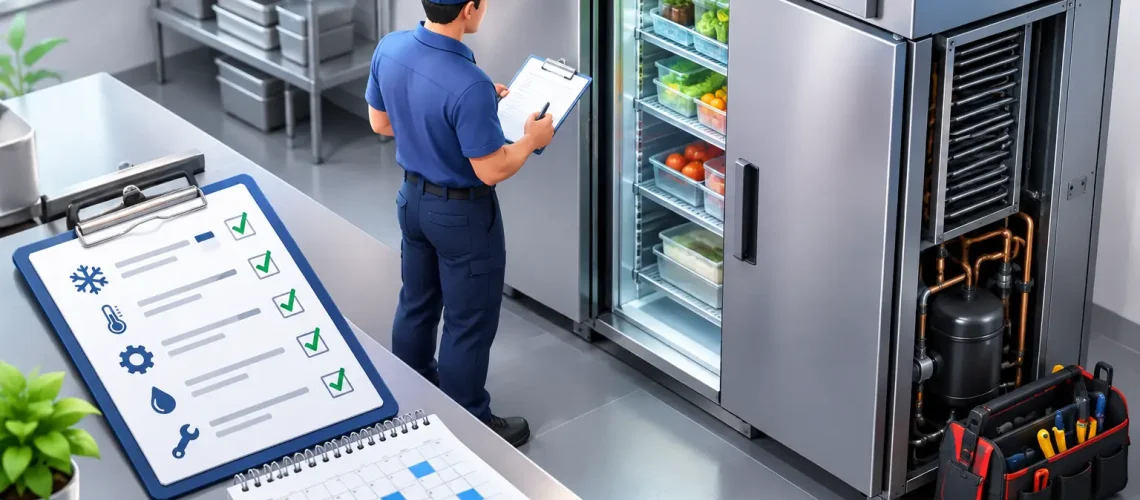

A walk-in cooler that drifts just a few degrees overnight can create a six-figure problem by morning. Product loss, emergency labor, health-code exposure, customer disruption, and damaged equipment often begin with small changes that were visible long before the failure. Commercial refrigeration maintenance planning gives facility teams a disciplined way to identify those changes, prioritize corrective work, and protect both inventory and operating budgets.
For grocery, food service, cold storage, medical, biotech, and institutional facilities, maintenance cannot be treated as a calendar task alone. Refrigeration systems operate under changing loads, ambient conditions, usage patterns, and equipment age. A plan that works for a low-traffic restaurant may not be enough for a multi-door retail case lineup, a pharmaceutical storage room, or a warehouse refrigeration rack serving multiple zones.
What a Maintenance Plan Must Protect
The purpose of a refrigeration maintenance plan is not simply to keep equipment running. It is to maintain controlled conditions at the lowest practical operating cost while preventing interruptions that put product, people, and revenue at risk.
A strong plan addresses three connected outcomes: temperature reliability, equipment health, and energy performance. If any one is ignored, the others usually follow. A condenser that is running hot may increase energy use first, then shorten compressor life, then reduce the system’s ability to hold temperature during peak demand. By the time the alarm is obvious, the repair is usually more expensive and less convenient.
This is why maintenance decisions should be based on the criticality of each asset. A reach-in cooler in a staff break room and a freezer holding high-value inventory do not require the same response time, inspection depth, or monitoring coverage. Facilities should identify systems where a failure would create immediate product loss, regulatory risk, operational shutdown, or safety concerns, then design maintenance around that exposure.
Build Commercial Refrigeration Maintenance Planning Around Assets
The first step is a complete, accurate asset inventory. This sounds basic, but many facilities still lack a dependable record of what is installed, where it is located, what it serves, and how it has performed over time. Without that information, maintenance becomes reactive by default.
For each refrigeration asset, document the equipment type, manufacturer and model, refrigerant, age, capacity, served area, control components, electrical details, warranty status, and known repair history. Include associated equipment, not only the condensing unit or compressor. Evaporators, fan motors, defrost controls, case controllers, sensors, drain systems, door hardware, alarms, and condensate management all affect reliability.
The inventory should also identify operating targets. Record required temperature ranges, acceptable alarm thresholds, product sensitivity, expected runtime patterns, and any regulatory requirements. A medical refrigerator may need tighter documentation and alarm escalation than a beverage cooler. A freezer with frequent door openings may need different defrost and airflow attention than a sealed cold storage space.
Once the inventory is complete, rank assets by business impact. A practical rating system considers the cost of failure, likelihood of failure, repair lead time, availability of backup capacity, and the consequences of temperature deviation. This ranking helps maintenance leaders spend time and budget where they will reduce the most risk.
Use the Right Maintenance Frequency
Time-based preventive maintenance remains necessary, but it should not be the only trigger for service. Quarterly, semiannual, and annual inspections provide a baseline, particularly for cleaning, safety checks, and manufacturer-recommended tasks. The right frequency, however, depends on the equipment and its operating environment.
A rooftop condensing unit near grease exhaust, pollen, cottonwood, or roadway dust may need coil cleaning more often than one in a protected environment. A busy grocery case with frequent loading and customer access may need more regular attention to doors, gaskets, airflow, and drainage. In contrast, some low-use equipment can be inspected less often when continuous monitoring confirms stable performance.
A maintenance schedule should define the work to be performed, not just the date of the visit. Vague instructions such as “check refrigeration” make it difficult to verify quality and compare results from one service event to the next. Task lists should be specific to the asset and include measurable readings.
During scheduled visits, technicians should evaluate temperatures, suction and discharge conditions, superheat, subcooling, amp draw, compressor runtime, fan performance, defrost operation, refrigerant leaks, electrical connections, contactors, capacitors, controls, sensors, door seals, drains, and condenser cleanliness as applicable. The objective is to identify deterioration before it becomes a service call.
Shift From Reactive Repairs to Condition-Based Work
The most valuable maintenance indicator is often a trend, not a single reading. A system can still hold temperature while its runtime rises, its defrost cycle extends, or its suction pressure becomes less stable. Those changes may indicate fouling, airflow restrictions, sensor drift, refrigerant loss, control issues, or a component beginning to fail.
Condition-based maintenance uses operating data to decide when work is needed. Instead of replacing a component only because of age or waiting until it fails, the facility acts when measured performance shows a meaningful change. This approach can reduce unnecessary labor while improving reliability for critical systems.
Remote monitoring makes this possible across single-site and multi-site operations. Continuous data from temperature sensors, controllers, and equipment inputs can reveal recurring alarms, abnormal runtimes, loss of cooling capacity, defrost failures, and after-hours temperature drift. Properly configured alerts allow the right people to respond before a minor fault becomes an inventory emergency.
Monitoring is not a substitute for field maintenance. It is the information layer that makes field maintenance more targeted. A dashboard can show that a freezer is trending warmer during afternoon loading, but a technician still needs to determine whether the cause is a door issue, evaporator icing, control setting, inadequate capacity, or a mechanical fault.
At Refrigeration Technologies, LLC, intelligent controls and ArtikControl™ monitoring can support this shift by giving facility teams visibility into system conditions and actionable mobile alerts. The goal is not more data for its own sake. The goal is faster decisions, fewer surprises, and documented performance improvements.
Make Energy Performance Part of the Plan
Maintenance and energy management should not sit in separate programs. Refrigeration equipment is among the largest electrical loads in many commercial facilities, and declining performance is often visible on the utility bill before it produces a failure.
Dirty coils, damaged gaskets, failed fan motors, incorrect setpoints, excessive defrost, poor control sequencing, and unnecessary compressor runtime all increase energy consumption. Some issues are straightforward service corrections. Others point to a larger opportunity, such as upgrading controls, improving case operation, replacing inefficient components, or optimizing a refrigeration rack.
The trade-off is straightforward: not every efficiency project should be performed immediately. Capital decisions should be based on equipment condition, available incentives, energy rates, repair history, operational disruption, and expected payback. An older asset that still performs reliably may be best managed with focused maintenance and monitoring. A unit with repeated failures, high runtime, and rising repair costs may justify an engineered retrofit sooner.
Track energy-related measures alongside maintenance records. Useful indicators include compressor runtime, alarm frequency, temperature variance, defrost duration, repair spending, refrigerant leak history, and electrical consumption where submetering is available. These records show whether maintenance is producing results instead of simply generating work orders.
Define Alarm Response Before an Alarm Occurs
An alarm without a response plan is only a notification. Every critical asset should have defined thresholds, escalation contacts, response expectations, and after-hours procedures. The plan should clarify who receives the alert, who validates the condition, who calls for service, and who has authority to move product or adjust operations.
Avoid setting alarm thresholds so tightly that teams receive constant nuisance alerts. Alert fatigue causes real warnings to be ignored. At the same time, thresholds cannot be so broad that product is already compromised when someone is notified. The correct settings depend on product requirements, normal temperature variation, door activity, recovery time, and sensor placement.
Facilities should periodically test alarm routing and escalation. A contact list that has not been updated in a year is a common point of failure. Test whether alerts reach the right people, whether backup contacts respond, and whether staff can access the information needed to make an informed decision.
Turn Service History Into a Capital Plan
Every repair tells part of the story. When service records are organized by asset, patterns become visible: a recurring low-temperature alarm, repeat fan motor failures, persistent ice buildup, frequent refrigerant additions, or a compressor that trips under load. Those patterns should guide maintenance changes and long-term capital planning.
Review critical assets at least annually with operations, maintenance, and finance stakeholders. Identify systems that need continued preventive care, systems that need corrective upgrades, and systems approaching replacement. Include expected downtime, product protection measures, energy savings potential, and available backup capacity in the discussion.
A useful plan also accounts for parts availability. Controls, compressors, fan motors, and specialty components can have long lead times. For mission-critical equipment, keeping selected spare parts or establishing a contingency strategy may be less expensive than absorbing the cost of a prolonged outage.
Measure the Plan by Business Results
A maintenance program is working when it produces fewer emergency calls, fewer temperature excursions, lower spoilage exposure, better equipment uptime, and more predictable spending. It should also make the facility easier to manage. Operations leaders should be able to see which systems need attention, which repairs are recurring, and where energy or reliability investments will have the strongest return.
The best next step is to begin with the assets that create the greatest business risk. Establish their operating baseline, verify alarm coverage, define service tasks, and review performance after each maintenance cycle. A refrigeration plan earns its value when a potential failure becomes a scheduled correction rather than a late-night product-loss event.