
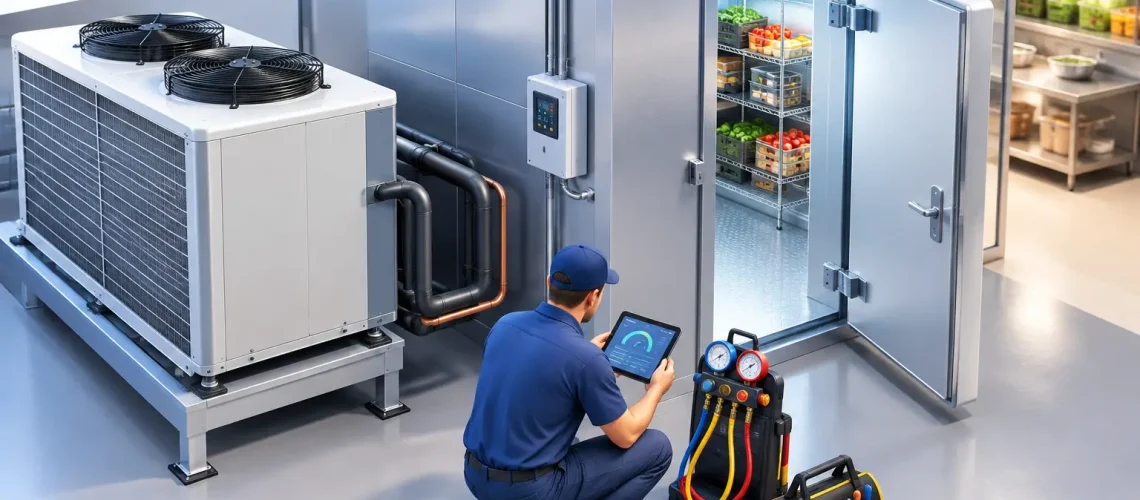

A refrigeration system can be installed exactly as specified and still fail the operation it was purchased to support. A walk-in may pull down overnight but struggle during deliveries. A rack may maintain case temperatures while cycling compressors excessively. Alarms may exist but be configured too broadly to warn anyone in time. Commercial refrigeration commissioning is the disciplined process that finds and corrects those gaps before they become inventory loss, emergency service calls, or unnecessary energy spend.
For grocery, food service, cold storage, medical, biotech, and institutional facilities, commissioning is not a final paperwork exercise. It is the point at which equipment, controls, operating procedures, and actual site conditions are tested as one system. The goal is clear: verify that the refrigeration plant will protect product, operate efficiently, and provide useful visibility when conditions begin to change.
What Commercial Refrigeration Commissioning Proves
A successful commissioning process proves more than whether compressors start and evaporator fans run. It confirms that the system can maintain the required temperatures at expected loads, respond correctly to changing conditions, and alert the right people before a small issue becomes a product-threatening event.
That standard matters because refrigeration performance is influenced by details that are easy to miss during installation. Refrigerant charge, piping practices, condenser airflow, defrost scheduling, case loading, door activity, controller settings, sensor placement, and alarm escalation all affect the outcome. A problem in any one area may not be visible during a brief startup check. It often appears later, during a busy delivery window, a heat wave, a defrost cycle, or an overnight staffing gap.
Commissioning creates documented evidence that the system is operating as intended. It also establishes a baseline. Without a baseline for temperatures, suction pressure, head pressure, superheat, compressor runtime, defrost behavior, and alarm response, facility teams are left reacting to symptoms instead of recognizing performance drift early.
Commissioning Starts Before the First Functional Test
The strongest commissioning work begins with a review of the facility’s actual refrigeration requirements. Design documents are useful, but they do not always reflect how a space is used after turnover. A cooler intended for moderate access may become a high-traffic staging area. A freezer may be loaded with warmer product at predictable times. A retail location may have added equipment that changes the building’s heat load or electrical demand.
The review should define the operating conditions that matter most: target product temperatures, allowable temperature ranges, expected loading patterns, ambient conditions, critical inventory, staffing coverage, and response responsibilities. In a medical or pharmaceutical application, the acceptable temperature range and documentation requirements may be much tighter than in a restaurant walk-in. In a cold storage facility, capacity under heavy loading may take priority over a narrow efficiency optimization.
This is also the time to verify that the equipment selection and control strategy align with the facility’s priorities. A system configured only for pull-down speed may consume more energy than necessary in steady operation. A system tuned too aggressively for energy reduction may recover too slowly after frequent door openings. There is no universal setting that is right for every operation. Commissioning makes those trade-offs visible and intentional.
Functional Testing Should Follow the Full Refrigeration Sequence
Once equipment and controls have been inspected, the system should be tested through normal and abnormal operating conditions. That means more than confirming setpoints on a controller screen. The sequence of operation should be observed from a call for cooling through compressor staging, condenser response, evaporator operation, defrost, temperature recovery, and alarm notification.
Technicians should verify that sensors are reading accurately and located where they represent the condition that matters. A sensor positioned near an evaporator coil or directly in an airflow path can report a temperature that does not reflect stored product. Calibration and placement are especially consequential in facilities where a few degrees can affect safety, quality, compliance, or shelf life.
Defrost deserves close attention. Too little defrost can lead to ice buildup, reduced heat transfer, fan damage, and poor temperature control. Too much defrost wastes energy and can create elevated temperatures that shorten product life. The correct strategy depends on the equipment type, humidity, traffic, coil condition, and load profile. A commissioned system confirms defrost termination, frequency, duration, drain performance, and recovery rather than relying on default settings.
Safeties and failure responses also need to be tested. High-pressure and low-pressure controls, fan cycling, pump-down operation, phase protection, door switches, heater controls, and emergency shutdown functions should perform as designed. If a sensor fails, a controller loses communication, or a temperature exceeds an alarm threshold, the facility should know exactly what happens next.
Controls and Alarms Need an Operational Purpose
Many sites have alarms. Fewer have alarms that support a fast, informed response. A generic high-temperature alert without context can produce nuisance notifications, while an alarm delay set too long may provide warning only after product is already at risk.
Commissioning should define alarm thresholds, time delays, escalation paths, and notification recipients around the facility’s actual response capabilities. An overnight alarm is only valuable if a responsible person receives it, understands its urgency, and has a clear action plan. Critical systems may require multiple escalation levels, including on-site personnel, maintenance leadership, and service support.
Connected monitoring adds another layer of protection. With a platform such as ArtikControl™, operating data can be observed continuously rather than only during scheduled visits or after a complaint. Temperature trends, compressor runtime, pressure conditions, defrost activity, and controller status can reveal early indicators of trouble. The value is not simply having more data. It is turning that data into usable warning before a system failure interrupts operations.
Energy Performance Is Part of Reliability
A refrigeration system that uses excessive energy is often signaling a performance issue. Dirty condensers, poor airflow, incorrect head-pressure control, short cycling, ineffective defrost, leaking doors, and poorly tuned setpoints can all increase utility consumption while placing added stress on equipment.
Commissioning should establish energy-related operating benchmarks alongside temperature and reliability targets. Depending on the application, that may include compressor staging behavior, floating head pressure, condenser fan operation, anti-sweat heater controls, nighttime case settings, or refrigerant leak indicators. The objective is not to reduce energy use at the expense of product protection. It is to eliminate waste while maintaining the operating margin the facility requires.
This distinction matters during retrofits. New controls or high-efficiency components can deliver meaningful savings, but only when they are integrated with the existing refrigeration plant and verified under real operating conditions. A retrofit that looks efficient on paper but causes unstable temperatures, nuisance alarms, or difficult maintenance will not produce lasting value.
Documentation Turns Startup Into a Manageable Standard
At closeout, the facility should receive more than a statement that the system passed inspection. Useful commissioning documentation includes verified setpoints, equipment operating data, control sequences, alarm logic, sensor locations, identified deficiencies, corrective actions, and recommended maintenance priorities.
This record gives maintenance teams a reference point when performance changes months later. It also helps multi-site operators establish common standards across locations while accounting for differences in equipment, climate, product load, and operating schedules. When service is required, documented baseline data can reduce diagnostic time and prevent repeated trial-and-error repairs.
Commissioning is not a one-time event for every facility. Seasonal changes, store remodels, equipment additions, product mix changes, and control upgrades can alter refrigeration performance. Sites with high-value inventory or mission-critical temperature requirements benefit from periodic recommissioning and continuous monitoring because conditions rarely remain static.
The best time to identify a weak alarm path, unstable defrost cycle, or inefficient control setting is before it becomes an emergency. Treat commissioning as the operating proof behind your refrigeration investment, then use ongoing performance data to keep that proof current.