
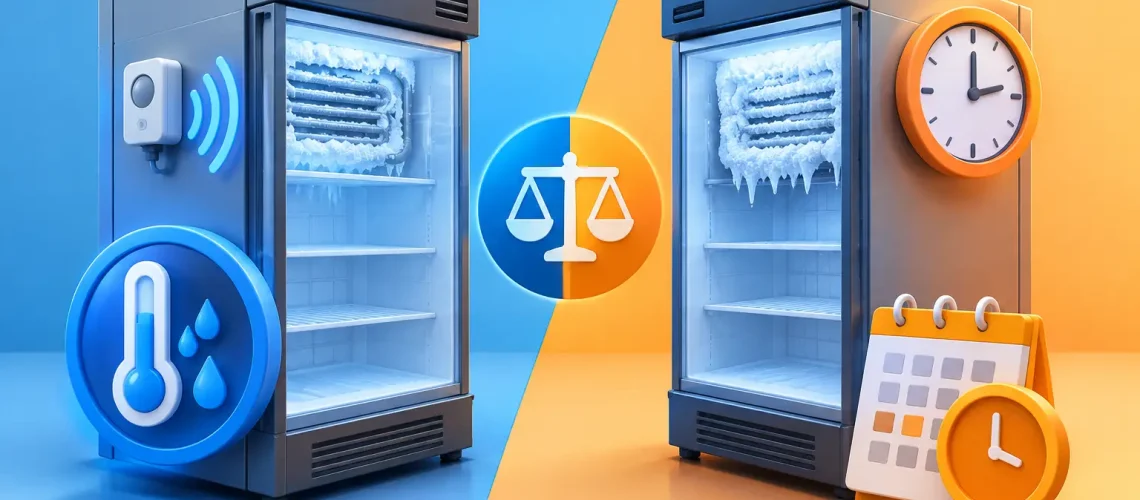

A freezer evaporator can look perfectly normal at 8:00 a.m. and be carrying enough frost by midafternoon to restrict airflow, raise suction pressure problems, and put product temperature at risk. The difference between demand defrost versus timed defrost determines whether the system responds to that actual condition or follows a fixed schedule regardless of what the coil needs.
For facilities managing energy-intensive refrigeration, defrost strategy is not a minor controller setting. It affects compressor runtime, electric or gas defrost consumption, case temperature stability, labor demands, equipment wear, and the likelihood of inventory loss. The right approach depends on the application, the refrigeration load, the controls already in place, and how much visibility the facility has into system performance.
Demand Defrost Versus Timed Defrost: The Core Difference
Timed defrost initiates defrost cycles at preset intervals. A controller may be programmed to defrost an evaporator four times each day, for example, with each cycle allowed to run for a specified maximum duration. The schedule is simple, predictable, and common in older commercial refrigeration systems.
Demand defrost uses measured conditions to determine when defrost is needed. Depending on the system and controller, that decision may be based on coil temperature, pressure differential, airflow, accumulated compressor runtime, humidity exposure, door activity, or a combination of signals. Instead of assuming frost has formed because the clock says so, the control logic looks for evidence that frost is affecting the evaporator.
That distinction matters because frost accumulation is rarely constant. A walk-in freezer with frequent door openings, high-moisture product loading, and busy receiving periods may need more defrost capacity on some days than others. A stable cold storage room with limited traffic may need substantially less. Timed controls treat those conditions the same unless someone manually changes the schedule.
Why Timed Defrost Remains Common
Timed defrost is not automatically a poor choice. It is straightforward to install, familiar to technicians, and easy for operations teams to understand. In applications with stable loads and predictable moisture infiltration, a properly set timed schedule can provide acceptable coil protection without the added complexity of demand-based sensors and control programming.
It also offers a known operating pattern. Maintenance personnel can anticipate when defrost events will occur, and the system will not depend on a sensor that may be mislocated, damaged, or poorly calibrated. For smaller or less critical applications, simplicity can be a legitimate priority.
The problem arises when the schedule is set conservatively and never revisited. Many facilities add defrost cycles over time to solve a temporary icing complaint, compensate for worn door gaskets, or address a loading practice that has since changed. The extra cycles remain in place long after the original issue is gone. Every unnecessary defrost cycle adds heat to the refrigerated space and requires the system to remove that heat afterward.
In electric defrost systems, the cost is especially direct: heaters consume power during the cycle, then compressors work harder to pull the space back to target temperature. In hot-gas defrost applications, the energy profile differs, but unnecessary cycles can still disrupt refrigeration performance, create temperature swings, and add wear to valves and related components.
Where Demand Defrost Creates Value
Demand defrost is designed to reduce waste without allowing frost to become a reliability problem. When it is applied correctly, the system defrosts only when coil conditions warrant it. That can lower defrost energy use, reduce heat added to refrigerated spaces, and support more stable product temperatures.
The operational benefit is often just as meaningful as the utility benefit. Frequent or poorly terminated defrost cycles can create elevated case temperatures, excessive recovery times, water management issues, and customer-facing problems in food retail environments. In cold storage, they can interrupt airflow patterns and make it harder to maintain consistent conditions across the room. In medical, pharmaceutical, and biotech applications, avoidable temperature variation can add unnecessary compliance and product-protection risk.
Demand controls can also reveal conditions that a fixed schedule hides. If a coil begins reaching defrost demand much more frequently than normal, the issue may not be a need for more scheduled defrost. It may indicate infiltration through damaged doors, failed strip curtains, excessive door-open time, fan problems, refrigerant feed issues, or changes in product loading. That is useful diagnostic information for a maintenance team.
A demand approach is most valuable where loads fluctuate, humidity infiltration is significant, or refrigeration downtime carries a high cost. Grocery stores, food service operations, distribution centers, walk-ins with active receiving traffic, and multi-site portfolios often fit this profile. The opportunity grows when facilities can verify results through monitored runtime, temperature, alarm, and energy data rather than relying on assumptions.
The Trade-Offs Behind Demand-Based Control
Demand defrost is not a plug-and-play energy savings measure. It requires accurate inputs, sound installation practices, and control logic that matches the equipment and application. A sensor that does not reflect real coil conditions can delay defrost too long or call it too often. Poorly configured termination settings can create the same problems found in inefficient timed systems.
There is also a practical difference between an evaporator that needs a demand signal and one that needs a more disciplined timed program. Some systems have limited capacity for controls integration. Others operate in conditions where frost formation is so regular that a well-tuned timed schedule performs reliably with little incremental gain from demand logic.
The question is not whether demand defrost is always superior. The better question is whether the facility is currently defrosting based on verified need, and whether the cost of unnecessary cycles justifies an upgrade. That evaluation should include the refrigeration system’s age, refrigerant type, evaporator design, existing controls, product temperature requirements, utility rates, and maintenance history.
How to Evaluate Your Current Defrost Strategy
Start with operating evidence. Review the number of programmed defrosts per day, the average time each cycle runs, and whether termination occurs naturally or routinely reaches the maximum time setting. If most cycles terminate quickly, the schedule may be more aggressive than necessary. If cycles regularly hit their time limit while coils still ice, the issue may be defrost capacity, airflow, infiltration, or a control problem rather than schedule frequency alone.
Next, compare defrost activity with temperature performance. Look for case or room temperature spikes after defrost, extended recovery periods, nuisance alarms, and compressor loading patterns. In a multi-evaporator system, compare similar circuits. A single evaporator that behaves differently from the rest may provide a targeted maintenance clue.
Facility conditions deserve equal attention. High door traffic, warm product pull-down, washdown activity, seasonal humidity, and changes in operating hours all affect frost load. A freezer that performs well on a fixed schedule in winter may be over-defrosting or under-defrosting during humid summer operations. Static programming does not adapt unless someone is actively managing it.
Finally, confirm that defrost termination and fan delay are functioning as intended. Defrost initiation gets most of the attention, but poor termination can waste energy and poor fan delay can blow warm, humid air into the refrigerated space before the coil is ready. Effective defrost control is a sequence, not just a start command.
Monitoring Turns Defrost Into a Managed Performance Variable
The strongest defrost strategy combines appropriate controls with continuous visibility. Remote monitoring makes it possible to see defrost events alongside temperatures, alarms, compressor behavior, and equipment trends. That changes the conversation from “the freezer seems to be running hard” to “this evaporator has added two defrost cycles per day over the last month and recovery time has increased.”
For a facility team, that level of evidence supports faster corrective action and more defensible capital decisions. For multi-site operators, it creates a repeatable way to identify which locations have the largest energy and reliability opportunity. Refrigeration Technologies, LLC uses engineered controls and ArtikControl™ monitoring to help facilities identify these patterns before they become product-loss events or emergency service calls.
Demand defrost is generally the better fit when coil loads vary and the facility can support reliable sensing, configuration, and monitoring. Timed defrost can remain effective when conditions are stable and the schedule is based on actual operating data rather than habit. The practical goal is the same in either case: keep coils clear, protect product temperatures, and avoid paying to defrost equipment that does not need it.
The next time a defrost schedule is adjusted, treat it as an operational decision rather than a default setting. A few minutes of measured data can point to energy savings, a hidden equipment issue, or a better path to refrigeration reliability.