
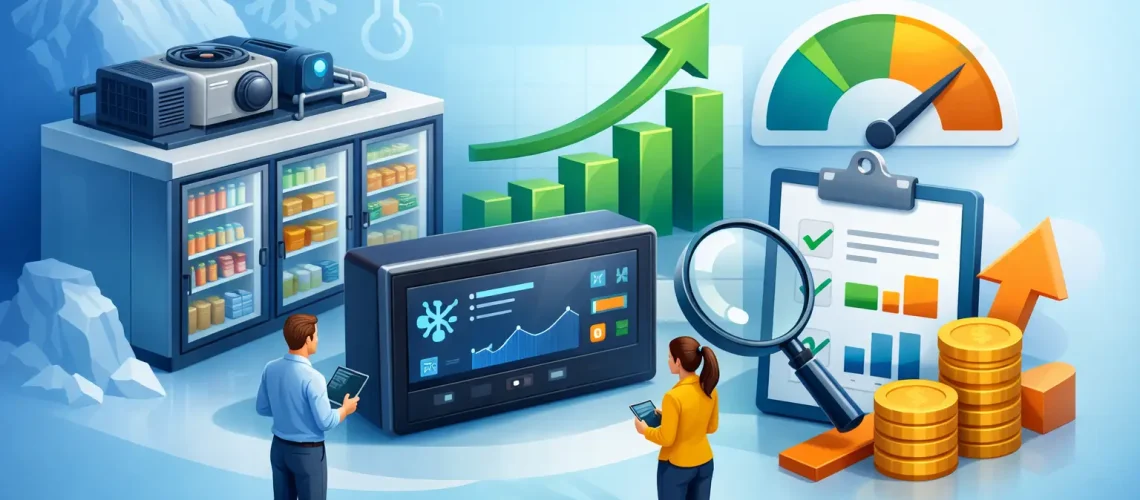

A walk-in cooler can appear to be operating normally right up until product temperatures rise, a compressor short-cycles, or a defrost issue creates an expensive service call. A refrigeration controller evaluation gives facility teams a clearer answer than a quick visual inspection: Is the control strategy protecting the load, operating equipment efficiently, and warning staff early enough to prevent loss?
For grocery, food service, cold storage, medical, and biotech operations, the controller is not a minor component. It is the decision point for temperatures, defrost cycles, fan operation, compressor staging, alarms, and, in many cases, energy use. Evaluating it properly means looking beyond whether the display is on and the setpoint looks reasonable.
What a Refrigeration Controller Evaluation Should Reveal
A meaningful evaluation connects controller performance to business risk. It should identify conditions that can lead to equipment failure, temperature excursions, excessive utility costs, poor maintenance visibility, or shortened asset life.
The first question is whether the controller is appropriate for the application. A basic thermostat may be adequate for a lightly used single-door cooler. It is rarely sufficient for a high-traffic walk-in, a sensitive medical storage area, a multi-evaporator system, or a facility that needs after-hours alarm escalation. The required level of control depends on the product being protected, system complexity, operating schedule, staffing coverage, and consequences of a failure.
The evaluation should also determine whether the existing controller is delivering accurate information. A display can report an acceptable temperature while a poorly located sensor, calibration drift, damaged probe, or communication issue conceals a developing problem. Field verification of sensor readings against actual conditions is essential, especially where inventory value or compliance requirements are high.
Just as important, the controller must be reviewed in the context of the equipment it commands. Compressor capacity, evaporator condition, defrost method, refrigerant type, door activity, condenser performance, and ambient conditions all affect what the controller should do. A control setting that works in one box can create unstable temperatures or unnecessary run time in another.
Start With Risk, Not a Controller Specification
The best refrigeration controller evaluation starts at the facility level. Before selecting features or recommending a retrofit, define what failure looks like for the operation.
For a restaurant, the priority may be protecting perishable inventory overnight when no one is on site. For a grocery store, it may be reducing repeated case alarms and avoiding product loss across dozens of refrigerated assets. For a pharmaceutical or biotech environment, documented temperature history, alarm response, and reliable sensor performance may carry equal weight with energy savings. A cold storage facility may need more sophisticated sequencing and remote visibility to manage high loads and prevent downtime.
This approach avoids a common mistake: replacing a controller simply because it is old. Age matters, but it is not the only criterion. A newer controller can still be poorly configured, inaccessible to staff, unsupported by reliable sensors, or unable to communicate critical alarms. Conversely, an older control can remain serviceable if it is accurate, correctly applied, and supported by an effective monitoring plan.
Evaluate the Core Control Functions
A field review should examine how the controller manages normal operation and how it responds when conditions move outside normal limits. The goal is to find control gaps before they become emergencies.
Temperature control and sensor integrity
Verify the setpoint, differential, sensor location, calibration, and actual product-space temperatures. Excessively wide differentials can allow unnecessary temperature swings. Overly tight differentials can cause short cycling and wear on compressors and contactors. Neither condition supports reliable, efficient operation.
Sensor placement deserves special attention. A sensor located too close to an evaporator coil, discharge air stream, door opening, or warm product load may not represent the temperature that matters most. Where product protection is critical, independent temperature monitoring can provide a necessary second layer of visibility.
Defrost performance
Defrost issues are among the most common sources of wasted energy and declining refrigeration performance. An evaluation should confirm the defrost schedule, termination method, duration, fan delay, and drain performance. Time-initiated defrost may be appropriate in some applications, but it can also run more often than needed. Demand-based or intelligently terminated defrost strategies may reduce energy use while maintaining coil performance.
The trade-off is application-specific. Cutting defrost time without understanding frost load, door traffic, humidity, and coil conditions can lead to ice buildup and temperature instability. The right objective is not the fewest defrosts possible. It is effective defrost with the least disruption and energy waste.
Compressor protection and staging
Controller settings should protect compressors from rapid cycling, high head pressure exposure, inadequate off time, and other damaging operating conditions. Review anti-short-cycle delays, pressure safeties, staging logic, and restart behavior following power interruptions.
In larger systems, poor staging can force compressors to run inefficiently or create unnecessary wear by bringing on capacity too early. Facilities with variable loads often benefit from controls that better match refrigeration capacity to real demand. The savings can be meaningful, but only if equipment condition and system design support the strategy.
Alarm logic and response paths
An alarm that no one sees is not a protection system. Evaluate alarm thresholds, delays, escalation procedures, notification recipients, and after-hours coverage. Repeated nuisance alarms create another problem: staff begin to ignore them.
Alarm logic should distinguish between a brief operational fluctuation and a condition that threatens inventory or equipment. Door-open alarms, high-temperature alarms, condenser performance alerts, power-loss notifications, and communication failures each need practical thresholds and clear ownership. The most effective system tells the right person what happened, how urgent it is, and where to look first.
Look for Energy Waste Hidden in Control Settings
Utility costs are often where controller evaluation produces the fastest measurable value. Refrigeration systems can consume excessive energy even when they appear to hold temperature.
Common control-related waste includes unnecessary defrost cycles, evaporator fans running continuously when they are not needed, poor floating pressure strategies, unstable setpoints, and refrigeration equipment operating during low-load periods without effective sequencing. A controller may also be compensating for mechanical problems such as dirty condensers, failed door gaskets, refrigerant issues, or airflow restrictions. That is why controls and equipment must be evaluated together.
Trend data is especially useful here. A single temperature reading does not show compressor run time, repeated alarm patterns, defrost recovery, or gradual performance decline. Continuous monitoring can expose trends that are invisible during a quarterly maintenance visit, allowing teams to correct the underlying issue before energy waste turns into equipment damage.
Decide When Retrofit Is the Better Option
A controller retrofit is often justified when existing controls lack remote access, reliable alarming, data logging, sensor accuracy, configuration flexibility, or supportability. It may also make sense when a facility is replacing aging refrigeration assets in phases and needs a more consistent operating standard across sites.
However, a controller upgrade should not be treated as a universal fix. If a system has undersized equipment, severe refrigerant problems, failing motors, damaged insulation, or chronic airflow restrictions, new controls alone will not solve the performance problem. The right recommendation may be a targeted repair, a control retrofit paired with mechanical improvements, or a broader system modernization plan.
For organizations with multiple facilities, standardizing on an intelligent platform can reduce this complexity. Refrigeration Technologies, LLC uses solutions such as ArtikControl™ to combine field-engineered control improvements with ongoing dashboard visibility and mobile alerts. The benefit is not simply more data. It is faster recognition of abnormal conditions and a more accountable path from alarm to corrective action.
Turn the Evaluation Into an Operating Plan
The evaluation should end with prioritized actions, not a generic equipment list. Immediate items may include correcting unsafe setpoints, replacing failed sensors, revising alarm recipients, or addressing defrost settings that are causing ice buildup. Near-term recommendations may include controller retrofits, remote monitoring, equipment repairs, or targeted energy improvements.
Each recommendation should identify the operational impact: product protection, avoided downtime, estimated energy reduction, maintenance benefit, or improved compliance visibility. That allows facility and operations leaders to make decisions based on risk and return rather than on controller features alone.
The strongest refrigeration programs treat controller performance as an ongoing discipline. Review trends, validate alarm response, and revisit settings as product loads, operating hours, and equipment conditions change. A controller that is evaluated with that level of attention becomes more than a temperature display – it becomes an early-warning and performance-management tool that helps protect inventory, control costs, and keep critical refrigeration running when the facility needs it most.