
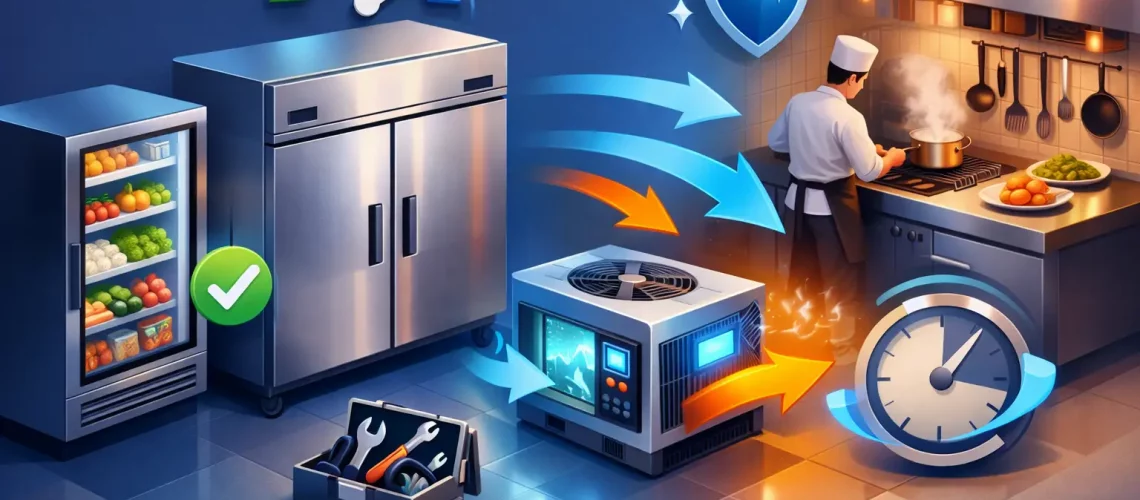

A walk-in cooler that drifts a few degrees overnight can create a costly morning: compromised inventory, emergency labor, disrupted service, and a system that may still be headed toward failure. The best foodservice refrigeration upgrades address that risk before it becomes an incident. They improve control, visibility, and energy performance while helping foodservice operators get more reliable life from the equipment already in place.
For restaurants, institutional kitchens, food retailers, and multi-site operators, the right investment is rarely a simple question of replacing the oldest box or condensing unit. Refrigeration performance depends on how equipment, controls, airflow, maintenance practices, and staff response work together. A targeted upgrade plan should begin with the operational problems that have the greatest financial consequences: temperature excursions, high utility costs, recurring service calls, product loss, and limited visibility after hours.
Start With a Refrigeration Performance Assessment
Before selecting equipment, establish a clear baseline. Utility bills reveal trends, but they do not explain whether the root cause is a short-cycling compressor, poor door discipline, iced evaporator coils, incorrect setpoints, refrigerant issues, or controls that no longer match the load.
A field assessment should review temperatures across refrigerated spaces, compressor run time, defrost behavior, electrical consumption, door condition, coil cleanliness, refrigerant performance, and alarm history. It should also account for how the operation uses each space. A high-volume kitchen walk-in with frequent deliveries and repeated door openings needs a different strategy than a beer cooler, floral cooler, or low-access storage room.
This step protects capital budgets. Replacing equipment without correcting controls, airflow, or infiltration can leave the same energy and reliability problems in place. Conversely, a well-maintained system may benefit more from intelligent controls and monitoring than from a full equipment replacement.
The Best Foodservice Refrigeration Upgrades Prioritize Control
Predictive temperature monitoring and mobile alerts
Temperature monitoring is one of the highest-value upgrades for operations that cannot afford to lose perishable inventory. Basic data logging records what happened. Continuous monitoring adds far more operational value when it provides live dashboards, trend data, actionable alarms, and mobile notifications for the people who can respond.
The goal is not to generate more alerts. It is to identify conditions that signal a developing failure, such as a cooler slowly warming, an unusually long compressor cycle, a door left open, or a defrost event that does not complete properly. Early notice allows staff or service partners to intervene before product reaches an unsafe temperature.
For multi-site foodservice organizations, centralized visibility is especially valuable. Facility leaders can compare performance across locations, see which alarms recur, and prioritize maintenance based on actual operating conditions rather than guesswork. Refrigeration Technologies, LLC applies this approach through its ArtikControl™ platform, pairing system monitoring with engineered recommendations and ongoing performance oversight.
Intelligent refrigeration controls
Many refrigeration systems operate with fixed schedules and legacy control logic that does not reflect actual occupancy, product load, ambient conditions, or utility demand. Intelligent controls can improve how compressors, fans, defrost cycles, and temperature setpoints respond to real operating conditions.
For example, demand-based defrost can reduce unnecessary defrost events when coil conditions do not require them. Evaporator fan controls can reduce fan energy during low-load periods while maintaining proper temperature and airflow. Compressor control strategies can also reduce inefficient cycling and help stabilize case or room temperatures.
The trade-off is that controls must be designed and commissioned for the specific application. Aggressive energy settings that work in a lightly used cooler may create temperature recovery problems in a high-traffic kitchen. The right control strategy balances energy savings with food safety, product quality, and recovery time.
High-efficiency ECM evaporator fan motors
Electronically commutated motors, commonly called ECMs, are a practical retrofit in many walk-ins and reach-in refrigeration applications. Compared with older shaded-pole or permanent split capacitor motors, ECM fan motors use less energy and can operate at variable speeds where the application supports it.
Because evaporator fans often run continuously, the savings can accumulate quickly across multiple coolers, freezers, and locations. Reduced motor heat can also lower the refrigeration load inside the box, creating an additional efficiency benefit.
ECMs are not a universal fix. Motor selection, blade configuration, airflow requirements, and control compatibility matter. A fan retrofit should preserve the airflow needed to protect product temperatures and prevent coil icing. This is why installation should be evaluated as a system change, not treated as a simple motor swap.
LED cooler and freezer lighting with occupancy controls
Lighting upgrades are straightforward, but their benefits go beyond lower wattage. LEDs produce less heat than older lighting technologies, reducing heat added to refrigerated spaces. Better illumination also improves visibility for inventory rotation, cleaning, and staff safety.
Occupancy sensors and door-switch controls can further limit lighting run time in low-traffic walk-ins. In freezer environments, fixtures and sensors must be selected for low-temperature conditions and installed to maintain vapor barriers and electrical reliability. Poorly selected products can create nuisance failures that erase the benefit of an otherwise simple upgrade.
Reduce Infiltration Before Adding More Capacity
A refrigeration system cannot efficiently overcome a constant stream of warm, humid air. Worn door gaskets, damaged strip curtains, misaligned hinges, gaps around penetrations, and doors left open during receiving all increase compressor run time and ice buildup.
Door upgrades are often overlooked because they do not look as sophisticated as a new condensing unit. Yet high-speed doors, automatic closers, strip curtains, upgraded gaskets, and door alarms can materially reduce infiltration in busy operations. They can also reduce frost accumulation, which helps maintain evaporator performance and limits emergency defrost-related service calls.
The best approach depends on traffic patterns. A strip curtain may be appropriate for intermittent access, while a high-speed door may make more sense at a heavily used receiving area. If employees regularly prop a door open because the workflow is inefficient, the durable solution may involve operational changes as well as hardware.
Upgrade Defrost Management Where Ice Is Driving Costs
Excessive frost is more than a housekeeping issue. It restricts airflow, raises energy consumption, affects temperature stability, and can cause evaporator coils to ice over. In freezers and humid applications, defrost management deserves close attention.
Demand defrost controls, properly configured termination settings, drain-line heat management, and verified defrost schedules can reduce unnecessary electrical use while keeping coils clear. The opportunity is significant when systems are defrosting on a fixed schedule regardless of actual frost load.
Still, reducing defrost frequency without a proper assessment can create problems. Product load, door traffic, ambient humidity, coil design, and freezer use all influence frost accumulation. Trend data is useful here because it shows whether a revised defrost strategy improves performance over time rather than simply reducing a programmed event count.
Know When a Condensing Unit or Compressor Upgrade Is Justified
A major equipment replacement can deliver meaningful gains, particularly when a legacy condensing unit has declining capacity, frequent compressor failures, difficult-to-source components, or poor part-load efficiency. Modern equipment may offer better compressor technology, improved fan motors, stronger controls, and refrigerant options aligned with current regulations and long-term serviceability.
But replacement should be justified by lifecycle value, not age alone. A newer system with recurring failures may have an installation, sizing, airflow, or control problem. An older system with stable temperatures, reasonable energy use, and low service costs may be better served by targeted retrofits and monitoring.
When replacement is warranted, consider load calculations, ambient exposure, redundancy requirements, refrigerant transition planning, electrical capacity, and future expansion. For mission-critical foodservice operations, a lower first-cost system is not always the lowest-risk option. Capacity recovery, alarm integration, service access, and the financial impact of downtime should be part of the decision.
Build an Upgrade Plan Around Measurable Results
The strongest refrigeration upgrade programs define success before work begins. That may mean reducing after-hours temperature events, lowering kilowatt-hour consumption, cutting emergency service calls, improving temperature recovery after deliveries, or extending the useful life of existing assets.
Document baseline conditions, prioritize upgrades by risk and return, and verify performance after installation. Monitoring data gives operators a way to confirm whether projected savings and reliability improvements are actually occurring. It also helps distinguish a one-time anomaly from a recurring system issue that needs engineering attention.
A practical first step is to identify the cooler, freezer, or refrigerated case that generates the most alarms, service calls, or operational concern. Improving that asset with the right controls, monitoring, and mechanical corrections can create a clear model for smarter refrigeration decisions across the rest of the facility.