
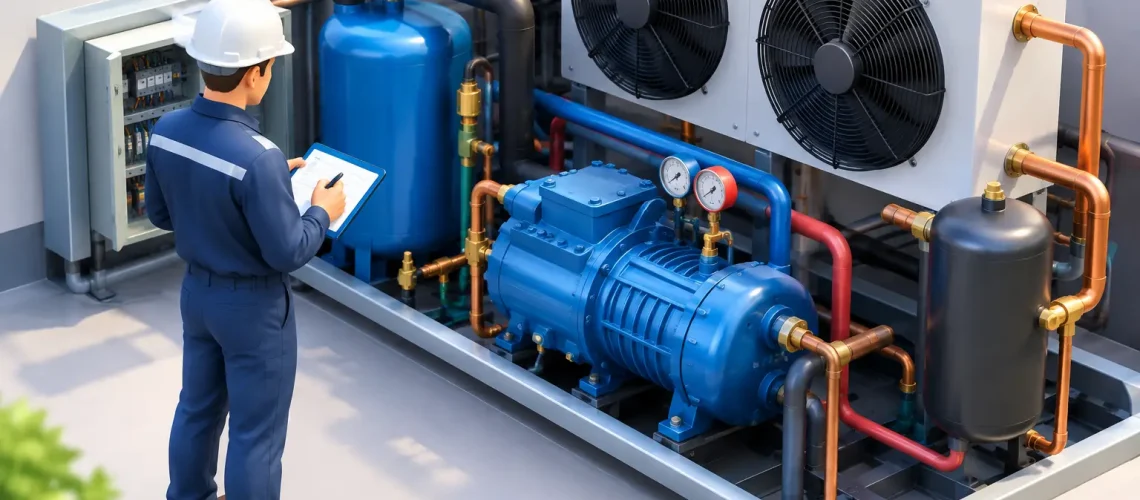

A walk-in cooler can hold temperature right up until it cannot. By the time a case alarm sounds, product is warming, staff are scrambling, and a minor mechanical or control issue may have become an expensive disruption. A refrigeration system assessment gives facility leaders a clearer view of what is happening before a failure, utility spike, or inventory loss forces the issue.
For grocery, food service, cold storage, medical, biotech, and institutional facilities, refrigeration performance is not a background maintenance concern. It directly affects operating cost, product protection, compliance, and customer confidence. The purpose of an assessment is to identify where the system is losing efficiency or reliability, then build a practical plan to correct the highest-value issues first.
What a Refrigeration System Assessment Should Cover
A meaningful assessment goes beyond checking whether equipment is running on the day of the visit. Commercial refrigeration systems can appear functional while operating with excessive run time, unstable temperatures, poor defrost performance, refrigerant issues, or controls that no longer match the facility’s operating needs.
The process should begin with an on-site review of the refrigeration load, equipment condition, operating history, and facility priorities. A single-site restaurant may need to prevent recurring walk-in failures. A supermarket may be focused on reducing energy consumption across cases, racks, and refrigeration circuits. A cold storage or pharmaceutical facility may place temperature documentation and alarm response at the center of its priorities. The scope should reflect the consequences of failure in that environment.
An effective assessment evaluates the system as an operating whole. That includes compressors, condensers, evaporators, cases or cold rooms, controls, sensors, defrost strategies, electrical components, refrigerant piping, and the way personnel interact with alarms and maintenance needs. Looking at one component in isolation can miss the condition that is actually driving poor performance.
Equipment condition and operating stability
Mechanical condition still matters. Technicians review visible wear, airflow restrictions, fan operation, coil condition, electrical connections, drainage, insulation, door seals, and signs of refrigerant leakage or oil loss. They also assess whether equipment is properly sized and whether it is being pushed beyond its intended load.
But condition alone does not tell the full story. A compressor may be operational while short-cycling due to control issues. An evaporator may ice up because of a defrost sequence problem, a failed sensor, an open door, or airflow obstruction. A condenser may be clean at the time of inspection but still operate inefficiently because head-pressure controls are not responding correctly to changing ambient conditions.
Energy use and hidden waste
Refrigeration is often one of the largest electrical loads in a facility. Unnecessary energy use can result from high floating head pressure, poor suction pressure management, excessive defrost, inefficient fan operation, worn door gaskets, improper setpoints, or controls that run equipment at fixed conditions regardless of actual demand.
A strong assessment connects these conditions to measurable operating impact. Instead of simply identifying an aging component, it should explain whether that component is increasing compressor run time, causing temperature swings, creating maintenance exposure, or adding avoidable kilowatt-hours. This allows operations and finance stakeholders to prioritize work based on business value, not just equipment age.
Controls, sensors, and alarm readiness
Many reliability issues begin as small changes in pressure, temperature, runtime, or defrost behavior. Without useful monitoring, those changes remain invisible until the system crosses a failure threshold.
The assessment should review how the facility currently collects and uses refrigeration data. Are temperature readings reliable? Are sensors calibrated and located where they reflect actual product risk? Do alarms reach the right people, or are they buried in a panel, ignored after repeated nuisance alerts, or sent without enough context to support a response?
Modern monitoring and intelligent controls can help facilities move from reactive repair to early intervention. Refrigeration Technologies, LLC evaluates opportunities to apply dashboard-based visibility, mobile alerts, and ArtikControl™ solutions where they can improve decision-making and reduce the chance that a developing problem becomes a product-loss event.
The Findings That Matter Most
An assessment can produce a long list of observations. The useful result is not the length of that list. It is a clear ranking of issues by urgency, risk, cost, and expected operational benefit.
Facilities should expect a practical improvement plan that separates immediate reliability concerns from scheduled maintenance, efficiency improvements, and longer-term capital decisions. In many cases, the highest-return work is not a full replacement. It may be a control upgrade, a sensor correction, targeted retrofit, condenser optimization, defrost adjustment, or repair of a recurring airflow issue.
A well-organized plan typically addresses five distinct areas:
- Immediate failure risks that could threaten inventory, safety, or continuity of operations.
- Conditions that increase energy use or reduce equipment capacity.
- Monitoring and alarm gaps that delay problem detection.
- Maintenance items that can extend equipment life when addressed on a planned schedule.
- Capital improvements that warrant budgeting because repair alone will not deliver dependable performance.
This prioritization matters because not every issue should be solved the same way. A facility with a reliable but inefficient system may benefit most from controls and targeted retrofits. A system with repeated compressor failures, unstable temperatures, and obsolete components may require a more substantial upgrade. The right answer depends on the equipment’s condition, load profile, repair history, energy costs, and the financial consequence of downtime.
From Assessment to Measurable Improvement
An assessment is valuable only when it leads to action that can be verified. The next step is to establish a baseline for performance, then define the improvement being pursued. That may be lower electrical consumption, fewer emergency service calls, improved temperature consistency, faster alarm response, reduced compressor runtime, or better visibility across multiple locations.
For example, a food retailer may find that refrigeration cases are meeting temperature requirements but operating with unnecessarily high energy demand. Adjusting control sequences and improving monitoring may reduce waste without disrupting operations. A medical storage facility may find that its greatest exposure is not energy use but limited after-hours visibility. In that case, reliable sensor data, escalation procedures, and remote alarms can be more valuable than a purely mechanical upgrade.
Execution should also be coordinated around the facility’s operating schedule. Refrigeration work can affect customers, production, product storage, and staffing. A customized plan accounts for access windows, temporary protection for inventory, commissioning requirements, and the need to confirm that changes perform as intended after installation.
Why ongoing monitoring changes the equation
A one-time inspection captures a point in time. Refrigeration systems operate through changing weather, occupancy, delivery schedules, loading patterns, seasonal demand, and equipment wear. Conditions that were acceptable during an assessment can shift weeks later.
Continuous monitoring provides the operational layer that a single assessment cannot. It helps teams see temperature trends, identify abnormal runtime, investigate recurring alarms, and respond before a deviation becomes a shutdown. It also creates a record of performance that can support maintenance planning and validate whether upgrades are producing the expected result.
For multi-site operators, this visibility is especially valuable. Instead of relying solely on local observations and emergency calls, facility and operations leaders can compare conditions across locations, identify repeat patterns, and direct resources toward the sites with the highest risk or greatest savings opportunity.
When to Schedule an Assessment
The best time to assess a refrigeration system is not after a product-loss event. Facilities should consider an evaluation when utility costs rise without a clear explanation, emergency repair calls become more frequent, temperatures fluctuate, equipment is approaching a decision point, or a new location is being acquired or renovated.
It is also wise to schedule an assessment before peak seasonal demand. That gives decision-makers time to address capacity limitations, correct control issues, and strengthen alarm readiness before the system is under its greatest load.
A refrigeration system should not have to fail to reveal its weaknesses. With a focused assessment, prioritized improvements, and ongoing visibility, facility teams can protect inventory, control energy spend, and operate with greater confidence when refrigeration performance matters most.