
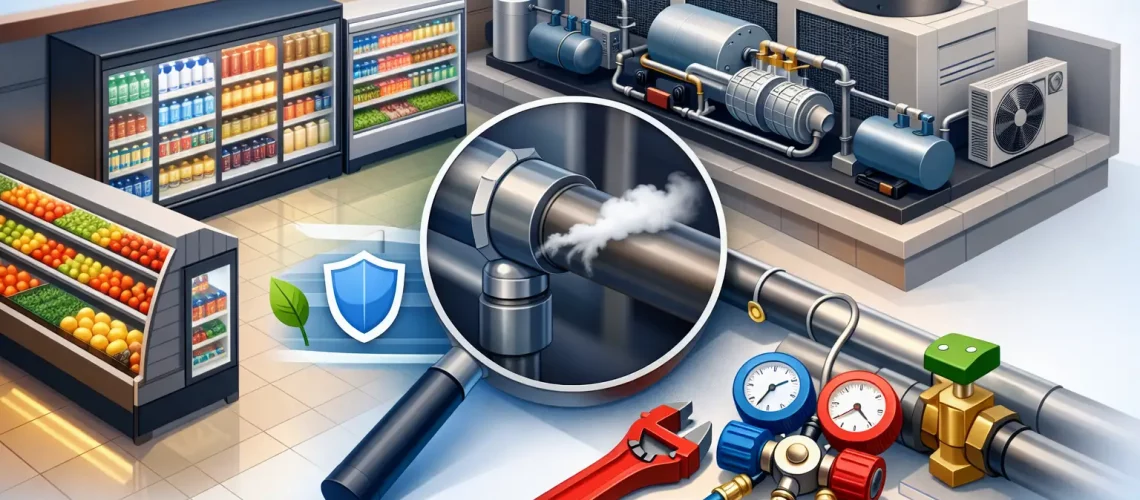

A supermarket refrigerant leak rarely announces itself as a major failure. It often begins as a gradual loss of charge, longer compressor run times, warmer case temperatures, and higher electric demand. By the time a store sees spoiled inventory or an emergency service call, the underlying leak may have been affecting operating cost and equipment reliability for weeks. The practical way to reduce supermarket refrigerant leaks is to treat leak prevention as a continuous performance discipline, not a periodic repair task.
For grocery operators, the stakes extend beyond compliance. Refrigerant loss reduces system capacity, increases energy consumption, strains compressors, and puts temperature-sensitive product at risk. A leak-management strategy should therefore connect field repairs with controls, monitoring, maintenance practices, and clear accountability across the store portfolio.
Why supermarket refrigerant leaks become expensive
A refrigeration system can continue operating with a modest refrigerant loss, but it will not operate efficiently. As charge declines, suction pressures and superheat can move out of their intended ranges. Compressors may run longer to satisfy load, case temperatures can become less stable, and components experience more wear.
The direct cost of refrigerant is only one part of the equation. Stores also face elevated utility bills, service labor, lost product, disrupted operations, and shortened equipment life. For a multi-site retailer, small recurring leaks can create a material portfolio-wide expense even when no single event appears catastrophic.
Leak rates also vary by system design, equipment age, store environment, and maintenance history. A legacy rack with extensive field piping has different exposure than a newer distributed system. That is why effective programs begin with a site-specific assessment rather than a generic checklist.
Find the leaks that routine inspections miss
Traditional leak checks remain necessary, especially around known high-risk components. But a technician walking a machine room or sales floor during a scheduled visit sees only a moment in the system’s operating life. Many leaks change with vibration, temperature, pressure, defrost cycles, and seasonal loading.
Continuous monitoring fills that visibility gap. Tracking suction pressure, superheat, compressor performance, case temperatures, defrost behavior, and alarm trends can reveal conditions consistent with a developing charge loss before product temperatures rise. The objective is not to replace field diagnosis with data. It is to send technicians to the right problem earlier, with a clearer picture of what has changed.
Focus inspections on common failure points
Mechanical inspection should concentrate on the places where vibration, corrosion, thermal movement, and service activity create risk. These include valve stems, Schrader cores, flare and braze joints, evaporator connections, condenser connections, receiver fittings, service ports, and piping supports.
Display cases and walk-ins deserve the same attention as the rack. Case piping is exposed to customer traffic, cleaning activity, door impacts, and repeated temperature cycling. On remote systems, a small leak at an evaporator or branch connection may be harder to identify than a machine-room leak, yet it can have the same effect on performance.
Technicians should verify repairs under realistic operating conditions. A joint that appears tight while the system is idle may leak when pressure changes or vibration returns. Pressure testing, evacuation discipline, and electronic leak detection are not interchangeable steps. Each validates a different part of the repair process.
Use trends, not alarms alone
An alarm tells the team that a threshold has been crossed. Trend data helps explain whether the condition is isolated, recurring, or worsening. For example, a gradual change in compressor run time paired with unstable suction pressure may warrant investigation even if product temperatures remain acceptable.
This approach reduces the tendency to wait for a high-temperature alarm. It also helps distinguish a suspected refrigerant issue from other causes of poor performance, such as dirty coils, failed fans, control problems, floating head pressure settings, or defrost errors. The right diagnosis matters because adding refrigerant without locating and correcting the leak only postpones the next failure.
Build leak prevention into maintenance and service work
The most reliable repair program has documented standards. Every service event that opens the refrigerant circuit introduces an opportunity for contamination, improper evacuation, or an imperfect connection. Clear procedures protect the system after the technician leaves.
A disciplined service process should include proper recovery, pressure testing with an appropriate dry gas, verified evacuation, accurate charging, and documented leak testing after startup. Technicians should record the location and cause of each leak, not simply the amount of refrigerant added. Over time, that history identifies repeat failures, vulnerable equipment families, and stores that need a deeper retrofit evaluation.
Maintenance intervals should be based on risk as well as calendar dates. High-volume stores, older equipment, sites with long line sets, and locations with a history of refrigerant additions may require more frequent attention. Conversely, a well-performing store with stable operating data may not need the same level of field intervention. The goal is to allocate maintenance resources where they prevent the most loss.
Improve system stability with intelligent controls
Controls do not repair a damaged pipe or failed gasket. They do, however, help a refrigeration system operate within intended parameters and make abnormal behavior visible sooner. Stable suction control, coordinated defrost, optimized condenser operation, and accurate case temperature management reduce unnecessary stress across the system.
Intelligent control strategies can also limit the operational damage while a developing problem is being investigated. Remote alerts allow store teams and service providers to respond to changing temperatures or operating pressures before a critical product event occurs. For operators responsible for many stores, a centralized dashboard creates a consistent view of refrigeration health instead of relying on isolated site reports.
Refrigeration Technologies, LLC applies this approach through engineered system improvements and ArtikControl™ monitoring and control solutions. The value is not a device alone. It is the ability to combine field knowledge with operating data, identify the conditions that require action, and verify whether corrective work improved performance.
Set action thresholds that match the store
Not every alert should generate an emergency dispatch. If thresholds are too broad, teams receive noise and may start ignoring important notifications. If they are too narrow, developing issues remain hidden until they affect product temperatures.
Thresholds should reflect the equipment type, refrigerant, product load, operating schedule, and site history. A store with frequent door openings, heavy seasonal traffic, or mixed-temperature loads may need different alarm logic than a smaller-format location. The best configuration evolves as operating data reveals normal patterns and recurring exceptions.
Measure the results that matter to operations
Leak reduction should be managed with measurable outcomes. Refrigerant additions per store, repeat repairs, high-temperature events, compressor run time, energy consumption, alarm frequency, and emergency service calls all help show whether the program is working.
A falling refrigerant-addition rate is meaningful, but it should not be viewed in isolation. If additions decline because leaks are going undetected, temperature risk and energy use may rise. Pair refrigerant data with system performance indicators and completed repair documentation to get a more accurate picture.
For capital planning, recurring leaks can indicate that repair is no longer the best economic choice. Replacing damaged piping sections, upgrading valves and fittings, improving line supports, retrofitting controls, or modernizing aging equipment can have a stronger long-term return than repeated emergency repairs. The right decision depends on remaining equipment life, repair history, energy impact, and the operational importance of the affected load.
Make leak prevention a shared responsibility
Store personnel are often the first to notice warning signs: unusual frost, noisy equipment, persistent case alarms, condensation, or products that do not feel properly chilled. They do not need to diagnose refrigeration circuits, but they should know how to report observations quickly and accurately.
Facility teams, service contractors, energy managers, and operations leaders need a common process for reviewing recurring issues. When data, service records, and store observations remain disconnected, the same leaks tend to return. When they are reviewed together, organizations can move from repeated response to targeted prevention.
The strongest leak-management programs are built around an operational mindset: identify abnormal behavior early, verify the root cause, repair it correctly, and use the result to prevent the next event. That discipline protects inventory and margins while giving refrigeration equipment a better chance to perform as designed.