
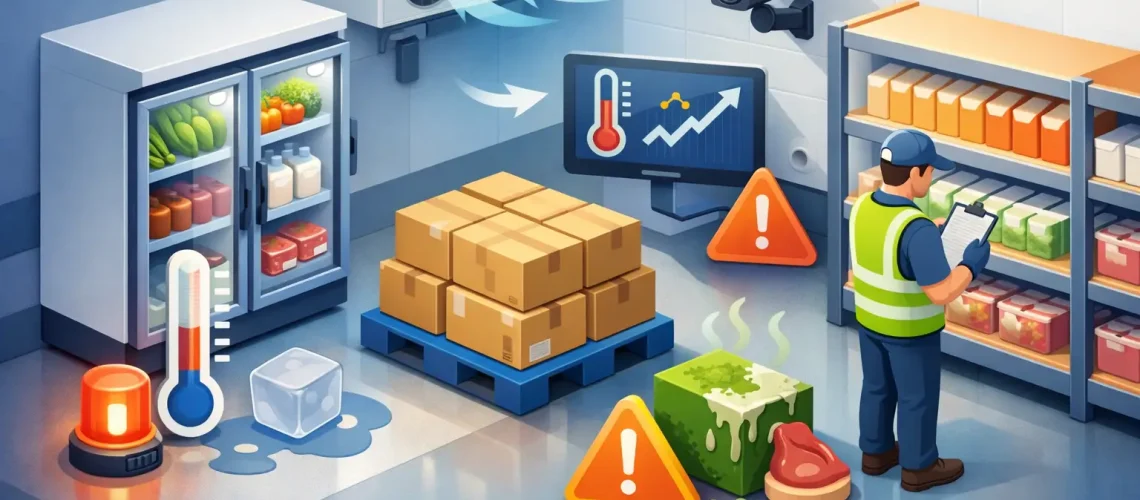

A refrigerated case can appear to be operating normally while product temperature is already moving outside an acceptable range. A door that does not fully close, a failing fan motor, a drifting sensor, or an overloaded condenser can create a costly problem long before a complete equipment failure occurs. To prevent refrigerated inventory spoilage, facilities need visibility into both product conditions and the system behaviors that cause temperatures to drift.
For grocery, foodservice, cold storage, medical, biotech, and institutional facilities, spoilage is not simply a maintenance concern. It is a business continuity risk. Lost inventory, emergency labor, regulatory exposure, lost customer confidence, and unplanned replacement costs can exceed the price of the repair that might have prevented the event.
Prevent Refrigerated Inventory Spoilage Before an Alarm Becomes a Crisis
The strongest spoilage-prevention strategy starts with a simple operational shift: move from responding to breakdowns to identifying deteriorating performance early. Refrigeration systems rarely fail without warning. They usually show measurable changes in temperature stability, run time, pressure, defrost behavior, energy use, or alarm frequency before inventory is at risk.
A basic local thermostat or walk-in thermometer may confirm that a space is cold at one moment. It does not show whether temperatures were unstable overnight, whether a compressor is short-cycling, or whether a recurring high-temperature condition clears itself only after product has warmed. Continuous monitoring fills that gap by creating an operating record and notifying the right people when a condition requires attention.
The appropriate response time depends on the product and the facility. A brief temperature excursion in a beverage cooler may be manageable; the same excursion in a vaccine refrigerator, seafood case, or frozen-food storage area may demand immediate action. Alarm thresholds, escalation paths, and documentation should reflect the actual consequence of failure, not a one-size-fits-all setting.
Monitor the conditions that matter to inventory
Temperature is the central measurement, but it should not be the only one. A high-temperature alarm tells operators that a problem exists. Trend data and supporting system information help identify why it exists and whether it is becoming more severe.
For a walk-in, case, cooler, or freezer, effective monitoring commonly tracks product-zone temperature, air temperature, door activity, power status, compressor operation, defrost cycles, and refrigeration pressures where appropriate. Monitoring ambient conditions can also be useful when equipment is located in hot mechanical spaces, receiving areas, or kitchens with variable heat loads.
Placement matters. A sensor located directly in the path of supply air can read colder than the product zone. A sensor near a door can overstate normal temperature movement. Site-specific sensor placement, calibrated devices, and clear acceptance ranges produce far more useful data than simply adding more sensors.
Build an alarm process people can execute
An alarm is only valuable when someone knows what to do with it. Facilities should define who receives alerts, who acknowledges them, when an on-site inspection is required, and when a refrigeration contractor or internal technician is called. That process must work after hours, on weekends, and during staff turnover.
Avoid setting thresholds so tightly that normal door openings and defrost cycles produce constant notifications. Alert fatigue causes teams to ignore the alarm that matters. At the same time, thresholds that are too broad can allow inventory to remain in an unsafe range for too long. The right configuration accounts for normal operating variation, product sensitivity, equipment type, and the time required to respond.
A practical escalation plan can distinguish between a short, self-correcting deviation and a sustained temperature rise. It should also identify what to verify first: a propped-open door, a tripped breaker, an iced evaporator, a condenser obstruction, or a failed component. When staff have a defined first-response procedure, they can protect inventory while technical support is mobilized.
Control the Mechanical Causes of Spoilage
Monitoring gives teams early warning, but it does not replace equipment maintenance and engineered controls. Product loss is often the final result of small mechanical issues that were allowed to persist.
Condenser cleanliness is a common example. Dirty coils reduce heat rejection, raise head pressure, increase compressor workload, and can eventually reduce cooling capacity. In facilities with grease, dust, pollen, cardboard debris, or outdoor exposure, coil condition can change quickly. A maintenance interval that works for one location may not be sufficient for another.
Door gaskets, hinges, closers, strip curtains, and loading practices also deserve attention. A walk-in with a damaged gasket can run longer, accumulate frost, and struggle to recover after deliveries. Refrigerated display cases may be affected by incorrect loading, blocked air curtains, damaged night covers, or nearby HVAC supply air. These are operational details, but they directly affect equipment run time and product temperature.
Defrost deserves the same scrutiny. Too little defrost can lead to ice buildup and restricted airflow. Too much defrost wastes energy and may introduce unnecessary temperature swings. The best schedule depends on humidity, door traffic, coil condition, product loading, and equipment design. Reviewing defrost performance against actual operating data can reveal whether a fixed schedule is protecting the system or creating avoidable stress.
Use controls to stabilize performance
Intelligent refrigeration controls can improve both reliability and energy performance when they are matched to the facility’s equipment and operating demands. Controls may coordinate compressor operation, manage defrost, prevent harmful operating conditions, and identify abnormal patterns before they become emergency calls.
For multi-site operators, standardized control and monitoring strategies also improve visibility across locations. A facility manager should not have to wait for a store, kitchen, or warehouse to report that a cooler is warm. Centralized dashboards and mobile alerts help operations teams see exceptions quickly, compare performance, and direct service resources where they will have the greatest impact.
There is a trade-off to manage. Aggressive energy-saving adjustments that reduce compressor run time or widen temperature deadbands can be appropriate in some applications, but they must never compromise product requirements or recovery capacity. Refrigeration optimization should be engineered around the protected inventory, local conditions, and the system’s ability to perform during peak load.
Make Preventing Refrigerated Inventory Spoilage Measurable
A reliable program uses evidence, not assumptions. Review temperature trends, alarm histories, runtime data, maintenance records, and energy consumption together. Any one data point can be misleading. A rise in energy use, for example, may reflect a hotter summer, but paired with longer compressor run times and rising head pressure, it may point to a condenser or control issue.
Facilities should also measure the results that matter to operations: temperature excursions avoided, response time to alarms, emergency repair frequency, product-loss incidents, compressor runtime, and utility cost. This creates a business case for upgrades and helps leaders prioritize the highest-risk assets rather than replacing equipment strictly by age.
An on-site assessment is often the most efficient starting point, particularly where equipment has been expanded over time or where recurring alarms have become normal. Refrigeration Technologies, LLC approaches these evaluations as performance-improvement opportunities, looking at system condition, control logic, monitoring coverage, and the operational practices surrounding the equipment.
The goal is not to add technology for its own sake. It is to create a practical protection layer around the inventory your organization cannot afford to lose. In some facilities, that means better alarm routing and sensor placement. In others, it means a retrofit, controller upgrade, targeted maintenance correction, or a broader monitoring plan.
Spoilage prevention becomes dependable when refrigeration is treated as a managed operating system rather than a piece of equipment that receives attention only when it stops cooling. Start with the assets carrying the highest inventory and operational risk, establish clear temperature accountability, and use the resulting data to act before a minor deviation becomes a loss event.