
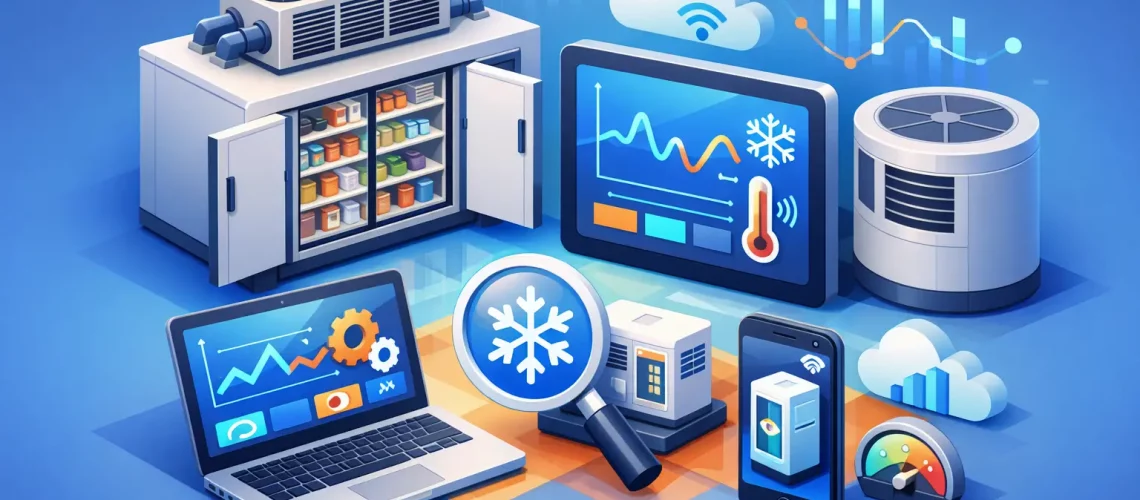

A walk-in cooler can appear normal at 7:00 a.m. and be hours away from a product-loss event. A compressor may still be running while suction pressure, defrost performance, or condenser conditions quietly move outside a healthy range. By the time a temperature alarm sounds, the underlying issue may have already been building for days.
That is where predictive refrigeration monitoring benefits become operationally significant. Rather than waiting for a high-temperature event or equipment failure, predictive monitoring identifies developing conditions early enough to investigate, correct, and document them. For facilities that depend on refrigeration, this changes maintenance from an emergency response function into a managed reliability strategy.
Predictive Refrigeration Monitoring Benefits Start With Earlier Warning
Traditional monitoring often answers one question: Is the box temperature currently too high? That information matters, but it is only one part of system health. A refrigeration system can hold temperature temporarily while components work harder than they should, cycling inefficiently or operating under conditions that increase the likelihood of failure.
Predictive monitoring evaluates operating patterns over time. It can bring attention to changes in temperatures, pressures, run times, defrost cycles, door activity, electrical behavior, and other application-specific signals. The objective is not simply to generate more alarms. It is to distinguish between a normal operating variation and a condition that requires action.
For example, a gradual rise in condenser temperature may point to airflow restrictions, coil fouling, fan issues, or an emerging control problem. A case that begins taking longer to recover after defrost may indicate a developing issue before product temperatures are affected. When operations teams receive that insight early, they can schedule service during normal hours instead of dispatching an emergency technician after a failure.
Better Alerts Reduce Alarm Fatigue
An alert that arrives too late does little to protect inventory. An alert that arrives constantly, without context, may be ignored. Both outcomes create risk.
A properly engineered monitoring strategy uses thresholds, operating history, and equipment context to focus attention on meaningful exceptions. The right people receive mobile or dashboard notifications based on the severity of the condition and the facility’s response plan. This helps maintenance teams prioritize work while giving operations leaders a clearer view of what is happening across their refrigeration assets.
The exact alert logic should be customized. A grocery store, pharmaceutical storage area, restaurant, and cold storage facility do not share the same temperature tolerances, equipment configurations, or response requirements. Monitoring is most effective when it reflects the operational reality of the site.
Protect Product Before Temperatures Reach Critical Limits
Inventory loss is often the most visible cost of refrigeration failure, but it is not the only one. A temperature excursion can lead to product disposal, interrupted service, compliance exposure, customer dissatisfaction, and labor-intensive recovery efforts. In medical, biotech, and pharmaceutical environments, the consequences can be even more serious because stored materials may be highly valuable or subject to strict handling requirements.
Predictive monitoring gives facilities time to intervene before a developing mechanical or control issue becomes a critical temperature event. That may mean cleaning a condenser coil, replacing a fan motor, correcting a defrost schedule, repairing a door seal, or dispatching a technician to an issue that would otherwise remain hidden.
This does not eliminate every failure. A sudden electrical outage, component failure, or refrigerant leak can still occur. The value is that teams are no longer limited to reacting after the product zone is already in danger. They have a better chance to protect inventory through early action, backup procedures, or product relocation.
Lower Energy Use Without Sacrificing Reliability
Refrigeration is one of the largest electrical loads in many commercial and institutional facilities. Systems consume more energy when they operate with dirty coils, poor airflow, excessive run times, incorrect setpoints, failed sensors, inefficient defrosting, or controls that no longer match the facility’s needs.
Monitoring makes those patterns visible. Instead of relying on monthly utility bills to reveal a problem after the fact, facility and energy managers can evaluate how equipment is operating and where performance has changed. A compressor that runs longer than its historical baseline or a defrost cycle that consumes more energy than expected deserves investigation, even if the refrigerated space is still maintaining temperature.
The energy savings opportunity depends on the age of the equipment, existing controls, maintenance condition, load profile, and utility rates. Monitoring alone is not a substitute for needed mechanical repairs or system upgrades. Its role is to provide the data required to make better decisions, validate corrective work, and sustain performance after improvements are made.
For multi-site operators, this visibility can be especially valuable. Comparable facilities can be reviewed side by side, helping teams identify which locations need attention first instead of allocating capital and service resources based only on the loudest complaint.
Improve Maintenance Planning and Equipment Life
Reactive refrigeration maintenance is expensive because it happens at the least convenient time. Emergency labor rates, rushed diagnostics, temporary product moves, and after-hours disruptions add cost well beyond the failed part itself. Repeated emergency events can also shorten equipment life by allowing small problems to become major mechanical stressors.
Predictive monitoring supports a more disciplined maintenance approach. When a trend suggests declining performance, a technician can arrive with a clearer starting point and a more focused scope of work. Maintenance directors can coordinate service around production schedules, delivery windows, staffing, and customer traffic rather than responding only when an alarm becomes urgent.
It also creates a useful record of equipment behavior. Over time, performance data can help answer practical questions: Is this rack becoming increasingly unstable? Did the recent repair restore normal operation? Is a recurring issue isolated to one location, one equipment model, or a broader control strategy? Those answers support stronger repair-versus-replace decisions.
Data Must Lead to Accountability
Monitoring has limited value if alerts are not acknowledged, investigated, and resolved. The technology should reinforce a clear operating process: who receives the notification, who evaluates the condition, when escalation occurs, and how corrective action is recorded.
That process is particularly important for organizations with distributed sites and limited on-site technical staff. A central dashboard can provide visibility, but local teams still need defined responsibilities. Facilities that pair monitoring with responsive service procedures gain more value than those that treat it as a passive data collection tool.
Gain Visibility Across Systems, Sites, and Stakeholders
Refrigeration performance can be difficult to manage when information is scattered among service invoices, handwritten logs, individual controllers, and utility statements. A connected monitoring platform brings critical operating information into one view, allowing stakeholders to see current conditions, alarms, trends, and maintenance priorities without waiting for a site visit.
For executives and procurement teams, that visibility supports more defensible investments. For operations leaders, it supports continuity and product protection. For maintenance teams, it reduces time spent searching for the source of a problem. Each group sees a different benefit, but all benefit from a clearer picture of system health.
Refrigeration Technologies, LLC applies this approach through engineered assessments, monitoring, controls, and ongoing optimization. A platform such as ArtikControl™ is most effective when it is part of a broader improvement plan that accounts for the equipment, facility conditions, operating requirements, and response capabilities of the customer.
Where Predictive Monitoring Delivers the Most Value
Predictive monitoring is particularly well suited to facilities where refrigeration downtime creates immediate operational or financial exposure. Grocery stores and food service operations need to protect perishable inventory and maintain customer-facing cases. Cold storage operators need stable conditions across large volumes of product. Medical, pharmaceutical, and biotech facilities may require documented temperature management and rapid response. Schools, government facilities, floral operations, and beer and wine storage environments also benefit when refrigeration performance is continuously visible.
The business case is different at every site. A single walk-in cooler may justify monitoring because the inventory is high-value or there is no overnight staff. A multi-location retailer may prioritize monitoring because centralized visibility reduces the burden on local teams and helps standardize maintenance decisions. The appropriate solution depends on risk, equipment condition, labor availability, energy goals, and the cost of disruption.
A useful first step is to evaluate the current system before selecting technology. Identify the equipment that creates the greatest exposure, review recurring service issues, determine what operating data is missing, and define how alerts will be handled. From there, monitoring can be designed around measurable outcomes rather than added as another disconnected facility tool.
The most valuable refrigeration issue is the one corrected while it is still small. When a facility can see performance drift early, assign responsibility quickly, and verify the result of corrective work, refrigeration becomes less of a recurring emergency and more of a controlled business system.