
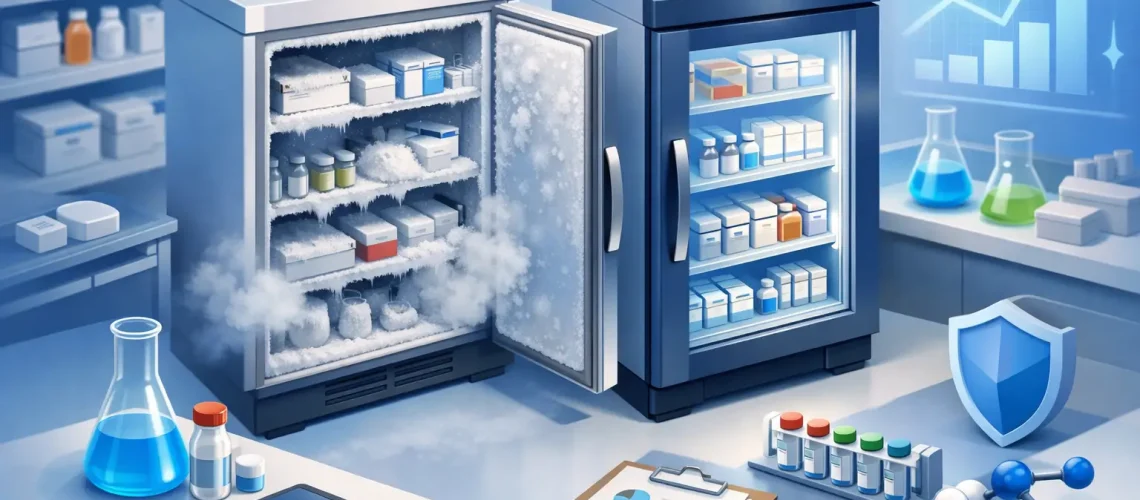

A pharmacy freezer can appear to be operating normally right up until a temperature excursion puts high-value inventory at risk. That is why pharmacy freezer retrofit outcomes should be measured by more than a lower utility bill. The right retrofit improves temperature control, exposes developing equipment problems, reduces avoidable service events, and gives facility teams documented confidence in how their freezers are performing.
For pharmacies, hospitals, clinics, laboratories, and other medication-dependent operations, refrigeration performance is a product-protection issue first. Energy savings matter, but they are most valuable when they come alongside stronger reliability and better operational visibility.
What a Pharmacy Freezer Retrofit Should Change
A retrofit is not simply a replacement project. It is a targeted improvement to the components, controls, airflow, monitoring, or operating sequence that limit a freezer’s performance. The scope depends on the equipment’s age, condition, temperature requirements, usage patterns, and the consequences of a failure.
In one facility, the priority may be replacing inefficient fan motors, worn door gaskets, or unreliable defrost controls. In another, the more meaningful improvement may be adding continuous temperature monitoring, alarm escalation, and intelligent controls to identify a failing compressor or condenser condition before the freezer drifts out of range.
The desired result is not a generic “newer” freezer system. It is a system that maintains the required temperature range with less strain, less wasted energy, and fewer surprises.
Stable temperatures under real operating conditions
A freezer that holds setpoint overnight but swings during busy receiving periods, frequent door openings, or defrost cycles is not delivering dependable performance. Retrofits can address conditions that cause unstable temperatures, including poor airflow, improper control settings, frost buildup, weak door seals, failing sensors, and inefficient refrigeration components.
Temperature stability protects inventory and reduces the time staff must spend responding to questionable readings. It also supports clearer operational documentation when inventory handling procedures or compliance reviews require evidence that storage conditions remained within specification.
Not every temperature event signals a mechanical failure. A door left ajar, warm product loaded too quickly, or a change in room conditions can create temporary stress. The value of a properly designed retrofit is that it helps distinguish normal operating variation from a condition that needs immediate attention.
Earlier warning of equipment problems
Reactive service is expensive because the most costly part of a refrigeration failure is rarely the repair invoice alone. It is the product exposure, emergency labor, disruption to pharmacy operations, and uncertainty about whether inventory can remain in use.
Monitoring and intelligent control upgrades can provide a clearer view of trends that often precede a failure. Rising run time, changing temperature recovery behavior, repeated alarms, abnormal defrost patterns, or a gradual loss of capacity can indicate that the system needs attention before it reaches a critical point.
With dashboard-based visibility and mobile alerts, facility teams can respond based on severity rather than discovering a problem during a manual check or after an overnight failure. Refrigeration Technologies, LLC applies this approach through engineered retrofit work and ArtikControl™ monitoring and control solutions tailored to the facility’s operational needs.
Pharmacy Freezer Retrofit Outcomes That Can Be Measured
The strongest retrofit projects begin with baseline conditions. Without a starting point, it is difficult to separate a true improvement from normal seasonal variation, a change in freezer usage, or a temporary utility-rate difference.
A pre-retrofit assessment should establish the freezer’s current temperature performance, alarm history, energy use where practical, service history, component condition, and daily operating profile. After improvements are made, the same indicators can show whether the project is producing meaningful results.
Fewer temperature excursions and faster recovery
A practical outcome is a reduction in the frequency, duration, and severity of temperature alarms. A freezer may still experience brief deviations after door openings or loading events, but it should recover predictably and within the appropriate timeframe for the stored products.
Teams should look beyond the total number of alarms. Repeated nuisance alarms can cause alert fatigue, while a small number of high-severity alarms may represent a larger operational risk. Proper alarm thresholds, escalation paths, and maintenance response procedures are as important as the sensor that generates the alert.
Lower energy use without sacrificing protection
Energy reduction can come from several sources: more efficient motors, improved controls, tighter cabinet seals, corrected defrost operation, cleaner heat rejection, and reduced compressor run time. The outcome should be evaluated in the context of weather, product loads, operating hours, and utility pricing.
A lower kWh reading is favorable only if the freezer continues to maintain required conditions. Cutting run time by allowing wider temperature swings is not an optimization. The goal is efficient operation that preserves the stable environment medications and temperature-sensitive materials require.
Less emergency maintenance and more planned work
When alarms and performance data reveal developing issues early, maintenance can be scheduled before a component failure becomes a product-loss event. This shifts work from emergency response toward planned service, which is usually easier to coordinate and less disruptive to pharmacy staff.
The trade-off is that monitoring generates information that someone must own. A facility needs clear responsibility for alarm review, escalation, service dispatch, and closure verification. A monitoring system without defined response procedures can record a problem without preventing its impact.
Longer useful equipment life
Older freezers do not always need full replacement. If the cabinet is structurally sound and the refrigeration system can be improved with targeted upgrades, a retrofit may extend useful life while improving reliability and efficiency.
However, there is a point where repeated repairs, obsolete components, poor cabinet insulation, or chronic capacity limitations make replacement the better business decision. An assessment should identify that threshold honestly. Retrofitting a fundamentally unsuitable system can delay capital spending, but it can also prolong risk.
Where Retrofit Results Depend on the Facility
Pharmacy environments vary widely. A community pharmacy storing a limited volume of temperature-sensitive inventory has different operating demands than a hospital central pharmacy, specialty pharmacy, research facility, or multi-site health system. The same applies to freezer types, storage temperatures, backup arrangements, and monitoring requirements.
A facility with reliable backup storage may prioritize energy efficiency and service visibility. A site with irreplaceable products, limited transfer capacity, or strict continuity requirements may place greater value on redundant monitoring, immediate alarm escalation, and faster response planning.
Door traffic also matters. A freezer in a high-volume dispensing area experiences a different load profile than one used for long-term storage. Improving a component without accounting for staff workflow may produce limited results. In some cases, operational changes such as loading practices, door discipline, and inventory organization are part of the performance solution.
Building Accountability Into the Retrofit
The most durable results come from treating the retrofit as the beginning of a performance-management process, not the final event. Installation quality matters, but ongoing verification determines whether the system continues to deliver the expected benefit months and years later.
Facility leaders should establish what acceptable performance looks like: the temperature range, alarm response time, reporting cadence, maintenance triggers, and roles responsible for action. These standards turn monitoring data into operational accountability.
It is also wise to document the condition of the freezer before work begins, the improvements installed, and the post-retrofit performance trend. That record helps maintenance teams troubleshoot future issues, supports capital planning, and gives procurement and operations stakeholders a clearer view of return on investment.
A pharmacy freezer retrofit is most valuable when it gives staff fewer urgent calls, facilities teams earlier answers, and leadership stronger evidence that critical inventory is protected. Start with the failure risks that matter most at your site, then design the improvements and monitoring around those risks.