
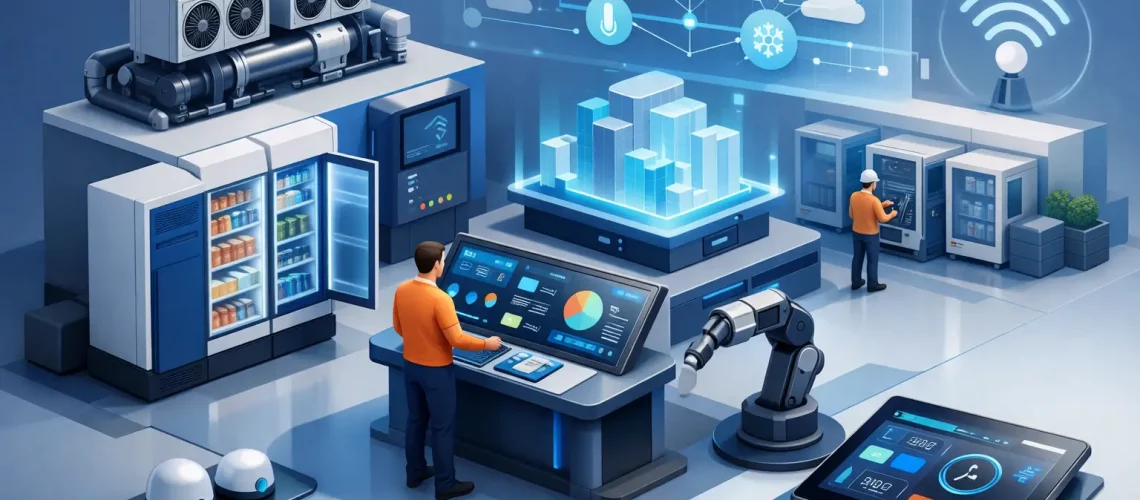

A walk-in cooler can appear to be operating normally right up to the moment product temperatures begin to climb. A compressor may be drawing excessive power for weeks before it fails. A defrost schedule can waste energy every day without triggering a service call. The future of refrigeration controls addresses these costly blind spots by moving facilities from reactive response to continuous, actionable system intelligence.
For commercial and institutional operators, this is not a discussion about adding technology for its own sake. It is about reducing utility expense, protecting perishable inventory, extending equipment life, and giving maintenance teams clearer priorities. The most valuable control strategies connect what is happening at the equipment level to decisions that improve operational performance.
The future of refrigeration controls is predictive
Traditional refrigeration controls were designed primarily to maintain a setpoint and protect equipment from immediate operating hazards. Those functions remain essential. A thermostat, pressure control, defrost timer, or compressor safety circuit still has a direct role in keeping a system stable.
What is changing is the control system’s ability to recognize performance drift before it becomes a failure. Instead of reporting only that a box is too warm, intelligent controls can identify a trend: rising run time, declining suction pressure stability, repeated high-temperature recoveries after defrost, or a compressor cycling pattern that points to an emerging problem. That distinction matters. An alarm at the point of failure creates urgency. Early detection creates options.
Predictive monitoring uses data from temperatures, pressures, run status, door activity, electrical load, and other relevant points to establish what normal operation looks like for a specific system. When performance deviates from that baseline, facilities can investigate while product is still protected and repair planning is still possible.
The result is a different maintenance model. Teams can direct service resources toward equipment showing real signs of deterioration rather than relying only on calendar-based visits or waiting for an alarm that arrives too late. In high-dependency environments such as grocery, cold storage, medical, pharmaceutical, and biotech facilities, that added warning time can prevent both product loss and business disruption.
Connected controls create visibility beyond the mechanical room
Refrigeration performance has historically been difficult to manage across multiple sites. A facility manager might know a store has received several refrigeration service calls, but not see the operating pattern behind those calls. An energy manager might see elevated utility use without knowing whether the cause is defrost, condenser performance, poor setpoints, or a failing component.
Connected controls close that information gap. They bring field-level data into a centralized dashboard where authorized operators can compare equipment, review alarms, evaluate trends, and confirm whether corrective actions worked. Mobile alerts allow the right people to respond quickly when conditions require attention, while historical data supports longer-term capital and maintenance decisions.
This visibility is particularly useful for organizations with distributed locations. A single-site operator may benefit most from immediate alarms and clearer diagnostics. A multi-site organization also needs consistency: common control standards, comparable performance data, and a way to identify locations that are consuming more energy or generating more service risk than similar facilities.
Connection alone is not the objective. Poorly configured alerts can overwhelm teams with notifications, causing important warnings to be ignored. The right approach is to prioritize alerts by operational impact, route them to accountable personnel, and define an escalation path when a condition is not resolved. A refrigeration control system should make a maintenance team more effective, not give it another screen to manage.
Better data must lead to better decisions
Data has value only when it is accurate, contextual, and tied to a response. A high-temperature reading may indicate an open door, a loading event, a defrost cycle, a failed fan, or a refrigeration capacity issue. Without system context, the same alert can produce unnecessary truck rolls or missed risk.
That is why engineered control design matters. Sensors must be placed correctly, points must be commissioned, and alarm limits must reflect the product, equipment, operating schedule, and facility conditions. A floral cooler, a beer storage room, and a medical refrigerator may all need precise temperature control, but their acceptable ranges, alarm priorities, and recovery expectations are not identical.
Energy optimization will become more dynamic
Energy savings remain one of the strongest business cases for modern refrigeration controls. Refrigeration is often among the largest electrical loads in a food retail, food service, cold storage, or institutional facility. Small inefficiencies that persist around the clock can create substantial annual utility costs.
The next generation of controls will increasingly adjust operation according to actual demand and system conditions rather than fixed schedules alone. Adaptive defrost is a clear example. Rather than initiating defrost strictly by time, a properly applied strategy can use indicators such as coil condition, run time, temperature behavior, or pressure trends to determine when defrost is needed. This can reduce unnecessary heat input and compressor work while helping maintain stable product temperatures.
Floating head pressure, suction optimization, variable-speed equipment coordination, anti-sweat heater control, and condenser fan management can also reduce energy use when they are applied as part of an integrated strategy. The potential savings depend on the equipment, climate, load profile, refrigerant, and existing control sequence. Not every facility should use the same settings simply because they worked elsewhere.
There are trade-offs to manage. Driving energy use down too aggressively can compromise temperature recovery, create humidity concerns, or place additional stress on equipment if control sequences are not carefully engineered. The best projects establish performance targets for both efficiency and reliability. Lower kilowatt-hours are meaningful only if product protection and equipment health are maintained.
Controls will support smarter service and capital planning
A major advantage of continuous refrigeration intelligence is that it improves the quality of decisions beyond the immediate repair. Facilities can see whether a recurring issue is isolated to one component, related to a control setting, or evidence that an entire system is approaching the end of its economic life.
For example, repeated compressor cycling, abnormal run hours, or poor pull-down performance may justify a deeper evaluation before another routine repair is authorized. Conversely, data may show that a system with an alarming service history is performing well after a targeted retrofit or control correction. That evidence helps operators avoid both premature replacement and the costly habit of repairing the same underlying problem repeatedly.
This approach also strengthens accountability. When an upgrade is installed, performance can be measured before and after implementation. When a maintenance procedure changes, the operating impact can be verified. When energy use rises, teams have a clearer starting point for investigation. Refrigeration Technologies, LLC applies this principle through engineered assessments, customized improvement plans, and ongoing monitoring designed around measurable facility outcomes.
The human role will become more valuable, not less
Automation will handle more routine adjustments and provide earlier warning of abnormal conditions, but it will not eliminate the need for experienced refrigeration professionals. Controls can identify patterns. Skilled technicians and engineers determine why they are occurring, evaluate risk, and select the right corrective action.
The strongest operating model combines intelligent control infrastructure with disciplined human response. Facility teams need clear ownership of alarms, service partners need access to useful diagnostic information, and leadership needs reporting that connects refrigeration performance to energy, inventory protection, and operating cost. Technology makes that coordination faster, but process and expertise make it effective.
Preparing a facility for advanced refrigeration controls
The right starting point is not necessarily a full system replacement. Many facilities can gain meaningful visibility and control by evaluating existing equipment, identifying critical failure points, and prioritizing the systems with the highest product risk, energy use, or service burden.
Begin with a practical assessment of current conditions. Review temperature history, service records, utility patterns, control sequences, alarm practices, and equipment age. Then ask where the facility lacks visibility. Is the greatest concern overnight temperature excursions, excessive defrost, recurring compressor failures, remote site oversight, or a lack of proof that energy upgrades are working?
From there, controls should be matched to the facility’s operating reality. A targeted retrofit may deliver a faster return than replacement. In other cases, obsolete controls or severely inefficient equipment may make a larger modernization project the more economical path. The answer depends on risk, condition, and the cost of continuing to operate without reliable data.
The future will favor refrigeration systems that do more than react to temperature. Facilities that invest in meaningful monitoring, properly engineered controls, and disciplined response processes will be better positioned to prevent failures before they happen and make every refrigeration dollar work harder.