
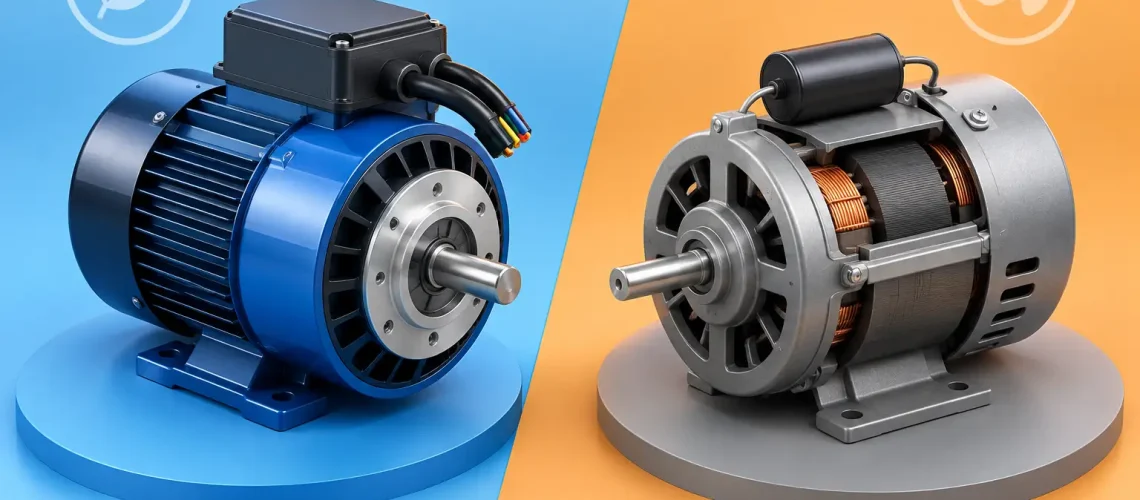

A walk-in cooler fan that runs every hour of every day can look like a minor load on an electric bill. Across a store, kitchen, warehouse, or multi-site portfolio, those small motors become a meaningful operating cost and a reliability consideration. The choice between EC motors vs shaded pole motors affects energy consumption, temperature control, maintenance exposure, and the value a facility receives from its refrigeration equipment.
For commercial refrigeration operators, the right answer is rarely based on motor purchase price alone. It depends on runtime, ambient conditions, fan application, existing controls, product sensitivity, and whether the facility can verify performance after an upgrade.
EC Motors vs Shaded Pole Motors: The Core Difference
Shaded pole motors are simple AC induction motors that have been common in low-horsepower refrigeration fan applications for decades. They are inexpensive, uncomplicated, and widely understood by service technicians. In many existing evaporators, unit coolers, display cases, and condensers, they are the original equipment.
Electronically commutated, or EC, motors use permanent magnets and onboard electronics to control motor operation. They generally require significantly less energy than shaded pole motors performing the same fan duty. They can also provide variable-speed capability, better efficiency at part load, and more precise response to control inputs.
That difference matters because refrigeration fans often run continuously. A modest wattage reduction multiplied by 8,760 annual operating hours, then multiplied across dozens or hundreds of motors, can create a material reduction in electrical consumption. Less motor heat released into refrigerated space can also reduce the refrigeration system’s cooling burden.
Why Shaded Pole Motors Still Exist
Shaded pole motors were not designed for the energy priorities commercial facilities face now, but they remain in service for understandable reasons. They have a low upfront cost, straightforward wiring, and a long history in basic fixed-speed fan applications. For a single low-runtime application with limited budget and no practical control requirement, replacing a failed shaded pole motor with a similar motor can be a reasonable short-term repair.
The trade-off is operating efficiency. Shaded pole motors are typically among the least efficient motor types used in refrigeration. They also run at a largely fixed speed, which means the fan continues consuming near-full power when a space needs less airflow. The motor itself can add heat to the refrigerated environment, increasing compressor runtime.
Their simplicity should not be confused with a lower total cost of ownership. In a continuously operating case or cooler, the energy cost over several years can outweigh the initial savings of a lower-cost motor. The economics become even more compelling where utility rates are high, equipment operates around the clock, or a facility has many fan motors performing the same duty.
Where EC Motors Create Operational Value
The most visible benefit of an EC motor retrofit is reduced fan energy use. Yet energy savings are only part of the case. EC motors can support a more controlled refrigeration environment when properly selected and commissioned.
Lower Energy Use Across Long Runtime Applications
Refrigerated display cases, walk-in coolers, walk-in freezers, reach-ins, and unit coolers frequently operate for long periods without interruption. That is where efficient fan motors have the greatest opportunity to pay back. A motor that draws fewer watts on every operating hour produces savings that are predictable and measurable.
Facilities should evaluate annual kilowatt-hour savings rather than relying only on a motor’s nameplate wattage. The relevant calculation includes actual fan runtime, local electric rates, the number of motors, and the refrigeration load avoided by reducing heat inside the conditioned space. A qualified assessment can identify applications where the return is strongest before capital is committed.
Better Control of Airflow and Temperature
Many EC motors can accept control signals or include programmable speed settings. This allows fan speed to be matched more closely to operating conditions. During low-load periods, a properly engineered control strategy may reduce airflow while maintaining acceptable product temperatures and coil performance.
That capability requires care. Airflow is essential for heat transfer, temperature uniformity, defrost performance, and compressor protection. Reducing fan speed without understanding the evaporator, coil condition, door activity, product load, and defrost schedule can create temperature problems rather than savings. The goal is not simply to run fans slower. The goal is to maintain product protection with the least necessary energy input.
Reduced Heat Load in Refrigerated Spaces
Every watt consumed by a motor operating inside a refrigerated box eventually becomes heat that the system must remove. EC motors typically release less heat than shaded pole motors, which can reduce compressor demand. In facilities with heavily loaded systems or marginal capacity, this secondary benefit can be operationally meaningful.
The exact effect varies by application. A freezer, for example, has a different load profile and energy value than a medium-temperature prep cooler. That is why motor selection should be part of a system-level evaluation rather than a stand-alone purchasing decision.
Reliability: Motor Choice Is Only One Part of the Equation
EC motors are sophisticated devices, and their electronic controls introduce considerations that shaded pole motors do not have. Power quality, moisture exposure, wiring practices, compatibility with fan blades, and installation location all matter. The correct motor must be rated for the operating environment and matched to the required airflow and static pressure.
A poor retrofit can underperform regardless of motor technology. An incorrectly selected fan blade can reduce airflow. A damaged coil, failed door gasket, improper defrost setting, or restricted condenser can erase expected savings and place additional stress on the system. In mission-critical refrigeration, the motor upgrade should be verified through temperature trends, run-time data, alarms, and post-installation performance checks.
This is where continuous monitoring has practical value. A platform such as ArtikControl™ can help facility teams see temperature exceptions, compressor behavior, and conditions that indicate a refrigeration issue before inventory is at risk. Monitoring does not replace maintenance, but it helps turn a motor retrofit into a measurable performance improvement rather than an assumption.
How to Decide Which Motor Fits the Application
The best decision begins with the application, not the motor catalog. Start by identifying where fans run continuously, where utility costs are highest, and where refrigeration failures would create the greatest product-loss exposure. Then evaluate the existing motor wattage, airflow requirements, fan condition, control capability, and expected annual runtime.
EC motors are often the stronger choice when the application has long operating hours, multiple similar fan motors, high energy costs, or a need for adjustable airflow. They are particularly well suited to facilities seeking portfolio-wide energy reductions without replacing entire refrigeration systems.
Shaded pole motors may still fit limited-duty or highly constrained replacement situations where the economics do not support an upgrade. They can also be appropriate when an older piece of equipment has compatibility limitations that make an EC conversion impractical. Even then, the decision should account for the energy cost expected over the remaining life of the equipment.
Procurement teams should avoid comparing only unit price. Compare installed cost, expected annual energy use, maintenance implications, refrigeration load impact, warranty, compatibility, and the ability to verify results. A slightly higher capital expense can be the lower-cost decision when it reduces energy use year after year.
A Retrofit Should Produce Measurable Results
Motor retrofits are often treated as small maintenance projects. In an energy-intensive refrigeration operation, they deserve more discipline than that. Establish a baseline before installation whenever possible. Record motor wattage, case or box temperatures, compressor runtime, defrost behavior, and relevant utility data. After the retrofit, confirm that airflow, temperatures, and system operation remain within target ranges.
This process also reveals issues that an efficient motor alone cannot solve. If temperatures remain unstable after a fan upgrade, the root cause may be refrigerant charge, coil cleanliness, door infiltration, controls, or equipment capacity. Finding that issue early is as valuable as the motor savings because it helps prevent unplanned downtime and product loss.
The best EC motor projects are selected for a reason, installed correctly, and monitored after startup. For facilities that depend on refrigeration, that approach turns a modest component change into a practical step toward lower operating costs and greater confidence in the equipment protecting their inventory.