
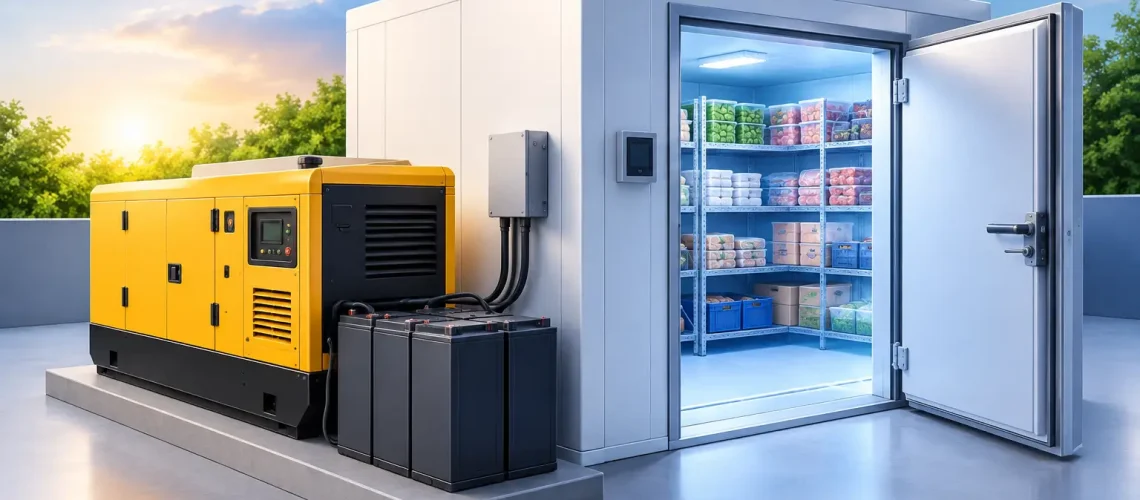

A power outage at a commercial freezer is not simply an inconvenience. It is a time-sensitive inventory, compliance, and equipment-risk event. The right commercial freezer power backup strategy gives facility teams time to protect product, maintain critical controls, and make informed decisions before a short outage becomes a major loss.
For grocery stores, foodservice operations, cold storage sites, laboratories, pharmacies, and institutional facilities, backup power should be designed around the actual refrigeration load and recovery requirements. A generator that starts eventually is not always enough. The system must support the right equipment, in the right sequence, while preserving visibility into what is happening inside the box.
Start With the Cost of a Power Failure
The financial impact of a refrigeration outage extends beyond spoiled product. A facility may face emergency labor, expedited product replacement, lost sales, cleanup, insurance documentation, and damage to customer confidence. In regulated environments, temperature excursions can also create reporting and disposal requirements that are far more expensive than the product itself.
There is also an equipment concern. When power returns, refrigeration systems can experience high inrush current as compressors, evaporator fans, condensers, defrost controls, and other connected loads attempt to restart. An undersized or poorly sequenced backup system may trip, cycle repeatedly, or leave the facility with partial cooling and no clear indication of what failed.
That is why power backup planning belongs in a refrigeration reliability program, not in a generic emergency-power checklist.
What a Commercial Freezer Power Backup Must Support
A freezer does not always need every connected component operating continuously during an outage. The best design depends on how long the outage may last, the thermal mass of the stored product, ambient conditions, door activity, and the facility’s operational priorities.
For a brief interruption, the immediate objective may be to keep doors closed, retain temperature data, and maintain alarms and communications. For a prolonged outage, the system may need to operate essential refrigeration equipment so the freezer can hold setpoint or recover before product reaches an unacceptable temperature.
Critical loads come first
Every facility should identify which loads must receive backup power and which can remain offline. Critical loads often include refrigeration controls, temperature monitoring, alarm dialers or cellular gateways, selected evaporator fans, condenser controls, and one or more compressor circuits. Lighting, office equipment, nonessential HVAC, and other discretionary loads may need to stay off until refrigeration stability is confirmed.
This load-prioritization approach can reduce generator size and fuel consumption while improving the odds that the equipment supporting product protection remains online. It also prevents a common failure mode: installing backup generation capacity based on a broad facility estimate without accounting for refrigeration startup demand.
Starting load matters as much as running load
Compressors can require substantially more current at startup than during normal operation. Defrost heaters, crankcase heaters, electric heat, and fan motors add complexity. If multiple compressors start together after utility power is lost or restored, the resulting demand can exceed generator capacity even if the calculated running load appears acceptable.
Engineered solutions address this through load analysis, compressor staging, time delays, soft-start technology where appropriate, and control logic that brings equipment online in a deliberate order. The goal is not merely to supply power. It is to keep the refrigeration system operating predictably under abnormal conditions.
Generator, UPS, Battery Storage, or a Combination?
There is no universal answer because each type of backup serves a different operational purpose.
A standby generator is typically the practical choice for long-duration refrigeration support. Properly sized, fueled, exercised, and maintained, it can carry essential freezer loads through extended utility failures. Its limitations are startup delay, fuel availability, maintenance requirements, and the need to manage electrical starting loads.
An uninterruptible power supply, or UPS, is generally not designed to run large compressor loads for extended periods. It is valuable for controls, monitoring devices, network equipment, alarm communications, and selected low-load electronics during the transition before a generator starts. That continuity matters because the first minutes of an outage are when teams need dependable alarms and temperature visibility.
Battery energy storage may be appropriate for facilities with demand-management goals, short-outage requirements, or a need to support critical controls without generator delay. However, the battery capacity required to operate freezer compressors for many hours can be significant. The economics depend on the load profile, local utility rates, outage history, available space, and the importance of continuous cooling.
For many sites, a combined approach works best: battery or UPS protection for controls and monitoring, plus generator support for designated refrigeration loads. The correct configuration should follow a site-specific assessment, not a one-size-fits-all equipment recommendation.
Protect Product With Monitoring Before, During, and After an Outage
Backup power without monitoring leaves decision-makers blind. A generator may be running while a freezer temperature is still rising because a compressor did not restart, a breaker tripped, a suction pressure condition developed, or a door was left open during recovery.
Continuous temperature and equipment monitoring provides the information needed to respond quickly. During an outage, facility teams need alerts that identify loss of power, generator operation, compressor status, freezer temperature trends, and alarm conditions. Remote visibility is particularly valuable for multi-site organizations and locations that are not staffed around the clock.
After power returns, monitoring is equally important. The recovery period can reveal issues that were not visible during normal operation, including high head pressure, delayed compressor staging, failed defrost scheduling, or unstable box temperatures. A dashboard-based platform such as ArtikControl™ can help teams track conditions, receive mobile alerts, and identify developing problems before they create a second failure event.
Temperature history supports better decisions
When product safety or quality is in question, a single current temperature reading does not tell the full story. Decision-makers need time-stamped trend data showing how fast the freezer warmed, how long it remained outside the preferred range, and how it recovered. That record supports product disposition decisions, internal documentation, and conversations with insurers, suppliers, or regulators.
Monitoring also improves future backup planning. If a site repeatedly sees rapid temperature rise during outages, the issue may be insufficient generator capacity, excessive door traffic, poor insulation, weak refrigeration performance, or a control sequence that needs adjustment.
Design for the Real Outage Scenario
A reliable plan considers more than a generator nameplate. Facilities should evaluate outage duration, weather exposure, fuel strategy, transfer-switch performance, staffing availability, and the electrical relationship between refrigeration equipment and other emergency loads.
A site in an area with frequent weather-related outages may require longer generator runtime and a formal fuel replenishment plan. A cold storage operation with high-value frozen inventory may need redundant generator capacity or a connection point for a rental generator. A restaurant may prioritize a smaller set of critical freezer circuits, while a pharmaceutical facility may require tighter documentation, alarms, and escalation procedures.
The building’s refrigeration architecture matters as well. A centralized rack system presents different backup challenges than several self-contained units. Facilities with electric defrost or large walk-in evaporator loads must account for how those functions will behave while on generator power. In some cases, temporarily disabling nonessential defrost cycles can preserve capacity, but only when the operating plan allows for it and controls are configured correctly.
Test the System Under Load
A backup system that has never been tested with refrigeration loads is an assumption, not a safeguard. Monthly generator exercise is useful, but no-load testing does not confirm that compressors can start, transfer switches operate correctly, controls retain settings, or monitoring alerts reach the right people.
A practical test should simulate the sequence the facility expects during an actual outage. Verify utility-loss detection, transfer timing, critical-load startup order, freezer temperature response, alarm delivery, and utility-restoration behavior. Review whether staff know who receives alerts, who can authorize product moves, and who contacts the refrigeration contractor if equipment does not recover as expected.
Testing should also include the less obvious components: fuel level sensors, battery chargers, generator block heaters, transfer-switch maintenance, cellular backup communications, and controller time delays. Small failures in these supporting systems can defeat an otherwise well-designed plan.
Make Backup Power Part of Refrigeration Optimization
The strongest commercial freezer power backup strategy combines electrical planning with refrigeration expertise. It accounts for compressor demand, control sequences, temperature risk, equipment condition, and real-time monitoring. It also recognizes that aging equipment may need corrective work before backup power can deliver the expected protection.
A free on-site assessment can reveal whether a facility’s current generator, controls, and monitoring infrastructure will support its most important loads during an outage. The right next step is to test the assumptions before the next utility failure tests them for you.