
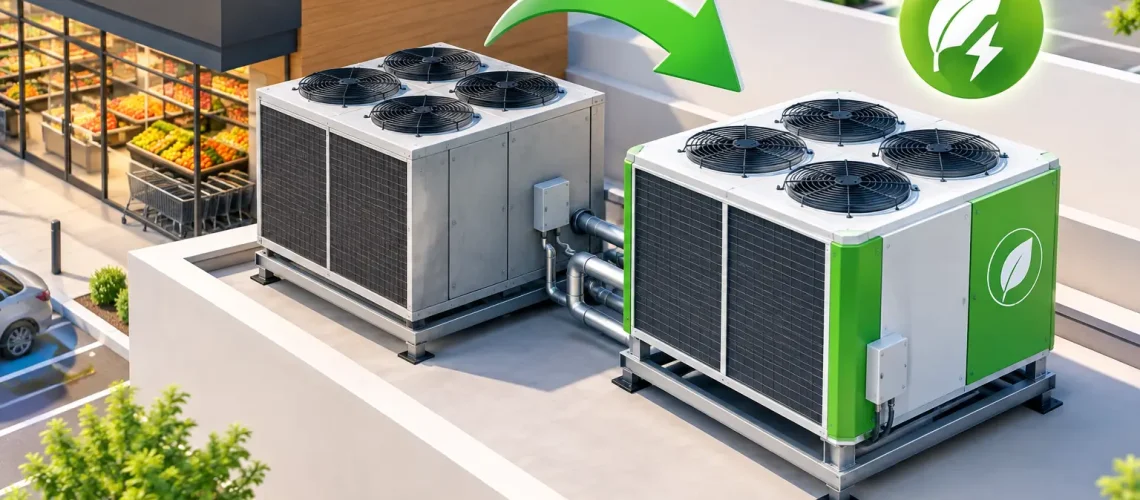

A condenser that runs harder than it needs to can quietly consume margin every hour a store is open. High head pressure, cycling fans, dirty coils, and limited visibility into operating conditions increase utility costs while putting compressors and refrigerated inventory at greater risk. Knowing how to retrofit supermarket condensers starts with treating the condenser as part of an operating system, not as an isolated piece of equipment.
A successful retrofit should lower condensing pressure when ambient conditions allow, improve heat rejection, reduce mechanical wear, and give facility teams early warning when performance begins to drift. The right scope depends on the rack design, refrigerant, store load profile, climate, equipment age, and existing controls. For many supermarkets, a targeted condenser retrofit delivers meaningful performance gains without the disruption and capital cost of a complete refrigeration replacement.
Start With a Field Assessment, Not a Product Selection
Condenser retrofits are often specified around a single issue, such as high energy bills or repeated fan failures. That approach can miss the actual cause. A fan upgrade will not solve a condenser that is undersized for a remodeled sales floor, has restricted airflow, operates with poor head-pressure control, or is paired with compressors already operating outside an efficient range.
Begin with a detailed assessment of the refrigeration rack, condenser condition, controls, electrical infrastructure, and operating history. Review suction and discharge trends, head pressure, compressor run time, fan staging, ambient conditions, refrigerant charge indicators, and alarm history. If data is not available, temporary monitoring should be installed before finalizing the retrofit design.
The assessment should also account for the store’s operational reality. A store in Phoenix faces different condenser controls and capacity considerations than a store in Minneapolis. Likewise, a rooftop air-cooled condenser serving a legacy HFC rack requires a different strategy than an evaporative system or a distributed refrigeration architecture. The goal is not to install the newest available component. It is to correct the specific performance limitations that are costing the store money or creating reliability exposure.
Identify What Is Driving Condenser Inefficiency
Most supermarket condenser problems fall into a small group of operational patterns. Fouled coils reduce heat transfer and force the system to operate at higher discharge pressures. Failed or poorly staged fan motors can leave available capacity unused, while constant-speed fans may consume full power even when the system needs only partial airflow.
Control settings are another frequent source of waste. Some systems maintain a fixed head-pressure target that is unnecessarily high during mild or cold weather. Others allow pressure to float but lack stable fan control, causing short cycling, excessive starts, or poor oil management. These conditions can increase compressor lift and energy use while shortening the life of contactors, motors, and compressor components.
Before specifying upgrades, verify that basic maintenance issues are addressed. Coil cleaning, fan blade condition, guards, electrical connections, refrigerant charge, receiver performance, and airflow clearance should all be inspected. Retrofitting controls onto a mechanically compromised condenser may conceal an issue temporarily, but it will not create reliable long-term performance.
How to Retrofit Supermarket Condensers for Better Control
For many air-cooled supermarket condensers, the highest-value retrofit combines electronically commutated motors or variable-speed fan control with intelligent head-pressure management. Instead of cycling all fans at full speed, the system can match condenser airflow to actual heat-rejection demand.
Variable-speed fan control can reduce fan energy during cooler periods, minimize abrupt starts, and maintain steadier operating pressure. The savings depend on climate, operating schedule, condenser size, and baseline fan strategy. A store with long periods of cool ambient weather may see substantial benefit from optimized floating head-pressure control. A high-ambient location may realize more value through improved capacity, reliability, and peak-demand management.
The control sequence must be engineered around the entire rack. Excessively aggressive pressure reduction can create operational issues if the system does not maintain adequate liquid pressure, oil return, or expansion valve performance. Conversely, overly conservative setpoints leave energy savings on the table. The correct sequence manages minimum safe operating conditions while allowing head pressure to float whenever the system can support it.
A modern controller should monitor discharge pressure, ambient temperature, fan status, sensor health, and alarm conditions. It should also provide configurable safeties, manual override capability, and remote visibility for maintenance teams. Refrigeration Technologies, LLC applies this approach through engineered controls and ArtikControl™ monitoring to help operators move from reactive service calls to measurable, condition-based decisions.
Upgrade Fan Motors and Electrical Components With the Control Strategy
Fan motor replacement is not simply a like-for-like procurement decision. Permanent split capacitor motors, electronically commutated motors, and variable-frequency-drive applications each have different performance characteristics, electrical requirements, and service considerations.
EC motors can be an effective option for retrofit projects because they offer speed control and strong part-load efficiency without requiring a separate drive for each motor. They may also reduce maintenance associated with traditional fan cycling and mechanical control methods. However, compatibility matters. The motor, blade, control signal, enclosure rating, and mounting arrangement must be selected for the condenser and outdoor environment.
For older condensers, inspect contactors, relays, fuses, disconnects, wiring, and control transformers as part of the project. A new motor or controller connected to degraded electrical components can create nuisance failures that undermine the retrofit’s value. Where fan staging is retained, verify that the sequence distributes run time across motors when practical. Balanced operating hours can prevent one fan from becoming the recurring failure point.
Add Monitoring That Finds Drift Before It Becomes a Failure
A retrofit is most valuable when its performance can be verified and sustained. Without monitoring, a failed fan, inaccurate sensor, dirty coil, or control override may go unnoticed until head pressure rises and the rack begins alarming.
Continuous monitoring gives operators a way to identify changing conditions early. Rather than reacting only to a high-pressure alarm, teams can investigate a gradual increase in condensing pressure at comparable ambient temperatures. That trend may indicate coil fouling, declining fan performance, a sensor issue, or a capacity problem developing before product temperatures are affected.
The most useful dashboard data is actionable, not excessive. Facility teams need clear visibility into condenser pressure, ambient temperature, fan command and proof of operation, alarm events, and operating trends. Mobile alerts should be prioritized so that urgent equipment conditions receive immediate attention, while lower-priority maintenance issues can be planned and resolved during normal service windows.
Commission the Retrofit Under Real Operating Conditions
Installation is only the midpoint of the project. Commissioning confirms that the retrofit performs as designed across varying loads and outdoor temperatures. It should include verification of sensor calibration, fan rotation, motor current, staging or speed response, control setpoints, safeties, and communications.
A practical commissioning process also establishes a baseline. Record operating pressures, temperature differences, fan power, compressor run characteristics, and relevant utility data before and after the upgrade. This helps quantify savings and provides a reference point for future troubleshooting.
After commissioning, review the system during different weather conditions. A sequence that appears stable on a mild day may need adjustment during low-ambient operation, high heat, or heavy store load. This is where remote monitoring and experienced refrigeration support protect the investment. The system can be tuned based on actual performance rather than assumptions made at startup.
Evaluate Retrofit Economics Beyond Fan Energy
Energy savings are a central reason to retrofit supermarket condensers, but they are not the only return. Lower condensing pressure can reduce compressor work. Stable fan operation can reduce electrical and mechanical stress. Earlier detection of poor heat rejection can prevent a high-pressure event that threatens cases, walk-ins, and product inventory.
When evaluating project economics, consider utility savings, avoided emergency repairs, potential demand reduction, equipment-life extension, and reduced risk of product loss. In some cases, a targeted retrofit is the right answer for a condenser with years of useful mechanical life. In other cases, repeated leaks, extensive coil deterioration, insufficient capacity, or obsolete equipment may justify replacement instead. A field assessment should make that distinction clear before capital is committed.
The best condenser retrofit is one that gives a supermarket more control over energy use and fewer surprises on the roof. When equipment condition, controls, monitoring, and commissioning are addressed together, the result is not just a lower utility bill. It is a refrigeration system that is easier to manage, more predictable to maintain, and better prepared to protect the inventory your operation depends on.