
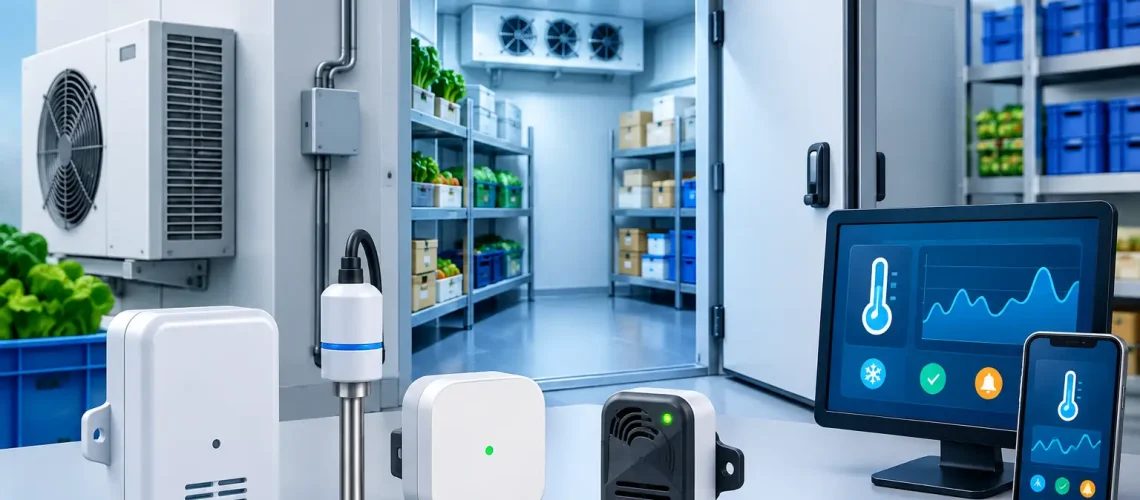

A cold room can remain within range at the evaporator while product at the back wall, near the door, or on a high rack is already at risk. That gap between what the refrigeration system is doing and what the stored product experiences is why the best cold room sensors are selected as part of a monitoring strategy, not as a stand-alone purchase.
For a grocery operation, food processor, pharmaceutical facility, restaurant group, or cold storage warehouse, a sensor is an early-warning device. It provides the evidence needed to identify temperature drift, door-related heat gain, defrost issues, power loss, and equipment performance problems before they become a product-loss event. The right selection depends on the room, the inventory, the risk tolerance, and the facility team’s ability to act on an alert.
What Makes a Cold Room Sensor Worth Installing?
A sensor’s value is not limited to measuring temperature accurately. Commercial facilities need measurement they can trust, records they can retrieve, and alarms that reach the right person before conditions become critical.
Accuracy matters, particularly in medical, pharmaceutical, biotech, and high-value food applications. But accuracy alone does not protect inventory. A highly accurate sensor that reports once per day or sends an alert to an unattended inbox will not prevent a loss overnight. The practical standard is accurate measurement combined with dependable communications, documented calibration, useful alarm logic, and ongoing visibility.
The installation environment also matters. Cold rooms expose devices to moisture, condensation, washdown practices, forklift traffic, door openings, and rapid temperature changes. A sensor package should be chosen for those conditions, including the probe type, enclosure rating, cable routing, battery strategy, and communications path.
The Best Cold Room Sensors Match the Risk
There is no single best sensor for every cold room. A small walk-in cooler holding produce has different requirements than a distribution center freezer, a blood product refrigerator, or a multi-site grocery operation. In most facilities, the strongest solution combines several sensor types rather than relying on one ambient temperature point.
Ambient air temperature sensors
Ambient temperature sensors are the foundation of cold room monitoring. They track air temperature within the storage area and establish the record used for operations, quality assurance, and compliance. For many rooms, more than one sensor is justified.
A single sensor mounted beside an evaporator, supply-air stream, or open doorway can create a misleading picture. One sensor may indicate normal conditions while another location reveals warm zones caused by poor circulation, overloaded shelving, blocked airflow, or frequent traffic. Sensor placement should reflect where product is most vulnerable, not simply where installation is easiest.
For freezer applications, confirm that the sensor and transmitter are rated for sustained low temperatures. Battery performance, cable insulation, display readability, and condensation management all require more attention below freezing.
Product temperature probes
Air temperature changes quickly. Product temperature changes more slowly, which can be an advantage during brief door openings but a serious concern during an extended refrigeration failure. Product probes provide a clearer view of the actual condition of high-value inventory.
They are especially useful when inventory has a narrow acceptable range or when a facility needs to distinguish between a short air-temperature excursion and a true product-risk event. A buffered probe, often using glycol or a similar thermal buffer, can approximate product response and reduce nuisance alarms from brief operational activity.
The trade-off is response time. A buffered or product probe should not be the only measurement in the room because it may not react quickly enough to identify a sudden system failure. Pairing it with ambient air monitoring gives operators both fast detection and a more meaningful view of stored product conditions.
Door position sensors
Door sensors are among the most practical additions to cold room monitoring. They show whether a door is open, how long it remains open, and whether recurring door activity is contributing to temperature swings or compressor load.
For operations with frequent picking, receiving, or staging activity, door data can separate an equipment issue from an operational one. It can also expose a door that was left ajar after a shift change, a damaged gasket, or a door closer that is no longer performing correctly. This information supports energy management as well as product protection.
Humidity and moisture sensors
Humidity monitoring is not required in every cold room, but it can be valuable where moisture affects product quality, packaging, frost buildup, or mold risk. Floral storage, produce rooms, cheese aging environments, and certain medical or laboratory applications may benefit from humidity visibility.
In freezer rooms, moisture and frost indicators can provide early evidence of infiltration, door seal issues, or defrost problems. The goal is not to collect more data for its own sake. It is to identify the conditions that create operating cost, maintenance burden, or inventory risk.
Power and equipment-status sensors
Temperature alarms tell you a room is warming. Equipment-status monitoring can help explain why. Monitoring power availability, compressor operation, defrost activity, condenser conditions, suction pressure, or controller status can shorten the time between alarm and corrective action.
This is where a facility moves from simple temperature logging toward predictive refrigeration monitoring. A rising temperature alert is useful. An alert that identifies a failed condenser fan, abnormal runtime, missed defrost cycle, or power interruption gives maintenance teams a stronger starting point and can reduce diagnostic time.
Sensor Features That Affect Real-World Performance
When evaluating cold room sensors, focus on the full monitoring chain: sensing, transmission, alarming, documentation, and response. A low-cost device can become expensive if it creates false alarms, loses data during an outage, or requires staff to manually retrieve readings from multiple locations.
Look for a system with appropriate temperature range and accuracy for the application, documented calibration options, and clear data retention practices. Determine whether the device communicates through Wi-Fi, cellular, wired network, Bluetooth, or a dedicated gateway. Each option has a place, but the building’s construction and cold room location can affect signal reliability. Metal panels, insulated doors, concrete structures, and equipment rooms often complicate wireless communications.
Alarm design deserves equal attention. Effective systems allow high and low limits, delay periods, escalation rules, and notifications by text, email, mobile application, or other approved channels. Delays prevent unnecessary alarms during normal door activity or defrost cycles. They should be configured carefully, however. A delay that is too long can turn a manageable event into a costly loss.
For multi-site organizations, centralized dashboard visibility is often more valuable than individual local displays. Operators need to see which locations are in alarm, who acknowledged the notification, and whether temperatures returned to normal. Maintenance leaders need trend data that identifies repeat failures and rooms with excessive equipment runtime.
Placement Is as Important as Sensor Selection
Even premium sensors can provide poor information when installed in the wrong locations. Avoid placing the only sensor directly in discharge air, immediately next to an evaporator coil, or in a spot shielded from the room’s true air movement. Those locations may measure the refrigeration equipment’s influence rather than the storage condition.
A site assessment should consider room size, shelving layout, product density, door locations, evaporator placement, workflow, and known hot or cold spots. Larger rooms may require sensors at multiple elevations and zones. A room with high racks can stratify, with warmer conditions near the ceiling and different temperatures deep within stored product.
For critical inventory, place a sensor where the greatest consequence exists. That may be the farthest point from the evaporator, the area nearest the loading door, or the location with the slowest air circulation. Historical data should guide future adjustments. If one zone repeatedly trends warmer, that is an operational finding worth addressing, not merely a sensor anomaly.
Avoid the Cheapest-Device Trap
The least expensive sensor may be acceptable for a low-risk application with manual checks and limited inventory exposure. It is rarely the best answer for a facility that cannot afford a missed alarm, weak documentation, or uncertain communications.
The real cost of cold room monitoring includes installation, calibration, connectivity, battery replacement, software access, alarm management, and the time required to respond. It should be weighed against the cost of product loss, emergency service, compliance exposure, wasted energy, and operational disruption.
A properly engineered system can also reveal opportunities beyond alarm response. Persistent warm trends may point to failing door seals or insufficient airflow. Excessive compressor runtime may identify controls that need adjustment. Repeated defrost-related excursions may signal a configuration problem. Those findings support measurable improvements in energy use and equipment life.
Build Monitoring Into the Refrigeration Strategy
Cold room sensors perform best when they are connected to a clear response plan. Define who receives each alarm, who is responsible after hours, how escalation occurs, and what actions are expected for a power outage, door alarm, or temperature excursion. Test those procedures before an emergency tests them for you.
For facilities with multiple rooms or sites, an engineered monitoring and control platform can provide the context that isolated sensors cannot. Refrigeration Technologies, LLC uses monitoring and intelligent control approaches to help facilities identify developing issues, protect inventory, and improve refrigeration performance over time.
The most useful sensor is the one that gives your team enough warning to act with confidence. Start with the inventory you must protect, the failure modes that create the greatest exposure, and the operational decisions your team needs to make. From there, the right sensor strategy becomes a practical investment in uptime, product integrity, and lower operating cost.