
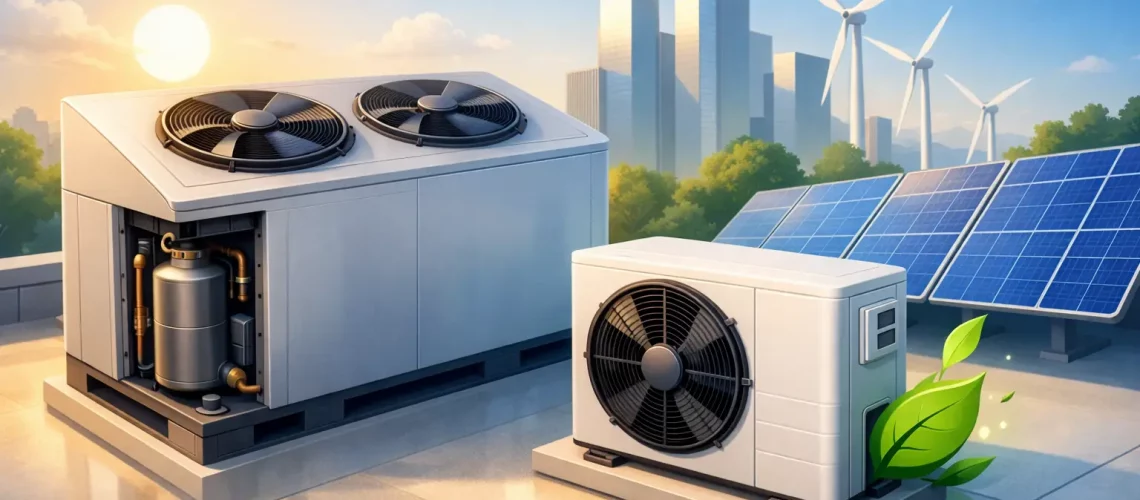

A condensing unit can look like a straightforward equipment purchase until it becomes the source of rising utility bills, temperature alarms, compressor failures, and product-risk events. Energy efficient condensing units address more than electrical consumption. When selected, installed, and controlled correctly, they reduce refrigeration load, stabilize operation, and give facility teams a stronger foundation for protecting inventory.
For grocery stores, cold storage operations, food service facilities, medical environments, and other refrigeration-dependent sites, the question is not simply whether a new condensing unit has a higher efficiency rating. The question is whether the complete system will perform reliably under the facility’s actual load, ambient conditions, operating schedule, refrigerant requirements, and maintenance realities.
Why Condensing Unit Efficiency Has a Bigger Impact
The condensing unit carries a significant share of a refrigeration system’s energy demand. It rejects heat from the refrigerated space, and its compressor, condenser fan motors, controls, and related components must respond to changing conditions throughout the day. A unit that runs longer than necessary, operates at excessive head pressure, or short-cycles under light load consumes more energy while placing added stress on the compressor.
Efficiency improvements therefore create value in several ways. Lower electrical use can reduce operating expense. Better capacity control can help maintain tighter temperatures. Reduced compressor run time can limit wear and extend useful equipment life. Those outcomes matter most when a site has multiple cases, walk-ins, coolers, freezers, or process loads operating around the clock.
The savings potential varies. A small restaurant walk-in and a multi-site grocery portfolio do not have the same load profile or return threshold. Yet in both cases, the cost of inefficient condensing equipment should be evaluated alongside the cost of emergency repairs, spoiled inventory, labor disruption, and lost customer confidence.
What Makes Energy Efficient Condensing Units Different?
High-efficiency performance is not tied to one component alone. It comes from how the unit matches capacity to demand and how well it rejects heat under changing outdoor conditions.
Variable-speed compressors are one important option. Rather than cycling fully on and off to meet a changing load, a variable-speed compressor can adjust output more gradually. That can reduce cycling losses and improve temperature stability, particularly where refrigeration demand changes substantially by time of day or season. The trade-off is higher first cost and a greater need for proper controls, commissioning, and technician support.
Electronically commutated condenser fan motors can also reduce energy use by modulating fan speed instead of running at full output whenever the unit is enabled. Floating head pressure controls take the same principle further by allowing the system to operate at a lower condensing pressure when ambient conditions permit. In cool weather, this can significantly reduce compressor lift and energy use. However, controls must still maintain adequate pressure for expansion valves, defrost functions, and stable system operation.
Other efficiency factors include coil design, compressor technology, refrigerant selection, receiver sizing, crankcase management, and the quality of piping installation. A premium unit installed with poor line sizing, restricted airflow, improper charge, or weak controls will not deliver its expected performance.
Part-Load Performance Matters
Commercial refrigeration systems rarely operate at their design peak every hour of the year. A condensing unit may be selected for the hottest expected day and the highest expected load, then spend most of its life operating below that condition. This is why part-load efficiency deserves as much attention as nameplate capacity.
A properly designed system should avoid excessive on-off cycling during lower-load periods. It should also manage head pressure and fan operation efficiently as outdoor temperatures fall. Facilities that only compare full-load ratings can overlook a large portion of their annual energy opportunity.
Reliable Controls Are Part of the Equipment Decision
Controls determine how efficiently mechanical components work together. A thermostat or controller that causes unnecessary compressor starts, permits temperature swings, or misses a failing fan motor can erase much of the benefit of an equipment upgrade.
Intelligent monitoring adds operational visibility. It can identify elevated head pressure, unusually long run time, repeated high-temperature events, door-related load issues, and other early indicators that deserve attention. Refrigeration Technologies, LLC applies this approach through engineered upgrades and ArtikControl™ monitoring and control solutions that help teams act before an efficiency issue becomes a product-loss event.
Start With the Refrigeration Load, Not the Catalog
The correct condensing unit starts with a site assessment. Facility teams should understand the load the equipment must support, including box temperature, product pull-down needs, door openings, lighting and evaporator loads, defrost schedule, heat-producing equipment nearby, and local design ambient conditions.
Oversizing is a common and costly mistake. An oversized unit may pull temperature down quickly, but it can short-cycle during normal operation. Short cycling wastes energy, creates temperature variation, and can reduce compressor life. Undersizing creates a different problem: long run times, poor recovery, high operating pressures, and an inability to hold setpoint during peak demand.
The right answer may be a single high-efficiency unit, a staged arrangement, a variable-capacity system, or a larger system redesign. It depends on the facility’s load variability, redundancy requirements, available electrical capacity, refrigerant transition plan, and tolerance for downtime during installation.
A useful assessment should also examine the evaporator side of the system. Dirty coils, failed fan motors, iced evaporators, poor airflow, and inadequate defrost can force the condensing unit to work harder. Replacing the outdoor unit without resolving those issues can produce disappointing savings.
Installation Details Determine Real-World Savings
Energy performance is won or lost during installation and startup. Condenser placement must allow sufficient airflow and avoid recirculating hot discharge air. Units located near exhaust outlets, heat sources, or enclosed service areas often operate at higher head pressure than expected. That increases compressor energy use and can shorten component life.
Line sets need correct sizing, routing, insulation, support, and oil management. Improper piping can create pressure drop, capacity loss, oil return problems, and compressor damage. Electrical connections, disconnects, control wiring, and sensor placement deserve equal attention. A sensor mounted in the wrong location can produce false readings and poor control decisions.
Commissioning should verify refrigerant charge, superheat, subcooling, suction pressure, head pressure, compressor amp draw, fan operation, defrost performance, and temperature recovery. These readings create a baseline for future maintenance and help prove that the new equipment is operating as designed.
Measure Performance After the Upgrade
A condensing unit replacement should not disappear from view after startup. The most useful projects establish operating benchmarks before and after the work. Track energy consumption where metering is available, but also review runtime, temperature compliance, alarm frequency, maintenance calls, and product-loss incidents.
Continuous monitoring is particularly valuable for multi-site operators and facilities with limited on-site refrigeration expertise. A dashboard and mobile alerts can show whether a unit is trending toward failure or simply operating outside its expected range. For example, a gradual increase in condensing pressure may point to coil fouling, airflow restrictions, fan issues, or refrigerant concerns before the system trips on a hot afternoon.
This approach changes maintenance from a calendar-driven task to a performance-driven process. Not every deviation requires immediate replacement, but every persistent deviation deserves investigation. Small corrections such as coil cleaning, control adjustment, door repair, or fan replacement can protect the efficiency gains of a larger capital investment.
Build the Business Case Around Total Cost of Ownership
Purchase price is easy to compare, but it is rarely the most meaningful number. Decision-makers should consider installed cost, projected annual energy use, expected maintenance needs, equipment life, refrigerant strategy, control compatibility, and the financial exposure associated with a refrigeration failure.
A lower-cost unit may make sense for a low-use application with limited runtime and a short ownership horizon. In a mission-critical cooler, freezer, warehouse, or medical storage environment, the stronger business case often favors equipment and controls that reduce both energy use and failure risk. The avoided cost of one inventory-loss event can outweigh a modest difference in initial equipment price.
Ask for assumptions behind projected savings. Local utility rates, runtime estimates, ambient conditions, system load, and baseline equipment condition all affect payback. Clear assumptions create a more credible capital plan and make post-installation results easier to verify.
The best next step is to evaluate the system while it is still operating, not after a compressor fails on a high-load day. A focused assessment of equipment condition, operating data, controls, and load requirements can identify where efficiency gains are available and where reliability needs immediate attention.