

A refrigeration failure rarely begins as a dramatic event. It often starts with a drifting suction pressure, an overlooked alarm, a compressor running longer than normal, or a case temperature that is still technically acceptable. That is why the choice between centralized versus distributed refrigeration is more than an equipment decision. It directly affects energy exposure, maintenance response, product risk, and visibility into system performance.
For grocery stores, cold storage facilities, food service operations, laboratories, and other refrigeration-dependent sites, there is no universal winner. The right architecture depends on the facility’s load profile, layout, criticality of stored product, available mechanical space, maintenance resources, and long-term operating objectives.
What separates centralized and distributed refrigeration?
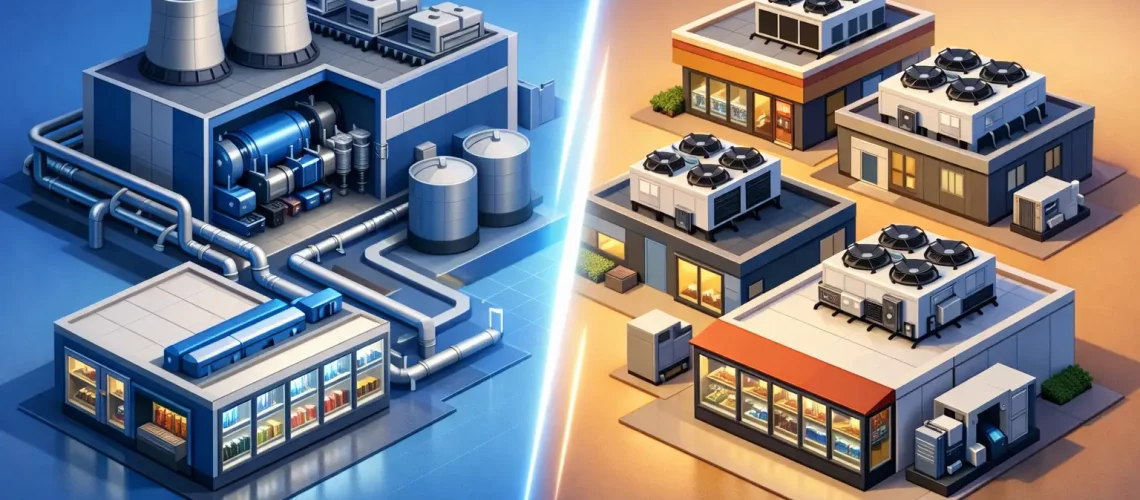
A centralized system consolidates refrigeration capacity in one primary location, typically a machine room or rooftop equipment area. Multiple compressors operate as a rack to serve refrigerated cases, walk-ins, freezers, or process loads throughout the facility. Refrigerant is distributed through piping runs to each connected load.
A distributed system divides capacity among several smaller refrigeration systems located closer to the loads they serve. These systems may support a specific department, group of cases, walk-in, or zone. Rather than relying on one large rack, the facility operates multiple independent circuits or packaged units.
The distinction matters because it changes where risk is concentrated. Centralized systems concentrate equipment, controls, and maintenance activity. Distributed systems spread those elements across the building. Neither approach eliminates risk. Each manages it differently.
Centralized versus distributed refrigeration: operational trade-offs
Centralized refrigeration is often attractive in larger facilities with substantial, relatively consistent refrigeration demand. A well-designed rack can stage compressors efficiently, match capacity to changing load, and make maintenance more accessible because core equipment is located in one place. For a busy supermarket or cold storage operation, that concentration can simplify service planning and reduce the number of equipment locations technicians must inspect.
It can also support sophisticated control strategies. Variable-speed compressors, floating head pressure, optimized suction setpoints, condenser fan control, demand-based defrost, and coordinated alarm management can be applied at the system level. When properly commissioned and monitored, these measures can reduce unnecessary runtime and provide a clearer picture of total refrigeration performance.
The trade-off is that a central rack represents a concentrated point of failure. A single component failure does not always take down an entire system, especially when redundancy is built into the design, but the potential consequence is broader. A control issue, refrigerant loss, electrical problem, or compressor failure can affect multiple cases or rooms if the system is not configured with appropriate safeguards.
Distributed refrigeration limits the scope of many failures. If one condensing unit serving a walk-in fails, other independent loads may continue operating normally. This can be valuable where product is separated by department, temperature requirement, tenant space, or process function. It is also useful for additions and remodels when extending a central system would require extensive piping, downtime, or rack capacity upgrades.
However, distributed systems create more assets to maintain. Multiple condensing units, controls, condensers, and refrigerant circuits mean more inspection points, more potential alarms, and more opportunities for performance drift to go unnoticed. Without centralized monitoring, a facility team may not know which unit is short cycling, running with elevated head pressure, or approaching a temperature failure until a local problem becomes an operational emergency.
Energy performance depends on design and control
It is tempting to assume that one architecture is always more energy efficient. In practice, energy performance depends on equipment selection, piping design, load diversity, control logic, maintenance quality, and how closely the system tracks actual demand.
Centralized racks can benefit from load diversity. Not every case, cooler, freezer, or process load peaks at the same time. A rack serving multiple loads can use that diversity to operate fewer compressors or vary capacity instead of forcing each individual unit to operate independently. A well-designed central system may also provide better opportunities for heat reclaim, coordinated defrost scheduling, and advanced energy optimization.
But central systems are not automatically efficient. Long refrigerant lines can introduce pressure drop, inadequate piping can impair oil return, and poor setpoint management can waste energy across the entire rack. A system that runs at unnecessarily high condensing pressure or maintains lower-than-required suction temperatures can add significant utility cost while accelerating wear.
Distributed equipment can be efficient when loads are small, remote, intermittent, or have specialized temperature needs. Locating refrigeration capacity closer to the load can reduce piping complexity and make incremental expansion easier. High-efficiency packaged equipment and modern electronic controls can perform well when they are correctly sized and maintained.
The energy challenge with distributed equipment is fragmentation. A facility may have dozens of units with independent schedules, setpoints, defrost controls, and maintenance histories. One poorly performing unit may not materially change the total utility bill, but a portfolio of neglected units can create substantial hidden waste.
Reliability is designed, monitored, and maintained
The best system architecture on paper can underperform without active performance management. Reliability starts with proper load calculations, equipment sizing, component selection, installation quality, and commissioning. It is sustained through monitoring, preventive maintenance, alarm response, and data-driven adjustment.
For centralized systems, redundancy should be evaluated at the compressor, control, electrical, and refrigeration circuit levels. A facility should understand what happens if a compressor fails, a sensor provides inaccurate data, a controller loses communication, or a power event affects the machine room. Critical loads may require backup capacity, isolation valves, emergency procedures, or alternate product storage plans.
For distributed systems, reliability planning should focus on asset consistency and response speed. Are similar units using standardized components? Can technicians access them safely? Is there a clear inventory of equipment, refrigerant type, alarm settings, and service history? If a unit fails after hours, will the facility receive a meaningful alert before product temperature reaches a critical threshold?
Continuous monitoring changes the conversation from reactive repair to early intervention. Tracking temperature, pressure, compressor runtime, defrost behavior, door activity, and alarm conditions helps identify abnormal operation before it becomes a shutdown or product-loss event. Refrigeration Technologies, LLC applies this approach through engineered system improvements and ArtikControl™ monitoring and control solutions designed to give facility teams actionable visibility.
Refrigerant strategy can influence the decision
Refrigerant regulations, leak management, safety requirements, and future serviceability should be part of the architecture decision. Centralized systems may contain a larger total refrigerant charge, making leak detection, recordkeeping, and system integrity especially important. They can also be designed around lower-charge or alternative refrigerant strategies, depending on the application and local requirements.
Distributed systems can reduce the charge per circuit, but they may increase the number of circuits that must be maintained. That can make leak detection and refrigerant inventory management more complex across a large site or multi-site portfolio. The most practical path is usually the one that aligns refrigerant choice, technician capability, safety procedures, and the facility’s replacement timeline.
How to choose the right refrigeration architecture
Start with the consequence of failure, not the purchase price. A grocery store with hundreds of refrigerated cases, a cold storage warehouse with high-value inventory, and a biotech facility with temperature-sensitive materials face very different exposure. Calculate the operational cost of a failure, including product loss, labor disruption, emergency service, reputational damage, and recovery time.
Next, evaluate the load. Centralized systems often make sense when a facility has large, connected, and diverse refrigeration loads that justify coordinated capacity and advanced controls. Distributed systems may be a better fit for smaller facilities, isolated loads, phased expansions, tenant-specific areas, or applications where limiting the impact of a single failure is the primary objective.
Then assess the organization’s ability to operate the chosen system. A distributed fleet without monitoring can become difficult to manage. A central rack without preventive maintenance, accurate controls, and contingency planning can create unacceptable exposure. The system should fit the facility team, not just the floor plan.
A thoughtful assessment should also examine existing equipment condition, electrical capacity, piping, refrigerant compliance, utility costs, service history, and available capital. In many facilities, the strongest answer is not a complete replacement of one approach with another. It may be a hybrid design that retains an efficient central rack for core loads while using distributed equipment for specialized, remote, or expansion loads.
The most valuable decision is the one that gives your operation control before a temperature alarm becomes a product-loss event. Whether capacity is centralized, distributed, or hybrid, measure performance continuously, respond to trends early, and make every refrigeration investment accountable to uptime, energy, and product protection.