
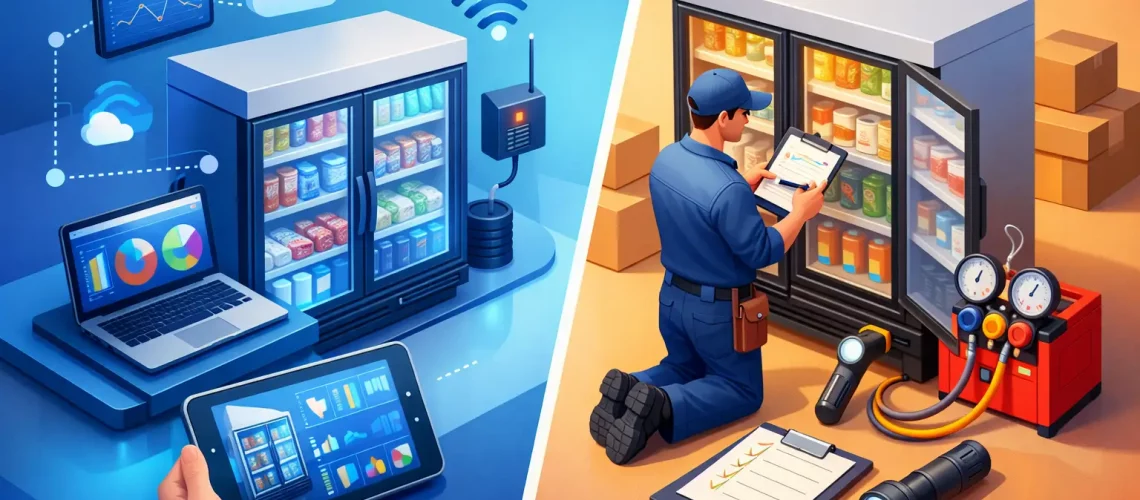

A walk-in cooler can drift out of range at 2:00 a.m., long after the closing temperature log was signed. By the next morning, a manual check may confirm the problem, but it cannot show when the condition began, how quickly it worsened, or whether inventory was already at risk. That is the operational difference at the center of remote refrigeration monitoring vs manual checks: one records a moment in time, while the other creates ongoing visibility into system performance.
For grocery stores, restaurants, cold storage facilities, medical operations, and other refrigeration-dependent sites, the question is not whether staff should care about temperatures. They should. The question is whether periodic observations provide enough protection for valuable inventory, equipment reliability, compliance requirements, and energy costs.
What Manual Checks Can and Cannot Tell You
Manual temperature checks remain common because they are straightforward, familiar, and inexpensive to begin. An employee reads a thermometer, documents the value, and alerts maintenance if the reading appears outside the acceptable range. In a stable system with attentive staff and limited refrigeration assets, this process can provide a basic record of operating conditions.
The limitation is the gap between readings. A cooler checked at 7:00 a.m. and again at 3:00 p.m. has eight hours of unobserved operation. A door left ajar, failed evaporator fan, defrost issue, refrigerant problem, power interruption, or compressor fault can develop during that interval. If the system recovers before the next check, the event may never be documented. If it does not recover, the first warning may be warm product.
Manual checks also depend on consistency. Staff must use the correct procedure, read the right location, record the value accurately, and respond appropriately when a result is questionable. During peak operating periods, shift changes, staffing shortages, or overnight hours, those steps can be delayed or missed. The process often confirms that someone looked at a number. It does not continuously verify system health.
There is still a place for manual inspection. Technicians need to assess ice patterns, airflow, coil condition, vibration, electrical connections, door seals, and other physical conditions that sensors alone cannot diagnose. But relying on manual temperature logs as the primary early-warning system creates avoidable blind spots.
Remote Refrigeration Monitoring vs Manual Checks: The Core Difference
Remote monitoring uses connected sensors, controls, and dashboard software to collect refrigeration data continuously or at frequent intervals. When temperatures, pressures, run times, door status, or other configured conditions move outside defined parameters, designated personnel can receive mobile or dashboard alerts.
That changes the maintenance model from scheduled observation to exception-based response. Instead of asking employees to find every developing issue through periodic checks, the system identifies abnormal conditions and directs attention where it is needed.
The value is not simply that a manager can view temperatures from a phone. The more meaningful benefit is trend data. A single high-temperature reading may be caused by a delivery door opening. Repeated temperature swings, longer compressor run times, or a gradual loss of pull-down performance can point to a developing mechanical or control issue. That context helps a facility team distinguish a temporary event from a condition that warrants service.
Remote monitoring also provides a more complete record. Facility managers can review how a system performed overnight, during defrost cycles, after a utility interruption, or through a busy weekend. For multi-site operators, this central visibility makes it easier to compare locations, prioritize service calls, and identify recurring problems that may otherwise remain isolated in paper logs or local spreadsheets.
Why the Cost Comparison Is Often Misunderstood
Manual checks can appear less expensive because the process may require little more than thermometers, log sheets, and employee time. That comparison is incomplete. The real cost includes the labor required to perform, verify, store, and review logs, plus the financial exposure created when an issue goes undetected between checks.
A single refrigeration failure can involve product loss, emergency repair premiums, business interruption, cleanup, regulatory exposure, and reputational damage. In medical, pharmaceutical, biotech, or food operations, the stakes may extend beyond replacement cost. Product integrity and documented temperature history can be essential.
Remote monitoring requires an upfront investment in sensors, communication infrastructure, installation, configuration, and ongoing service. Not every facility needs the same monitoring scope. A small site with a limited number of low-risk coolers will have different requirements than a distribution center, supermarket, or laboratory with multiple critical systems.
The right evaluation looks at risk-adjusted value. What inventory is exposed? How quickly can a failure be detected after hours? What does an emergency service call cost? How much staff time is spent on logging and follow-up? Is the facility experiencing repeated temperature excursions, nuisance alarms, high energy use, or unexplained equipment wear? These answers determine where continuous monitoring is likely to produce the strongest return.
Better Alerts Require Better Engineering
A poorly designed monitoring system can create its own problem: alert fatigue. If personnel receive frequent notifications for normal door openings, defrost cycles, brief recovery periods, or minor deviations, they may begin to ignore alerts that matter.
Effective remote monitoring is not a matter of placing a sensor in every box and sending an alarm at the first fluctuation. It requires proper sensor placement, realistic setpoints, delay parameters, escalation paths, and an understanding of how each refrigeration system operates. A reach-in unit, walk-in freezer, prep cooler, rack system, and cold storage room do not behave the same way.
This is where refrigeration engineering experience matters. Monitoring should reflect the operating conditions, product requirements, and failure modes of the equipment being protected. A consultative assessment can identify which assets are most critical, where monitoring will reduce the greatest risk, and whether controls or equipment improvements should accompany the monitoring deployment.
For example, a recurring high-temperature alert may not be solved by changing the alarm threshold. The underlying issue could be inadequate airflow, an inefficient defrost strategy, a failing fan motor, poor door discipline, oversized equipment cycling, or a control sequence that needs adjustment. Alerts should lead to informed action, not merely more notifications.
Energy Performance Is Part of the Decision
Manual checks are generally focused on product temperature. That is necessary, but it offers little insight into the energy behavior of the refrigeration system. Equipment can maintain acceptable temperatures while operating inefficiently due to excessive run time, poor control settings, dirty coils, degraded components, or unnecessary defrost activity.
Remote monitoring can expose patterns that are difficult to see during routine rounds. When paired with intelligent controls, it can support a more deliberate approach to refrigeration optimization: maintaining product protection while reducing wasteful operation and preventing conditions that shorten equipment life.
This does not mean every temperature trend directly translates to energy savings. Data must be interpreted in context, and corrective work must be targeted. However, continuous visibility gives facility and energy managers a stronger basis for deciding where to investigate, retrofit, or adjust operations.
A Hybrid Approach Is Usually the Strongest One
The choice between remote monitoring and manual checks does not have to be absolute. In well-managed facilities, remote monitoring handles continuous surveillance and early alerts, while trained staff and service technicians perform scheduled physical inspections and corrective maintenance.
Manual processes may still support receiving procedures, sanitation programs, regulatory routines, and on-site verification. The difference is that employees are no longer asked to serve as the only defense against an overnight equipment failure.
A platform such as ArtikControl™ can give operations teams dashboard-based visibility and mobile alerts while supporting a broader improvement strategy that includes controls, retrofits, and field engineering. The goal is not to replace knowledgeable people. It is to give them timely, usable information before a minor deviation becomes a product-loss event.
When Remote Monitoring Delivers the Most Value
Remote refrigeration monitoring is particularly valuable when a facility has high-value inventory, limited overnight staffing, multiple refrigeration assets, multiple locations, strict temperature requirements, or a history of costly failures. It is also well suited to operations where management needs proof of performance rather than a collection of handwritten checks.
Facilities with simple, low-risk refrigeration may begin with a narrower deployment focused on their most critical walk-ins, freezers, display cases, or storage areas. Monitoring can then expand as performance data demonstrates where additional coverage is justified. The best design is customized to operational risk, not sold as a one-size-fits-all package.
Before deciding, map the assets that would create the greatest operational disruption if they failed, identify the hours when no one is available to notice a problem, and calculate the cost of one serious temperature excursion. That exercise usually makes the appropriate level of monitoring much clearer.