
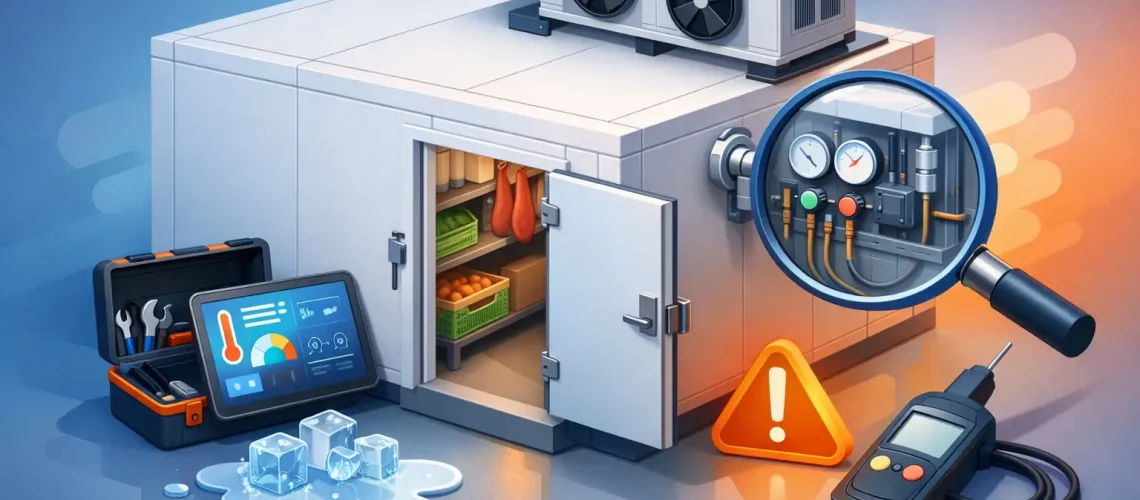

A walk-in cooler rarely fails without warning. A condenser may begin running longer, door frames may sweat, temperatures may drift during peak loading, or staff may notice frost where it does not belong. When those signals go unaddressed, a manageable maintenance issue can become spoiled inventory, emergency labor, business interruption, and a difficult conversation with regulators or customers.
Knowing how to prevent walk in cooler failures starts with treating refrigeration as a monitored operating system, not a piece of equipment to repair only after an alarm sounds. The best prevention programs combine disciplined maintenance, correct operating practices, reliable controls, and real-time visibility into conditions that threaten product protection.
Start With the Failure Risks That Matter Most
Walk-in coolers operate under constant stress. Warm product enters the box, doors open repeatedly, ambient heat loads change, and refrigeration components cycle for long hours. A system can appear to be operating normally while efficiency declines and component wear accelerates.
The most common failure paths are predictable: dirty or restricted condensers, evaporator icing, failed fan motors, refrigerant leaks, defrost problems, worn door gaskets, drain issues, electrical faults, and control failures. Each can cause a temperature excursion, but each leaves different early indicators. A prevention plan should identify which risks are most likely at a particular facility rather than applying the same checklist to every cooler.
For example, a high-volume foodservice walk-in may be most vulnerable to door-open time and airflow obstruction. A medical or biotech storage room may need tighter temperature tolerances, documented alarm response, and redundancy planning. The right approach depends on the product, operating schedule, equipment age, and cost of a loss event.
Build Preventive Maintenance Around Performance
Scheduled maintenance is essential, but a calendar alone does not prevent failures. A quarterly visit may identify obvious wear, yet a condenser can become restricted or a drain can plug between service calls. Maintenance needs to combine recurring inspection with performance data that shows whether the system is working harder than it should.
Keep heat rejection clean and unrestricted
The condenser is where the system rejects heat. When its coil is coated with dust, grease, cottonwood, debris, or damaged fins, head pressure rises. The compressor then runs hotter and longer, consuming more energy while facing a higher risk of premature failure.
Inspect and clean condenser coils on a schedule that matches the environment. A cleaner condenser at a climate-controlled facility may need less attention than one near a loading dock, kitchen exhaust, or outdoor debris source. Also verify that the condenser has adequate clearance and that its fans operate correctly. Cleaning a coil without correcting blocked airflow only solves part of the problem.
Protect evaporator airflow and defrost performance
Inside the cooler, evaporator airflow removes heat from the space. Product stacked too close to the coil, damaged fan blades, failing fan motors, or ice accumulation can reduce that airflow. The result is often uneven temperatures, longer runtimes, and eventually a warm box.
Check that product is stored with clearance around evaporators and that supply and return air paths remain open. Inspect coil condition, fan operation, drain pan condition, and drain line flow. If ice is present, do not assume the answer is simply to change the defrost schedule. Ice can point to a defrost heater or termination issue, a door seal problem, warm humid air infiltration, or a refrigerant-related condition. Finding the cause prevents repeat failures.
Inspect the parts that allow warm air inside
Door gaskets, hinges, closers, sweeps, and insulated panels are often overlooked because they are not part of the refrigeration circuit. They still have a direct effect on system reliability. A torn gasket or misaligned door lets humid air enter the box, increasing compressor load and creating frost on the evaporator.
Confirm that doors close fully without being forced and that gaskets make continuous contact around the frame. Look for damaged panel seals, loose hardware, strip curtain issues, and penetrations that have not been properly sealed. These are relatively low-cost corrections that can reduce energy waste and stabilize temperature control.
Use Temperature Monitoring to Catch Problems Before Product Is at Risk
A temperature display on the wall is not a monitoring strategy. It tells someone what conditions are at one moment, in one location, if someone happens to look at it. It cannot reliably reveal overnight drift, frequent short cycling, a door left open after a delivery, or a compressor that runs continuously while the box slowly warms.
Continuous monitoring provides the operating history needed to identify a developing issue. Temperature sensors should be positioned to reflect actual product risk, not merely the coldest or most convenient location. Facilities with large boxes, multiple doors, or sensitive inventory may require more than one sensing point to detect temperature variation.
Set alerts with a purpose. An alarm threshold that is too broad may not protect product. One that is too tight can create nuisance notifications that staff learn to ignore. Effective alarm programming accounts for the required temperature range, normal defrost cycles, door activity, product loading, and the time a condition can persist before intervention is required.
Alert escalation also matters. If the first contact does not acknowledge an after-hours alarm, the notification should move to the next responsible person or service partner. Every site should have clear instructions for who responds, what they check first, when product should be moved, and when emergency service is authorized. A useful alert without an accountable response process still leaves the facility exposed.
Monitor the Equipment, Not Just the Box Temperature
Temperature is the outcome. Equipment conditions explain why the outcome is changing. A cooler can hold setpoint until a stressed compressor, failed fan, or control issue reaches a breaking point. Monitoring key system behavior helps maintenance teams act earlier, when the repair is less disruptive and less expensive.
Depending on the application, valuable signals may include compressor runtime, discharge conditions, suction conditions, coil temperatures, defrost performance, door status, fan operation, and power-related alarms. Long runtimes during normal ambient conditions may indicate a dirty condenser, a refrigerant issue, poor door sealing, or an oversized heat load. Repeated high-temperature events after defrost may point to a defrost or airflow problem rather than random operator behavior.
This is where intelligent controls and dashboard-based reporting create operational value. Instead of relying on isolated alarms, facility teams can see trends across a single site or an entire portfolio. Refrigeration Technologies, LLC uses engineered assessments and ArtikControl™ monitoring and control solutions to help organizations identify abnormal performance early, prioritize repairs, and reduce avoidable downtime.
Reduce Human-Caused Load on the Cooler
Even a well-maintained system will struggle when operating practices create unnecessary heat and humidity load. The goal is not to blame staff. It is to design simple procedures that support the refrigeration system during busy periods.
Keep product organized so doors are open for the shortest practical time. Avoid storing boxes directly against evaporators or blocking air paths with pallets, carts, and overstock. Cool product according to established procedures before placing it in storage when possible, since loading large quantities of warm product can overwhelm a cooler designed primarily for holding temperature.
Train employees to report frost, unusual noise, water on the floor, a door that does not close, or a temperature reading outside the normal range. These observations are often the earliest warning signs. A team that knows what to report gives maintenance personnel a chance to correct a fault before inventory is threatened.
Plan for Power and Component Failures
Some failures cannot be eliminated, including utility outages and sudden component breakdowns. They can still be planned for. Evaluate whether mission-critical rooms need backup power, remote alarming during outages, spare components, or service agreements that define response expectations.
For locations with high-value or highly regulated inventory, create a written product protection plan. Define acceptable temperature exposure, alternate storage locations, decision authority, contact lists, and documentation requirements. Test the plan periodically. During an actual failure, fast decisions are more valuable than a binder no one has used.
Equipment age should also inform capital planning. Repeated repairs, rising energy use, and unstable temperatures may indicate that an upgrade is more economical than another emergency repair. A lifecycle assessment can compare repair costs, expected reliability, energy consumption, refrigerant considerations, and the cost of a potential product-loss event.
Make Prevention an Ongoing Operating Discipline
The strongest walk-in cooler prevention programs do not wait for a crisis to justify attention. They review alarm history, recurring repairs, runtime trends, temperature excursions, and energy performance at regular intervals. That information turns maintenance from a reactive expense into a controlled reliability process.
Start by establishing a baseline for each cooler: normal temperatures, expected runtimes, maintenance history, known vulnerabilities, and the business impact if it goes down. Then use that baseline to spot changes early. A small deviation may be the first chance to prevent a major loss.
Reliable refrigeration is not created by one service visit or one new sensor. It is built through consistent inspection, informed operating practices, and the visibility to respond before a minor performance change becomes a failure.