
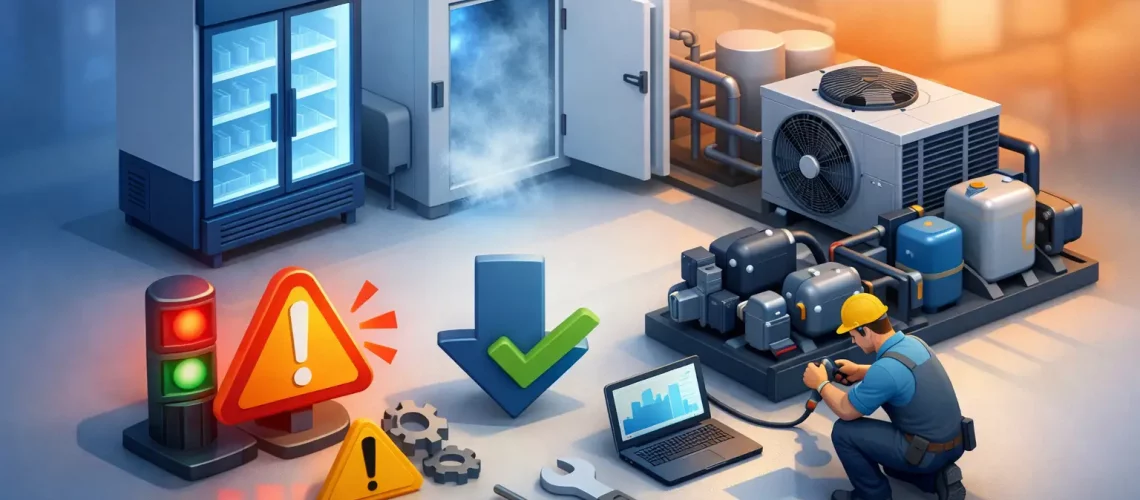

A walk-in cooler that drifts a few degrees overnight can turn into spoiled inventory, emergency service calls, and a full day of operational disruption by morning. That is why facility leaders keep asking how to reduce refrigeration downtime – not as a technical exercise, but as a business priority tied directly to product protection, labor efficiency, and operating cost.
For most commercial sites, downtime is rarely caused by a single dramatic failure. More often, it starts with small issues that go unnoticed: a struggling evaporator fan motor, a control problem that causes short cycling, a condenser that is losing efficiency, or temperature alarms that arrive too late to prevent loss. The practical path to better uptime is to catch those conditions earlier, correct them faster, and build a system that is easier to manage across daily operations.
How to reduce refrigeration downtime starts with visibility
If your team cannot see what the system is doing in real time, you are relying on complaints, manual checks, and after-the-fact alarms. That approach leaves too much room for hidden degradation. Refrigeration systems usually show warning signs before failure, but those signals are easy to miss when monitoring is limited to periodic inspections.
Continuous visibility changes that. When temperatures, pressures, runtime patterns, defrost behavior, door activity, and alarm conditions are monitored consistently, maintenance teams can spot developing issues before they create a shutdown event. A technician who sees rising box temperatures paired with longer compressor run times can investigate the root cause early, instead of arriving after a unit has already failed and product is at risk.
This is where intelligent monitoring has a measurable operational advantage over basic alarm-only setups. A simple high-temperature alarm tells you something is wrong. A predictive monitoring strategy helps explain what is trending in the wrong direction and where to act first.
The biggest causes of avoidable downtime
Reducing downtime begins with understanding what typically drives it. In commercial and institutional refrigeration environments, the same patterns appear again and again.
Control failures are a common source of disruption. Aging thermostats, inconsistent defrost schedules, sensor drift, and outdated control logic can all create unstable operation. The equipment may still run, but not in a way that protects product or equipment life.
Deferred maintenance is another major factor. Condenser coils foul gradually. Drain lines clog over time. Refrigerant charge issues worsen slowly. Fan motors often weaken before they fail completely. When maintenance is reactive, these problems stack up until one event triggers a much larger outage.
Poor system visibility also extends downtime once a failure occurs. If the team does not know whether the issue started at the controller, compressor, electrical feed, case temperature, or airflow level, diagnosis takes longer. Longer diagnosis means longer downtime.
Then there is the issue of operating conditions. Kitchens, grocery stores, cold storage facilities, and medical environments all place different demands on refrigeration systems. A solution that works in a low-load storage area may not hold up in a high-traffic food service setting with frequent door openings and fluctuating ambient temperatures. Downtime prevention depends on matching the control strategy to the actual load profile.
Use monitoring to move from reactive to predictive
The most effective answer to how to reduce refrigeration downtime is to stop treating every service event as a surprise. Predictive monitoring gives operations and maintenance teams a better way to work.
Instead of waiting for a box to go out of range, teams can respond to early indicators such as excessive compressor cycling, abnormal temperature recovery after defrost, recurring alarm patterns, or equipment that is running longer than baseline. Those are the conditions that often precede hard failures.
This approach also improves prioritization. Not every alarm deserves the same urgency. A nuisance alert that clears in minutes is different from a recurring temperature excursion on a critical cooler storing high-value product. With dashboard-based monitoring and mobile alerts, decision-makers can separate noise from risk and direct resources where they matter most.
For multi-site operators, predictive visibility becomes even more valuable. Without centralized data, performance issues tend to stay local until they become expensive. With remote monitoring, a corporate facilities team can identify recurring patterns across locations, standardize corrective actions, and reduce the chance that one site repeats another site’s failure.
Controls matter more than many facilities realize
Mechanical equipment gets much of the attention, but controls often determine whether the system runs efficiently and reliably. If control sequences are outdated or inconsistent, the equipment can be placed under unnecessary strain even when the major components are still serviceable.
Modern controller upgrades can stabilize temperatures, improve defrost management, reduce short cycling, and provide better alarm logic. That does not mean every site needs a full system replacement. In many cases, strategic retrofits deliver significant reliability gains without the cost and disruption of replacing all major refrigeration assets.
There is a trade-off here. Some facilities continue to operate with legacy controls because the equipment is technically still functioning. But the hidden cost shows up in service frequency, unstable temperatures, higher energy use, and longer downtime when problems do occur. Replacing failed components one by one may feel economical in the short term, yet a targeted controls upgrade often produces a better lifecycle outcome.
Build a maintenance plan around failure prevention
Preventive maintenance only reduces downtime if it is aligned with actual failure risks. Generic checklists have value, but they do not go far enough for facilities that depend on refrigeration uptime.
A stronger approach starts by identifying critical assets, common failure modes, and product-risk areas. A walk-in freezer supporting core food inventory should not be maintained with the same priority framework as a less critical holding unit. High-impact assets deserve tighter inspection intervals, better alarm thresholds, and clearer escalation procedures.
Maintenance planning should also reflect seasonal and operational realities. Condensing units may face heavier strain during summer peaks. High-volume retail periods can increase door openings and thermal load. Facilities storing pharmaceutical or biotech materials may need much narrower tolerance bands than standard food applications. The best plans are customized to the environment, not copied from a manual.
That is one reason consultative engineering support matters. A thorough site assessment can reveal where maintenance dollars are best spent, which upgrades will reduce repeat service calls, and where monitoring can prevent losses before they happen.
Train for response speed, not just repair quality
Even well-maintained systems will occasionally have issues. When that happens, downtime depends as much on response structure as it does on technical skill.
Teams should know who receives alarms, who verifies conditions, who can authorize emergency action, and what temporary safeguards are available if product needs to be protected during service. Too many outages last longer than necessary because the first alert sits unanswered or because no one has a clear playbook for escalation.
Good response planning is especially important for facilities with limited on-site technical staff. If store managers, shift leads, or operations staff are the first to see a refrigeration alert, they need simple instructions that help them protect inventory and communicate useful information to service providers.
The goal is not to turn non-technical staff into refrigeration technicians. The goal is to remove delay between detection and action.
How to reduce refrigeration downtime across older equipment
Many facilities operate a mix of aging assets, retrofits, and newer equipment. That does not automatically mean high downtime, but it does require a more deliberate strategy.
Older systems often benefit from targeted upgrades instead of full replacement. Sensors, controllers, alarm logic, and monitoring infrastructure can often be modernized while the core refrigeration equipment remains in place. That gives operators better visibility and control without forcing a major capital project before it is truly necessary.
Still, there are limits. If compressors are near end of life, leak issues are recurring, or key components are increasingly hard to source, the cost of preserving old equipment can outweigh the benefit. The right choice depends on failure history, criticality, available redundancy, and the value of the product being protected.
A performance-driven partner will evaluate that balance carefully. At Refrigeration Technologies, LLC, the most effective projects typically combine field engineering insight with ongoing monitoring so that improvements are not just installed, but continuously validated.
Downtime prevention is an operating strategy
Facilities that consistently reduce refrigeration downtime do not rely on luck or fast emergency service alone. They build a system around visibility, intelligent controls, prioritized maintenance, and faster response. That strategy protects inventory, lowers avoidable labor and repair costs, and gives operators more confidence in daily performance.
If your refrigeration operation still depends on manual checks and reactive repairs, the next failure is probably already forming in the background. The better move is to identify those risks while they are still manageable, when the fix is smaller, the cost is lower, and the product is still protected.