
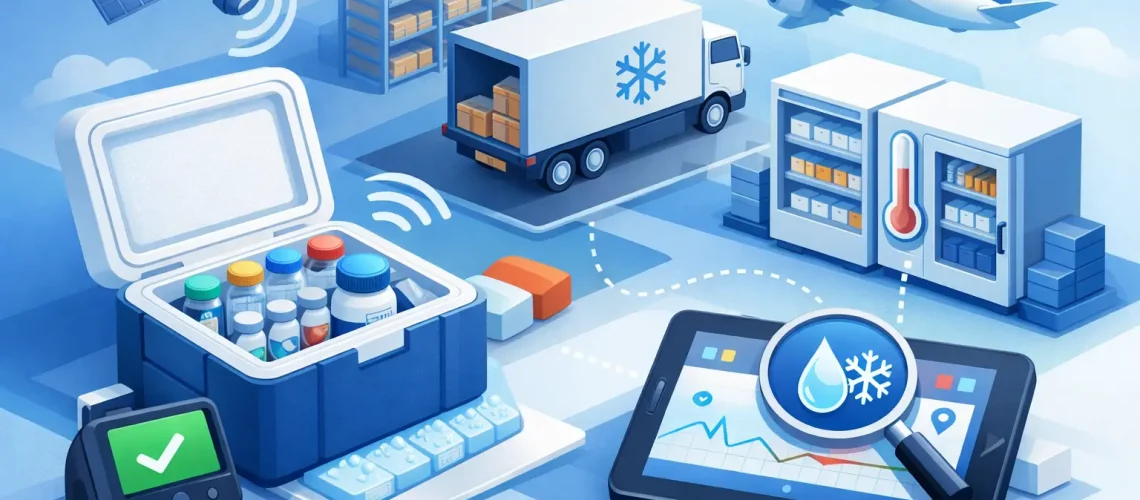

A vaccine refrigerator can look perfectly normal right up to the moment it puts thousands of dollars in product at risk. The same is true for pharmacy freezers, biologics storage, transport coolers, and backup cold rooms. Pharmaceutical cold chain monitoring exists to catch the problems people cannot see in time – rising temperatures, unstable defrost cycles, door openings, sensor drift, controller faults, and equipment conditions that lead to loss long before a total failure occurs.
For facilities that store or move temperature-sensitive pharmaceuticals, monitoring is not just a recordkeeping function. It is an operating control. When product integrity, compliance exposure, and business continuity all depend on refrigeration performance, the quality of your monitoring strategy directly affects risk.
What pharmaceutical cold chain monitoring actually needs to do
At a basic level, monitoring should verify that products remain within required temperature ranges throughout storage and transport. In practice, that is only part of the job. Strong pharmaceutical cold chain monitoring must also create usable visibility for operations teams, maintenance teams, quality staff, and leadership.
That means capturing accurate temperature data at the right interval, retaining records for audits and investigations, and issuing alerts early enough for staff to act before product is compromised. It also means identifying patterns behind repeat events. If a unit drifts warm every afternoon, alarms alone are not enough. The real value comes from finding whether the cause is airflow restriction, overloading, poor setpoint strategy, evaporator icing, a failing component, or a larger control issue.
This is where many facilities run into trouble. They may have data loggers and still lack actionable monitoring. A report that confirms product was exposed after the fact does not protect inventory. A text alert that arrives after staff hours without escalation logic may not protect it either. Monitoring has to support response, not just documentation.
Why isolated alarms are not enough
A common mistake is treating each refrigerator, freezer, or walk-in as a standalone asset with a simple high-low alarm. That approach may satisfy a narrow requirement, but it leaves operational blind spots.
Temperature excursions rarely happen in isolation. A warm event may start with a condenser issue, a control sequence problem, a power interruption, a door left ajar, or a refrigeration system that has been losing capacity for weeks. If your team only sees a single threshold alarm, they are responding to the symptom rather than the cause.
For pharmaceutical environments, that distinction matters. Product value is high, compliance expectations are high, and the cost of uncertainty is often larger than the cost of the actual repair. If staff cannot quickly determine how long a condition existed, how severe it was, whether product was affected, and whether the event is likely to repeat, the incident becomes both an operational and quality problem.
A better monitoring model connects alarms, historical trends, equipment conditions, and notification workflows into one operating view. That gives teams the ability to intervene earlier and document decisions with confidence.
The core components of effective pharmaceutical cold chain monitoring
Effective systems usually combine several layers. The first is dependable sensing. Sensor accuracy, placement, calibration practices, and redundancy all matter. A high-quality platform can still produce poor decisions if the sensing point does not represent actual product conditions.
The second layer is intelligent alarming. Not every deviation should create the same response. Brief door-related fluctuations may need different logic than sustained temperature rise during compressor failure. Escalation rules should reflect product sensitivity, staffing coverage, and site criticality.
The third layer is data visibility. Teams need access to live conditions, historical trends, alarm history, and exception reporting without hunting through separate systems. This becomes even more valuable across multiple clinics, pharmacies, labs, distribution points, or storage rooms.
The fourth layer is equipment insight. Monitoring is strongest when it goes beyond box temperature and includes operating conditions that help predict failure. Runtime behavior, defrost performance, suction and discharge patterns, ambient effects, and controller anomalies can all provide early warning. This is where engineered monitoring produces more value than generic compliance logging.
Pharmaceutical cold chain monitoring and compliance pressure
Compliance is a major driver, but it should not be the only one. Facilities often start evaluating pharmaceutical cold chain monitoring because of audit readiness, documentation requirements, or concern over excursion reporting. Those are valid reasons. Still, if monitoring is implemented purely as a compliance checkbox, the result may be a system that stores data without reducing risk.
The better approach is to align compliance and operations. Accurate records, automated retention, alarm acknowledgment trails, and clear exception reporting support quality requirements. At the same time, early fault detection, faster response, and improved equipment stability reduce the number of incidents that quality teams need to investigate in the first place.
That dual value matters to decision-makers. Monitoring should help protect product, reduce downtime, support staff accountability, and lower the hidden cost of recurring refrigeration issues. If it only produces more alerts and more manual follow-up, it is not solving the right problem.
Where facilities often underestimate risk
Many losses happen in places that seem controlled because they have refrigeration equipment and some form of alarm. Small undercounter units, reach-ins in busy clinical areas, temporary storage during deliveries, and distributed sites without on-site maintenance support are frequent weak points.
Another issue is assuming that a newer unit is a lower-risk unit. New equipment can still be misapplied, poorly located, overloaded, badly configured, or left outside of an effective monitoring program. Age matters, but operating conditions and visibility often matter more.
Staffing models also affect risk. A hospital pharmacy with 24-hour coverage may respond differently than a specialty clinic that closes in the evening. A national operator with dozens of remote sites needs different escalation and dashboard capabilities than a single-location facility. The right monitoring strategy depends on who can respond, how fast they can respond, and what product is at stake.
Choosing a monitoring approach that matches the operation
There is no single template that fits every pharmaceutical facility. A small pharmacy storing limited temperature-sensitive inventory may need a focused solution centered on accurate sensing, audit-ready records, and reliable mobile alerts. A biotech or medical campus may require broader integration with central refrigeration assets, backup systems, and engineering oversight.
The key question is not just whether temperatures are being tracked. It is whether your team has enough visibility to prevent loss and enough information to act decisively when conditions change.
For many organizations, that leads to a more engineered monitoring model. Instead of layering generic devices onto aging refrigeration assets, they evaluate the refrigeration system itself, the controls, alarm pathways, operational workflow, and failure history. That allows monitoring to become part of a performance strategy rather than a disconnected add-on.
This is especially important when energy efficiency is also on the table. Facilities do not want to improve visibility at the expense of refrigeration stability, and they should not have to. Well-designed controls and monitoring can support both reliability and efficiency, but only when the system is evaluated as a whole.
What better monitoring looks like in practice
A stronger program usually produces quieter operations, not noisier ones. Staff see fewer nuisance alarms, but the alerts they do receive are more meaningful. Maintenance teams spend less time chasing vague temperature complaints and more time addressing identifiable issues. Leadership gets a clearer picture of asset performance, incident frequency, and where capital planning should be focused.
In practical terms, that may mean centralized dashboards, mobile notifications with escalation, historical trend analysis, and monitoring tied to intelligent controls that can identify developing faults before product is exposed. It may also mean reviewing problem locations, upgrading sensors or controllers, correcting equipment deficiencies, and building a response plan that matches the facility’s staffing reality.
That combination of monitoring and system insight is where companies like Refrigeration Technologies, LLC can create measurable value. In pharmaceutical environments, the goal is not simply to know that something went wrong. It is to prevent the event, protect the inventory, and give the organization a higher level of operational confidence.
The business case is bigger than avoided spoilage
Avoided product loss gets the most attention, and for good reason. But the return on better pharmaceutical cold chain monitoring extends further. Facilities can reduce emergency service calls, shorten incident investigations, improve audit readiness, support equipment life, and avoid the disruption that follows uncertain temperature exposure.
There is also a decision-speed benefit. When a temperature event occurs, the team with good data can assess exposure faster, isolate the issue faster, and restore control faster. That reduces the operational drag that often follows refrigeration incidents.
For organizations managing multiple sites, the value compounds. Standardized visibility across locations makes it easier to spot recurring issues, compare asset behavior, and prioritize maintenance or upgrades where they will have the biggest impact.
Pharmaceutical refrigeration will always carry risk because the products are sensitive and the tolerances are narrow. But the level of risk you accept is a choice. Better monitoring does more than document temperature. It gives your team a practical way to prevent failures before they turn into product loss, compliance exposure, or avoidable downtime.