
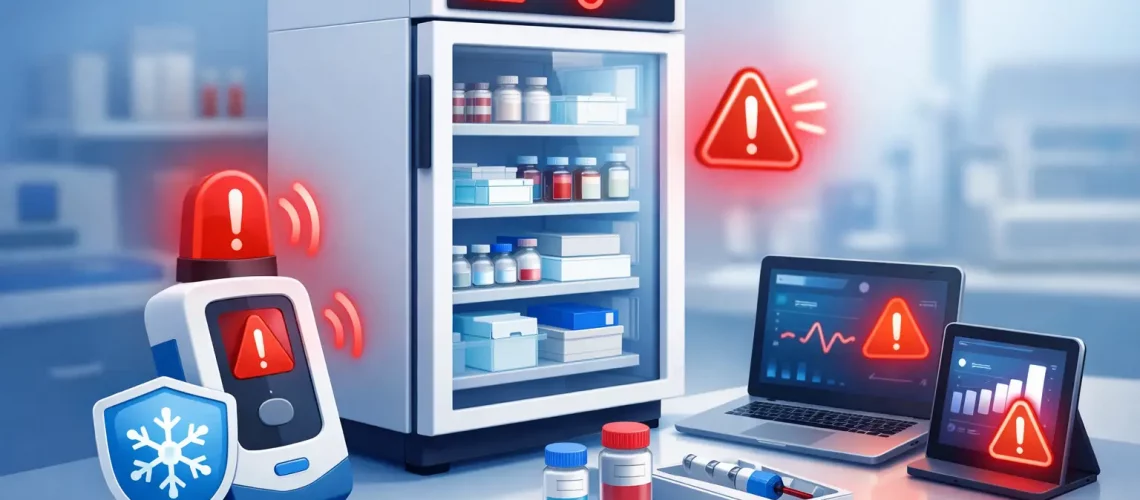

A vaccine refrigerator can drift out of range long before anyone notices the display. By the time staff opens the door for a morning check, the damage may already be done. That is why medical refrigerator temperature alerts are not a convenience feature. In healthcare, research, and pharmaceutical environments, they are part of the control strategy that protects product integrity, supports compliance, and reduces the risk of costly loss.
For facility leaders, the real question is not whether alerts matter. It is whether the alerting system is built to catch the right problem early enough to matter. A buzzer on the unit is one thing. A monitored alert that reaches the right person, with usable data and a clear response path, is something else entirely.
Why medical refrigerator temperature alerts matter
In a medical setting, refrigeration failures do not just create maintenance tickets. They can compromise vaccines, medications, biologics, lab samples, and other temperature-sensitive inventory with direct financial and operational consequences. One unnoticed overnight excursion can lead to disposal costs, replacement delays, interrupted care, and reportable compliance issues.
That is where alerting becomes operationally important. A strong system shortens the time between a temperature deviation and a response. It also gives teams a record of what happened, when it happened, and how long conditions were outside the acceptable range. That level of visibility is critical in regulated environments where proof matters as much as performance.
There is also a broader facility impact. Temperature excursions are often symptoms, not isolated events. A failing evaporator fan, a drifting controller, a dirty condenser, poor door discipline, or unstable ambient conditions can all show up first as a refrigeration alert. When alerts are part of a monitored system rather than a standalone alarm, they can help maintenance teams identify patterns before a full equipment failure occurs.
What effective medical refrigerator temperature alerts should actually do
Not all alerts are equally useful. Some systems notify too late. Others notify too often. Both create risk.
An effective alerting strategy starts with accurate sensing. If the temperature input is unreliable, every downstream alert is questionable. Sensor placement, calibration, buffering method, and logging intervals all affect whether the alert reflects real product risk or just air temperature fluctuation from a routine door opening.
The next requirement is threshold logic that matches the application. A blanket high-temp alarm is rarely enough. Medical refrigerators may need separate upper and lower thresholds, time delays to prevent nuisance alarms, and escalation rules based on duration or severity. A brief swing during loading activity may not require the same response as a sustained excursion at 46 degrees.
Delivery method matters just as much. If an alert only sounds locally, it depends on someone being nearby. If it only sends an email, it may sit unread. The most dependable systems route alarms to the responsible team through mobile notifications, text, email, or dashboard visibility, with escalation if the first alert is not acknowledged.
Finally, the system should create usable records. Event history, trend graphs, acknowledgements, and response notes are not administrative extras. They are part of maintaining accountability and supporting audits, investigations, and process improvement.
The difference between alarms and monitored alerts
A basic refrigerator alarm reacts when the unit reaches a limit. That has value, but it is only a starting point. In many facilities, local alarms are easy to miss during off-hours, weekends, or staffing transitions.
Monitored medical refrigerator temperature alerts add another layer. They connect the refrigeration asset to a platform that continuously tracks conditions and pushes notifications when something changes. More importantly, they centralize visibility across one unit, one department, or an entire portfolio of sites.
That difference becomes more significant as operations scale. A small clinic with one vaccine refrigerator may be able to manage with a local alarm and disciplined manual checks. A hospital campus, lab network, blood bank, or multi-site pharmacy operation usually needs a more structured alerting framework. Once there are multiple units, multiple stakeholders, and around-the-clock risk exposure, remote monitoring stops being optional and starts becoming part of standard risk management.
Where alert strategies commonly fail
Facilities often assume they are covered because a refrigerator has an alarm built in. In practice, several common gaps reduce effectiveness.
One is alert fatigue. If a system generates frequent nuisance notifications, staff starts ignoring them. The problem is usually poor alarm configuration rather than the idea of alerting itself. Thresholds that are too tight, no delay logic, or no distinction between warning and critical alarms can overwhelm the team.
Another gap is unclear ownership. If an alert goes to a general inbox or a rotating group with no defined response procedure, valuable time is lost. The best systems are matched with a clear escalation chain so everyone knows who acts first, who backs them up, and what happens next.
A third issue is relying on alerts without addressing root causes. If the same refrigerator repeatedly drifts out of range, the problem may be equipment condition, airflow, loading practices, door gaskets, defrost behavior, or controller performance. Alerting should prompt action, not normalize recurring instability.
How to evaluate medical refrigerator temperature alerts for your facility
The right solution depends on the risk profile of the inventory, the hours of operation, and the complexity of the facility. Still, a few questions separate basic alarm setups from systems that genuinely protect operations.
Start with response time. How quickly does the system detect a deviation, and how quickly can it reach the right person after hours? A five-minute difference may not matter for some products, but for others it can be the difference between recovery and loss.
Next, look at data quality. Does the system provide continuous logging and trend visibility, or only a single alarm event? Trend data helps teams understand whether the issue was a momentary disturbance, a door event, or the start of a deeper mechanical problem.
Then evaluate escalation and accountability. Can alerts be acknowledged? Can they be forwarded automatically if there is no response? Can you document corrective action? These capabilities matter in mission-critical environments where every excursion may require review.
It is also worth looking beyond the refrigerator itself. Temperature alerts are stronger when they are part of a broader refrigeration monitoring strategy that includes controller status, door activity, ambient conditions, power issues, and equipment performance indicators. That context helps teams move from reactive recovery to predictive maintenance.
Medical refrigerator temperature alerts and compliance expectations
Compliance requirements vary by application, but the operational theme is consistent: maintain proper storage conditions, document performance, and respond appropriately to excursions. Whether the inventory involves vaccines, medications, specimens, or research materials, temperature control must be defensible.
Alerts support that goal, but they do not replace policy. Facilities still need defined temperature ranges, response procedures, documentation practices, and staff training. Technology can accelerate detection and improve records, but only if it is aligned with the facility’s protocols.
This is where engineered monitoring solutions tend to outperform off-the-shelf alarm devices. A customized approach can account for the specific unit type, storage application, staffing model, and reporting requirements of the site. For organizations managing multiple critical environments, that customization can make the system easier to use and far more effective over time.
Why a consultative approach matters
Medical refrigeration is too important for guesswork. The best alerting setup is rarely just a sensor and a text message. It is a combination of equipment assessment, control strategy, monitoring architecture, and ongoing visibility.
That is why many facilities benefit from working with a refrigeration partner that understands both field conditions and monitoring technology. A consultative process can identify whether the main risk is weak alert coverage, aging equipment, inconsistent controls, or a larger refrigeration performance issue. From there, the solution can be built around measurable outcomes – fewer excursions, faster response, lower product-loss exposure, and better system reliability.
For organizations that need more than a standalone alarm, platforms such as ArtikControl™ are designed to turn refrigeration data into operational action. The value is not just getting an alert. It is knowing what the alert means, what to do next, and how to prevent the same event from happening again.
The strongest facilities do not wait for a spoiled inventory event to prove that monitoring matters. They build alerting into a broader refrigeration strategy, so when a temperature starts moving in the wrong direction, the response starts before the loss does.