
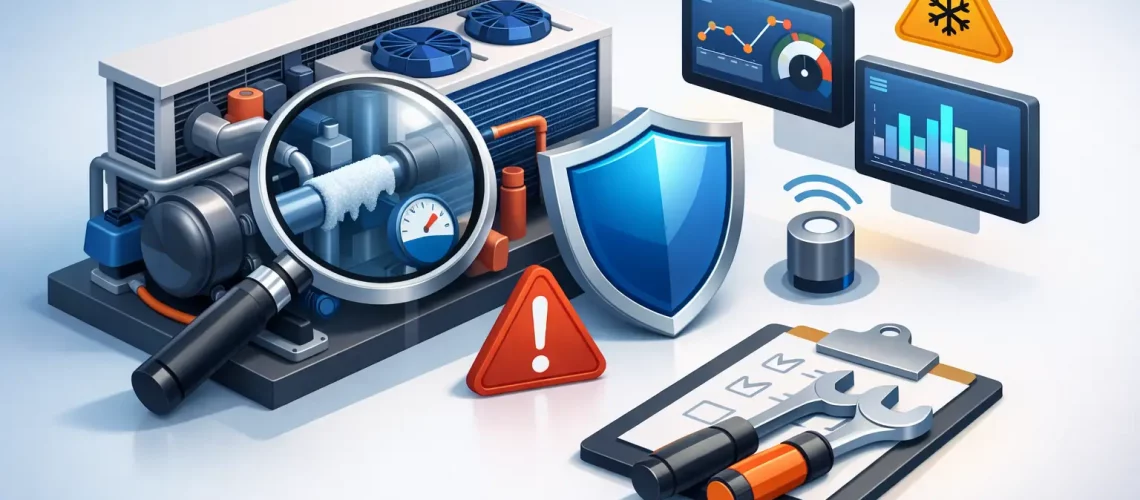

A walk-in box running warm at 2:00 a.m. is not just a maintenance issue. For a grocery operator, lab manager, foodservice group, or cold storage team, it can mean spoiled inventory, emergency labor, disrupted operations, and a repair bill that arrives after the real damage is already done. That is why refrigeration system failure prevention has to be treated as an operating strategy, not a reactive service call.
Too many facilities still manage refrigeration by waiting for alarms, complaints, or visible performance problems. By that point, the system has often been drifting out of range for hours or days. Suction pressure instability, rising compressor run time, coil fouling, control issues, refrigerant loss, and poor defrost performance usually show up as small warning signs long before they become shutdowns. The companies that avoid major losses are the ones that monitor those signals, act early, and build prevention into both equipment design and daily operations.
Why refrigeration failures keep happening
Most commercial refrigeration failures are not truly sudden. They look sudden because the facility did not have enough visibility into system behavior before the event. A compressor may fail after months of short cycling. An evaporator may ice over after repeated defrost issues. A reach-in case may run warm because an aging control component is causing unstable temperatures. In each case, the final breakdown gets attention, but the root condition was already there.
This is where many organizations run into a costly gap between maintenance and performance management. Preventive maintenance is necessary, but it is not always enough on its own. A quarterly inspection can catch obvious wear, but it may miss intermittent faults, nighttime temperature drift, or energy-consuming control behavior that only appears under certain load conditions. Refrigeration systems are dynamic. They respond to ambient conditions, store traffic, product loading, defrost cycles, and component interactions. Preventing failures requires a more continuous view.
There is also a trade-off to acknowledge. Some facilities try to avoid cost by stretching equipment life and delaying upgrades. That can work for a while, especially if the original system was well designed. But older controls, weak monitoring, and deferred component replacements often shift the cost from planned capital to unplanned downtime. The question is rarely whether the facility will pay. It is whether it will pay on schedule or during a crisis.
Refrigeration system failure prevention starts with visibility
The single biggest improvement most facilities can make is better system visibility. If you cannot see what the system is doing in real time, you are relying on lagging indicators. Product temperature complaints, ice buildup, compressor noise, or utility spikes all tell you something is wrong, but they tell you late.
Effective refrigeration system failure prevention depends on tracking the right operating data consistently. That includes temperature trends, suction and discharge behavior, compressor runtime patterns, defrost performance, alarm history, and control responses. When these signals are monitored together, it becomes easier to spot patterns that point to trouble ahead. A system that is holding temperature but running much longer than normal is already telling you something. So is a box that recovers more slowly after defrost or door activity.
Remote monitoring matters here because failure risk does not follow business hours. Facilities with mobile alerts and dashboard-based oversight can respond to abnormal conditions before they escalate into product loss or hard equipment damage. That is especially important for multi-site operators who need consistency across stores, restaurants, schools, medical facilities, or distribution points. A single standard for monitoring creates accountability that manual checks rarely achieve.
The most common weak points in commercial refrigeration
Failure prevention is more effective when teams focus on the conditions most likely to create downtime. Controls are a frequent issue, especially in older systems where components were never designed for modern visibility or precise performance tuning. A control problem may not shut a system down immediately, but it can drive unstable temperatures, unnecessary compressor stress, and higher energy use.
Airflow is another overlooked factor. Dirty coils, blocked evaporators, failing fan motors, and poor case loading practices can all reduce heat transfer and force the system to work harder. The result is often a slow decline rather than an obvious event, which makes it easy to ignore until performance falls outside acceptable limits.
Refrigerant issues are equally common. Even a small leak can change system efficiency and reliability over time. If the facility is not tracking performance trends, the leak may only get addressed after temperature control becomes inconsistent or a major component is affected.
Defrost problems deserve special attention in low-temp and high-moisture environments. A poorly timed or incomplete defrost cycle can create frost buildup, airflow restriction, and temperature instability. It can also mask itself as a capacity problem, leading teams to replace the wrong parts.
Electrical components round out the list. Contactors, sensors, relays, wiring connections, and breakers often fail in ways that appear random unless the system is being monitored closely. In practice, many electrical faults leave clues first – erratic readings, nuisance alarms, intermittent shutdowns, or unusual run patterns.
Prevention requires engineering, not just service calls
A service provider can repair a failed component. A refrigeration partner should be able to reduce the likelihood of the next failure. That difference matters in energy-intensive, product-sensitive environments.
Strong prevention programs start with an on-site system assessment. Not a quick visual inspection, but a real evaluation of how the refrigeration assets are configured, how they are performing, where failure exposure exists, and which upgrades will produce measurable operational value. In some facilities, the right answer is control modernization. In others, it may be sensor placement improvements, monitoring expansion, airflow corrections, refrigerant management, or targeted equipment retrofit work.
This is also where customization matters. A food retail chain, biotech facility, and school district do not carry the same temperature risk, staffing structure, alarm response process, or budget cycle. The prevention plan has to fit the operation. A blanket maintenance recommendation is easy to issue and hard to justify. A plan tied to downtime risk, energy waste, product protection, and response speed is much easier for decision-makers to act on.
How intelligent controls reduce failure risk
Controls do more than automate operation. When designed and configured correctly, they help stabilize the conditions that lead to equipment stress and product exposure.
Modern control strategies can reduce short cycling, improve defrost execution, tighten temperature management, and flag abnormal trends earlier than manual observation ever could. They also create cleaner data for analysis, which makes troubleshooting faster and more accurate. That matters when maintenance teams are stretched thin or when a contractor is trying to solve a problem across multiple sites.
There is an ROI case here beyond failure avoidance. Better controls often improve energy performance at the same time. A system that is running more predictably, cycling appropriately, and responding intelligently to load conditions usually wastes less energy. For many organizations, that means prevention and efficiency are not separate projects. They are the same project viewed from two angles.
Solutions such as ArtikControl™ are valuable in this context because they combine control capability with continuous monitoring and alerting. That combination gives operators a better chance to catch drift early, respond faster, and make better long-term decisions about retrofit timing and asset planning.
What decision-makers should ask before the next breakdown
If your organization is serious about prevention, the key question is not whether a refrigeration asset can be repaired. It is whether you can identify deteriorating performance before product, uptime, or energy costs are affected.
That means asking practical questions. Do you know which systems are trending toward failure and which are simply aging normally? Can your team see after-hours temperature events in time to respond? Are alarms configured to drive action, or are they just creating noise? Do you have enough system-level data to prioritize capital spending based on risk instead of guesswork?
It also means reviewing internal response procedures. Even good monitoring has limits if nobody owns the alarm path or if escalation is unclear. Prevention depends on both technology and process. The best systems in the field still need disciplined follow-through from the people managing them.
A well-run facility does not wait for a warm box, a failed compressor, or a lost inventory claim to reveal where its refrigeration strategy is weak. It builds the visibility, controls, and engineering support needed to catch problems while they are still manageable. That is how reliability improves, operating costs stay under control, and teams gain more confidence in the equipment they depend on every day.
The most valuable refrigeration upgrade is often the one that prevents a crisis nobody ever has to explain.